
Pi community ships `pi-listens`, `pi-kanban`, and `pi-codex-conversion` in one-day extension burst
Independent Pi builders shipped a voice layer, a kanban and observability dashboard, a Codex-conversion tool with `apply_patch`, and smaller UI extensions in the same window. The burst matters because it turns Pi from a single coding agent into a real local-first extension ecosystem with voice, review, and workflow primitives.
TL;DR
- Pi's extension scene had a one-day burst: badlogicgames' pi-listens repost surfaced a voice layer, while nicopreme's pi-kanban repost and badlogicgames' pi-codex-conversion repost added workflow and patching primitives.
- The kanban project is not just a nicer view. the pi-kanban launch repost describes a workspace that pulls sessions, todos, and subagents into one board, and badlogicgames' blog repost points to a full writeup.
- The codex-conversion package bundled
apply_patchcompiled from OpenAI's Codex repo, according to badlogicgames' repost of the package ship, which gives Pi users a familiar patching path instead of plain text edits. - Smaller extensions kept shipping in parallel: badlogicgames' pi-nyan-mode repost turned token progress into a nyan-style status bar, while the pi-listens repost pushed Pi toward voice input and output.
- Pi's own maintainer was also pushing ecosystem-breaking changes that week. badlogicgames' namespace migration post moved the repo to
earendil-worksand warned extension authors that switching imports would break older Pi versions.
You can browse Pi at pi.dev, read the pi-kanban writeup, and even see Pi used to build a small playable Mother's Day game. The weirdly useful bit is how fast the ecosystem split into layers: voice, workspace instrumentation, patch tooling, and tiny UI mods like nyan-mode all landed inside the same window.
pi-listens
The voice package was shipped as @p8n.ai/pi-listens v0.1.2. The repost text describes it as a voice layer for Pi that lets users speak naturally, then routes speech into the agent and reads responses back out.
That matters because Pi had already been showing up in speech-heavy hobby workflows. badlogicgames' Mother's Day game post described a child building little games with speech-to-text and text-to-speech on top of Pi, using an AGENTS.md file to keep the agent on track.
pi-kanban
Pi-kanban looks like the first serious workspace layer around Pi, not just an add-on panel. The launch repost says it puts sessions, todos, and subagents into one kanban view, while the linked pi-kanban post frames it as an observability dashboard for the coding agent.
The interesting part is the object model it exposes:
- sessions
- todos
- subagents
- a shared board view
- observability around active work
That is a pretty complete workflow surface for a local agent. It gives Pi something closer to an external control room than a single chat transcript.
pi-codex-conversion
The codex-conversion package was pitched directly at users who want Codex-style patch flows inside Pi. The repost says pi install npm:@howaboua/pi-codex-conversion@dev now bundles an apply_patch tool compiled straight out of the OpenAI Codex repository.
That detail is the whole story. apply_patch is a concrete compatibility primitive, not a vague integration claim, and it hints that Pi extensions are already borrowing tool behaviors users learned in other agent stacks.
Nyan mode and PiRAT
Two smaller projects showed the other half of the ecosystem: interface hacks. The pi-nyan-mode repost turned progress display into an Emacs-style nyan bar, the kind of extension that only appears once a tool has regular daily users.
PiRAT went further. Maxime Rivest's post combined Pi with rat, mrmd, and VS Code so he could edit both his own messages and the assistant's messages, run markdown code cells, and inject results back into the conversation. The attached video PiRAT demo shows a split workflow where the editor and the chat become one loop.
Namespace breakage
The extension burst landed in the middle of a deliberate package break. badlogicgames' post said the GitHub repo was moving to the earendil-works org and packages would start publishing under the @earendil-works namespace instead of @mariozechner.
The compatibility caveat was unusually explicit:
- old imports would keep working for a time
- extension authors with type checking were told to switch quickly
- extensions updated to
@earendil-workswould stop working on older Pi versions after that day's release
That kind of break is annoying, but it is also a sign the extension API is solid enough that namespacing now matters.
Session scope
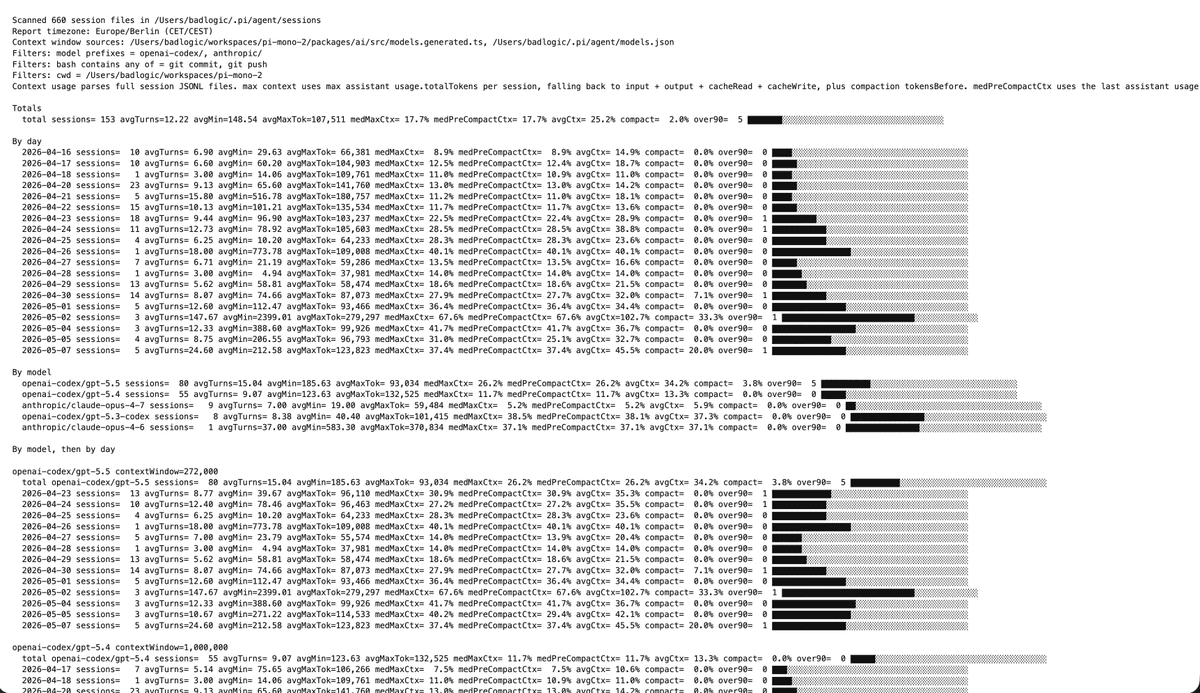
One more useful clue came from the maintainer's own workflow. badlogicgames' session-stats post linked a session context stats page showing how he keeps Pi session scope small, with one outlier day reserved for API design exploration.
The follow-up post also linked the underlying analysis script. Combined with his complaint about the industry's "hyper waterfall" habits in the thread context around the stats post, it suggests Pi's extension wave is growing around short, instrumented, local runs instead of giant monolithic agent sessions.