
Piotr Skalski reports Gemini Argon reaches 85.1% high-effort detection accuracy
Piotr Skalski reports Argon leads his detection and extraction tests at both effort levels. High-effort detection reached 85.1% accuracy at one-quarter Astra's cost, taking 19.6 seconds per image.
TL;DR
- Argon leads Roboflow's detection benchmark at both effort levels: the reported results put high-effort mAP@50 at 85.1%, versus Astra's 83.6%.
- Text localization shows a larger gap: Argon reaches 84.7% at high effort versus Astra's 76.8% in the extraction comparison.
- High-effort vision runs cost less and finish faster than Astra's, according to the cost comparison and the timing results. The 19.6-second figure is an across-task average.
Argon's tighter-box scores are the standout: its lead widens substantially when overlap requirements rise. The OCR suite demands exact meter readings and penalizes invented JSON fields.
Detection at stricter overlap thresholds
Piotr Skalski reported first place for Argon at both effort levels in his detection comparison. Models return bounding boxes and labels from a fixed class list in Roboflow's detection test.
The headline metric, mAP@50, measures mean average precision at a 50% intersection-over-union threshold. Raising that threshold exposes a larger difference in box placement:
- High-effort mAP@50: Argon 85.1%, Astra 83.6%, +1.5 points.
- Low-effort mAP@50: Argon 82.5%, Astra 82.1%, +0.4 points.
- High-effort mAP@75: Argon 73.3%, Astra 67.0%, +6.3 points.
- High-effort mAP@50:95: Argon 68.2%, Astra 61.9%, +6.3 points across multiple overlap thresholds.
Detection scores average three runs, with the published ± representing half the run range. Argon's high-effort mAP@50 runs ranged from 84.3% to 85.5%; Astra's ranged from 82.8% to 84.5%, so their observed ranges overlap.
OCR extraction
Argon's overall OCR scores reached 88.0% at high effort and 85.7% at low effort on the OCR leaderboard. Previous leader Claude Opus 5.5 scored 79.9% and 78.3%, respectively, in the earlier benchmark thread.
The four categories use different scoring rules:
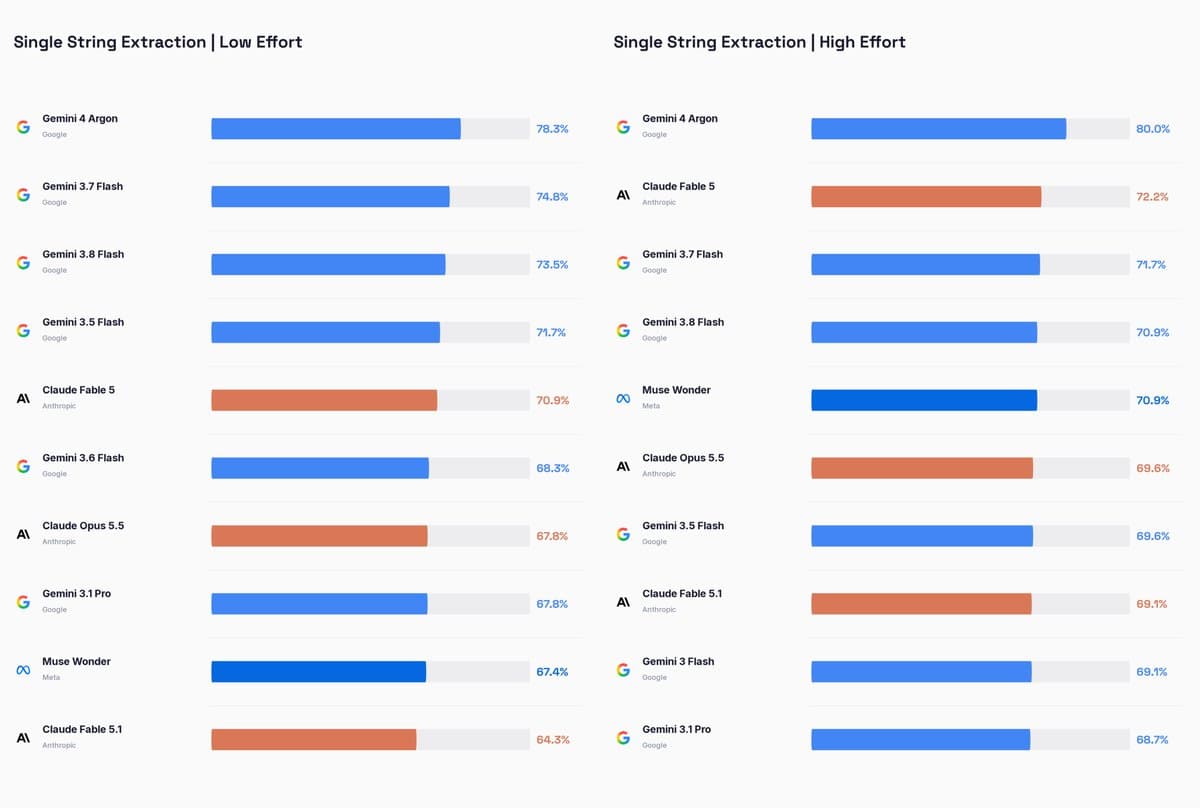
- Single-value extraction: Exact-match readings scored 80.0% at high effort and 78.3% at low effort in the single-value results. The previous leaders were Claude Fable 5 at 72.2% high and Gemini 3.7 Flash at 74.8% low.
- Transcription: Character-similarity scores reached 98.8% high and 95.5% low on the leaderboard; near misses receive partial credit.
- Structured JSON: Matching fields scored 94.8% high and 92.6% low, versus Astra's 91.7% and 91.8%, in the JSON comparison. Missing and extra fields both count against the model.
- Text localization: Boxes must overlap ground truth by more than half, with an exact text match. Argon scored 84.7% high and 81.6% low in the posted results; the linked leaderboard displays 81.5% for low effort.
Roboflow labels the OCR results “Preliminary: single run,” unlike the repeated detection measurements.
Cost and latency
Skalski described Argon as four times cheaper at high effort, then as a better model at half the price in a later reply. His cost chart reports average estimated API spend per image across the vision tasks.
The plotted high-effort costs, $0.0206 for Argon and $0.0734 for Astra, yield a 3.56× cost ratio, approximately the advertised fourfold difference.
The 34% reduction in high-effort elapsed time also applies to the across-task average: 19.6 seconds for Argon versus 29.7 seconds for Astra.
Low-effort runs reverse the speed comparison: Argon averages 13.4 seconds per image versus Astra's 9.9 seconds. For detection specifically, the task leaderboard reports high-effort latency of 23.94 seconds for Argon and 31.66 seconds for Astra.
Roboflow's overall benchmark separates task scores, cost, and latency; the headline detection score and the 19.6-second average come from different aggregations.
Instance segmentation
Skalski also tested instance segmentation, reporting masks that preserve holes and disconnected parts belonging to the same object. These are qualitative examples rather than a scored segmentation leaderboard.
Gemini API access and pricing
Google announced global Argon availability on October 13. Its launch post lists paid API access, Ultra access in Antigravity, and Pro or Ultra access in the Gemini app and AI Mode in Search.
More than 100,000 Google employees tested Argon over the preceding month, according to the rollout post.
The discounted token rates have an expiry date in Google's API pricing schedule:
- Through November 30, 2026: $2 per million input tokens and $10 per million output tokens.
- From December 1, 2026: $4 per million input tokens and $20 per million output tokens.
- Thinking tokens: Billed at the output rate.
- Cached input: $0.10 per million tokens during the promotion, then $0.20. Argon supports implicit caching only; explicit caching is unsupported.