
OpenAI reports Jalapeño delivers 1.5–1.9× more work per watt
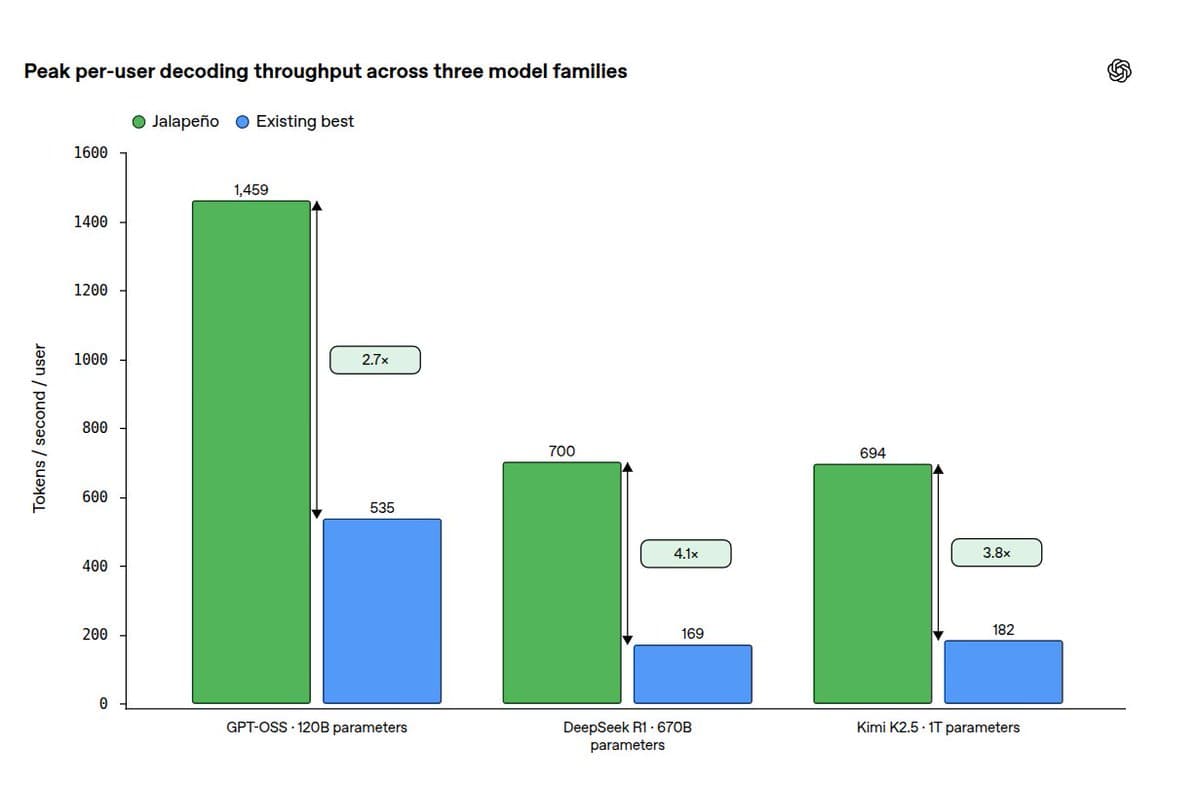
OpenAI says Jalapeño delivered 1.5–1.9× more work per watt and 1.7–3.6× lower end-to-end latency than NVIDIA systems in its tests. The company plans to deploy the inference chip in its compute infrastructure by year-end.
TL;DR
- Jalapeño produced 1.5 to 1.9 times more work per watt at peak throughput, and 1.7 to 3.6 times lower end-to-end latency, across three public model families in OpenAI's benchmark announcement.
- The spectacular 53.7 to 104.3 times efficiency figures measure a separate operating point, where rohanpaul_ai's post matched Jalapeño against each existing accelerator's fastest decoding speed.
- The published runs used nominal 8K-prefill and 1K-output requests, a constraint that eliebakouch's benchmark note flags as distinct from long-context, multi-turn agent workloads.
- AI helped take the design from initial work to tapeout in nine months, while kimmonismus's excerpt says AI-generated code beat human-written code by 1.5 to 1.8 times on selected attention and MoE blocks.
- OpenAI plans to start using Jalapeño inside its own infrastructure by year-end, according to OpenAI's roadmap post.
At the former system's fastest DeepSeek R1 decoding rate, the official result charts put Jalapeño at 12,258 mixed tokens per second per kW, versus 118. SemiAnalysis observed InferenceX runs in OpenAI's lab but says it did not run the full suite or see the long-context AgentX results. OpenAI's full-stack memo ties the chip directly to the economics and availability of its serving stack.
Peak and matched-speed curves
The headline comparison is peak mixed-token throughput at each platform's best operating point. kimmonismus's benchmark charts put Jalapeño ahead of the compared NVIDIA systems on all three models:
- GPT-OSS 120B: 85,448 versus 44,960 mixed tokens/s/kW, 1.9 times higher.
- DeepSeek R1 670B: 19,641 versus 11,781, 1.7 times higher.
- Kimi K2.5 1T: 18,195 versus 11,862, 1.5 times higher.
The much larger ratios come from pinning both platforms to the existing system's fastest per-user decode speed. At those rates, rohanpaul_ai's post lists 22,935 versus 427 mixed tokens/s/kW for GPT-OSS, 12,258 versus 118 for DeepSeek R1, and 6,744 versus 120 for Kimi K2.5. Peak-throughput and matched-speed results describe different operating points.
InferenceX scope
The reported tests cover GPT-OSS 120B, DeepSeek R1 670B, and Kimi K2.5 1T at nominal 8K input and 1K output. eliebakouch's note on the charts also points out that the public results use earlier model versions rather than Kimi K3.
SemiAnalysis says OpenAI supplied the figures, while its team verified InferenceX runs in person. It did not execute the full InferenceX suite or inspect AgentX, which SemiAnalysis describes as its preferred long-context, multi-turn evaluation because it exposes production cache behavior.
The InferenceX chart also warns that prefill-decode-disaggregated configurations can count only the decode or prefill engine's power, rather than total chip power. That makes those configuration comparisons non-equivalent to an aggregated setup.
Local state and a shared fabric
OpenAI attributes the efficiency result partly to keeping model state and KV cache local, cutting data movement as serving switches between compute-heavy prefill and memory-bound decode, as rohanpaul_ai's summary reports.
SemiAnalysis reports that Jalapeño does not split prefill and decode across separate chip pools. Its draft and main models share the same chips and fabric, while the observed runs used single-token prediction without speculative decoding.
OpenAI calls the accelerator balanced and fungible: one system intended to cover changing prefill and decode mixes rather than dedicate hardware to a fixed phase split.
AI-designed kernels
AI had two roles in the project. TheRealAdamG's post quotes OpenAI saying it used AI to explore implementations, tighten design, measurement, and verification loops, and optimize arithmetic circuits during the nine-month path to tapeout.
The programming model was also designed around local tensors, explicit communication, and predictable synchronization, according to eliebakouch's OpenAI excerpt. OpenAI says that structure lets AI optimize mapping, placement, scheduling, and coordination.
The same excerpt supplies two bounded results:
- Codex with GPT-Astra brought three unplanned open-weight model families to high performance within two months.
- AI-generated implementations ran 1.5 to 1.8 times faster on selected GPT-OSS attention and MoE blocks than existing human-expert code. The comparison applies to those blocks, not the full model.
Deployment roadmap
Jalapeño is scheduled for OpenAI's own compute infrastructure by the end of 2026. OpenAI's roadmap post describes it as generation one, with Gen 2 deep in development and Gen 3 taking shape.
OpenAI connects the internal rollout to faster ChatGPT responses, more responsive Codex sessions and agents, and more reliable access under demand in its product-facing follow-up.