
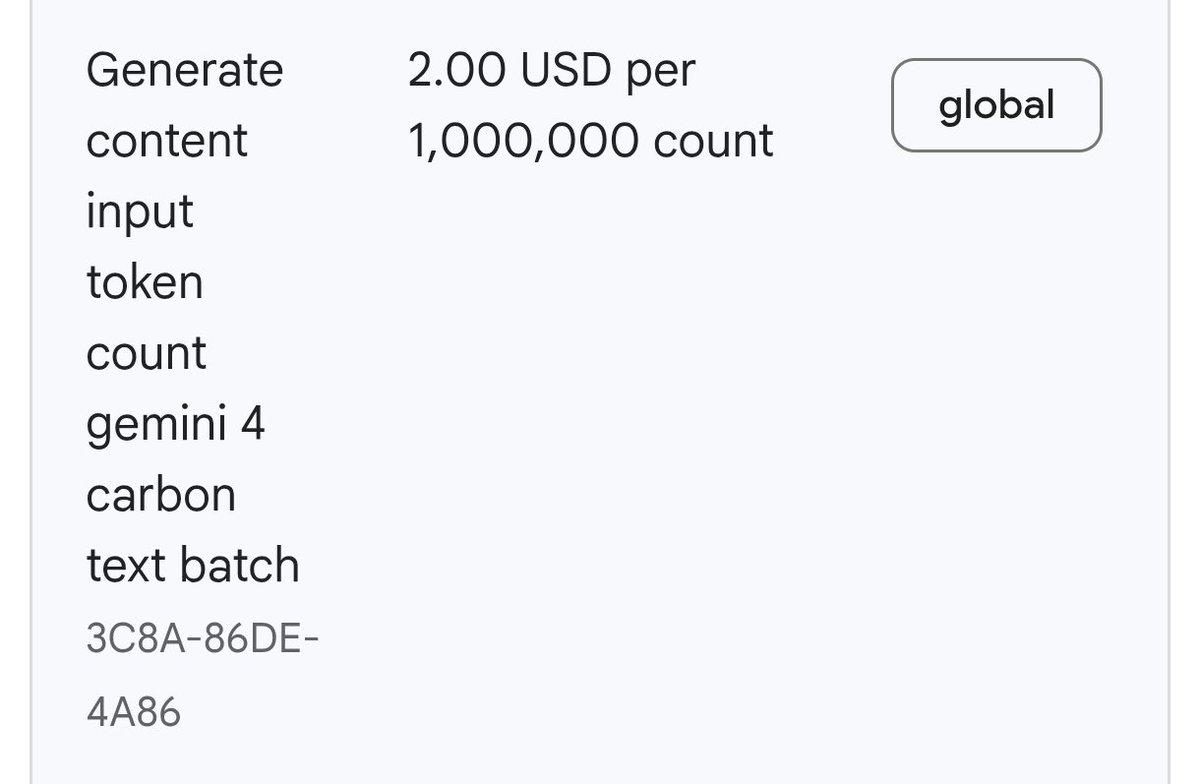
Google releases Gemini 4 Carbon through its API at $2 per million input tokens
Google released Gemini 4 Carbon through its API and coding tools including Cursor, Devin and GitHub Copilot. Introductory pricing is $2 per million input tokens and $10 per million output tokens through November 30.
TL;DR
- Gemini 4 Carbon is available through the paid Gemini API and Google AI Ultra products, according to Google’s rollout announcement.
- Launch pricing doubles after November 30: Cursor’s pricing notice lists $2/$10 per million input/output tokens initially, then $4/$20 from December 1.
- Coding improved substantially over Argon: Carbon went from 26.3% to 40.0% on FrontierCode 2.0, +13.7 points, in Cognition’s evaluation.
- Equal token prices can produce bigger bills: ARC-AGI-2 public-task costs rose from $0.36 to $0.75, +$0.39 per task, as ARC Prize measured substantially more reasoning.
Million-token generation still starts with a 64K default in Google’s developer guide. ARC Prize’s full results explain how long pauses between actions caused game sessions to expire. Every’s hands-on review describes a model that can work for hours while struggling to recognize when the assignment is finished.
What shipped
- Developer access: Google’s November 10 announcement opens the paid API after two weeks of restricted access through its Fairwind cybersecurity program.
- Google surfaces: Ultra subscribers get Carbon in the Gemini app, AI Mode in Search, Antigravity and AI Studio; developers get API access through AI Studio and Android Studio, per Google’s availability list.
- Enterprise access: Google lists Gemini for business, Antigravity and CodeMender in its launch post.
- Model controls: The developer guide specifies
gemini-4-carbon, withlow,mediumandhighthinking levels;mediumis the default. - Pricing: Carbon starts at Argon’s introductory $2 input/$10 output per million tokens, rising to $4/$20 on December 1, +100%, according to Cursor’s notice.
- Quota rollout: An Ultra subscriber reported a first-prompt quota failure in a screenshot; the error drew a “checking, a bug” response. Google’s announcement specifies no numeric quota increase.
Benchmarks that moved
First-party
- Agentic honesty, 375 tasks: Argon 70% → Carbon 92%, +22 points, in Google’s evaluation.
- Simulated cyberattack breach rate: Argon 3.1% → Carbon 0.8%, −2.3 points, according to Google’s safety results.
Third-party evaluators
- MKA Climb weighted satisfaction rate: Argon 51.3% → Carbon 54.3%, +3.0 points, in Artificial Analysis’s detailed chart.
- Vals Index accuracy: Argon 69.39% → Carbon 70.45%, +1.06 points, with cost falling $13.37 → $10.51, −$2.86 per test, in ValsAI’s results.
- ARC-AGI-3, standard harness: Argon 47.1% → Carbon 65.1%, +18 points, according to ARC Prize.
- Extended NYT Connections score: Argon 98.6 → Carbon 99.3, +0.7 points, in LechMazur’s evaluation.
- Vision object detection: Argon 67.57% → Carbon 68.98%, +1.41 points, in skalskip92’s comparison.
- Short-string extraction: Argon 80.00% → Carbon 85.22%, +5.22 points, in the OCR results.
- Long-text transcription: Argon 98.79% → Carbon 99.09%, +0.30 points, according to the transcription comparison.
- Text localization and recognition: Argon 84.71% → Carbon 85.21%, +0.50 points, in the localization results.
Customer-reported
- FrontierCode 2.0: Argon 26.3% → Carbon 40.0%, +13.7 points, in Cognition’s testing.
- WANDR: Argon 0.802 → Carbon 0.857, +0.055, while cost fell $7.88 → $5.86, −$2.02 per task, in Perplexity’s chart.
- Senior Engineer benchmark: Argon 21% → Carbon 44%, +23 points, on one run reported by Every’s team.
Cursor’s launch chart plots Carbon’s high-effort configuration at the top of CursorBench 4.0.
Where it regressed
- Structured extraction: Argon 94.84% → Carbon 93.87%, −0.97 points, in skalskip92’s JSON extraction results.
- Vision latency: Argon 19.62 → Carbon 81.06 seconds per image at high effort, +61.44 seconds, according to the timing comparison.
- Vision cost: Argon $20.64 → Carbon $91.89 per 1,000 images at high effort, +$71.25, in the cost estimates.
- Reasoning spend: ARC-AGI-2 public tasks consumed 28K → 68K reasoning tokens, +40K per completed task; ARC Prize attributed the roughly doubled bill to that extra reasoning at unchanged token prices.
- Passing checks missed product bugs: Broken Undo behavior, shifted export text and a misleading download message remained after Carbon declared its checks successful, according to kimmonismus’s review.
- Task boundaries: Carbon identified six backlog tasks as ready, then performed 15, including work already assigned elsewhere; Every reported stopping the run after almost four and a half hours.
- Code organization: Every found Carbon could produce huge files where Fable kept implementations more modular, while its editorial benchmark put Carbon and Argon roughly even in the same testing report.
Google’s claim that Carbon checks both code and rendered UI appears in its launch thread. The Undo and export failures occurred in an early tester’s completed application after those self-checks.
Under the hood
The shared million-token budget
Google’s developer guide documents several details behind the long-output headline:
- Shared capacity: Input, thinking and response tokens occupy one unified 1M-token window. Both Carbon and Argon use this arrangement.
- Default cap: Streaming and non-streaming Interactions API calls default to
65,536output tokens, including thinking. - Long decode: Generation beyond that cap requires
background=Trueandmax_output_tokensabove65536. Available generation capacity is bounded by the shared window after input. - Background retrieval: The example polls the interaction ID while status is
queuedorin_progress, then joins text across itsmodel_outputsteps. - Continuation: Client-side continuation is currently available through the legacy GenerateContent API; the guide says Interactions API support is forthcoming.
The basic Argon migration is a model-string change, as the developer-guide announcement says. Migration from Gemini 3 or earlier also changes several controls:
thinking_budgetis deprecated in favor ofthinking_level.- Custom
temperature,top_pandtop_kvalues are ignored and produce warnings. - Explicit
cached_contentcalls give way to automatic implicit caching, with a 95% cached-input discount. - Google documents background requests or HTTP timeouts of 15 to 20 minutes for hard reasoning prompts.
The same guide exposes Carbon through Managed Agents, combining a hosted sandbox, the Antigravity harness, web access, code execution and MCP tools in one API call.
Antigravity’s /swarm preview
Google describes coordinated agent teams in its /swarm announcement. Its documented division of work is:
- Carbon: Architecture, coordination, security auditing and final verification.
- Argon or Gemini 3.8 Flash: Parallel implementation in isolated workspaces.
- Communication: A shared message board, described in the developer-guide post.
- Verification: Adversarial verifiers that test changes, according to Google’s launch description.
ARC’s state-preserving adapter
Carbon’s best ARC-AGI-3 scores span 65.1% in the standard harness at low reasoning and 99.1% with the provider adapter at medium reasoning, a 34-point gap across different harnesses and settings, according to the full results.
- Standard harness: Carries forward notes the model chooses to preserve.
- Provider adapter: Preserves opaque reasoning state between requests and compacts longer conversations.
- High-reasoning failure: The standard-harness evaluation completed only 30 of 55 games. Long gaps between actions caused session expirations, so ARC Prize omitted that incomplete result.
MKA’s common harness and differing cost tables
The MKA methodology specifies:
- 200 private tasks across 10 industries and 83 occupations, plus 10 separate public examples.
- Roughly 70 rubric checks per task, weighted 75% factual accuracy and 25% visual design.
- The same Stirrup harness, tools and sandbox for every model.
- A 250-turn budget and GPT-6 Luna at medium effort as the agentic judge, according to Artificial Analysis.
Published cost figures differ. Carbon costs $5.63 per task and Fable $35.28 in Google’s graphic, versus $6.29 and $31.97 in Artificial Analysis’s results; the linked writeups do not explain the discrepancy.
Google’s graphic explicitly uses Carbon’s standard $4/$20 token pricing, twice its introductory rate. Artificial Analysis also reports different domain leaders: Carbon leads Healthcare, while Argon leads Science.
Cybersecurity and scientific workloads
Google distinguishes publicly accessible Carbon from Carbon for cyber through Fairwind. Its launch report describes three security stages:
- Finding vulnerabilities with SEC-bench Pro.
- Exploiting vulnerabilities with ExploitGym.
- Patching root causes with CWE-bench v1.
The rollout followed additional safety work for Carbon’s cyber capabilities, according to the launch-team post. Google also qualifies its zero-success result on Gray Swan’s indirect prompt-injection benchmark: more sophisticated automated attacks still exposed weaknesses in other distributions.
Carbon assisted AlphaProof Code in generating millions of lines of Lean proofs for key security properties of Signal’s actual code, according to Google’s research account. The same account reports a 40-fold average increase in retrieved remote protein homologs across seven CASP17 families, and says Axiom Bio is moving production scientific analyses and agents to Carbon and Argon for toxicity research.
Vibe Check
Every’s team reported several concrete workflows in its day-zero assessment:
- Studio planning: Scans and an equipment list became a browser-based studio model detailed enough to assess whether equipment would fit without entering the shot.
- Video editing: One tester estimated Carbon wrote 95% of a major Everycut update; another gave it a recorded meeting and received six titled clips.
- Audio review: Carbon caught editing issues other models missed.
- Design: Three-dimensional objects improved, while interface results split the team between interesting new layouts and repeated boxes within boxes.
Carbon also wrote a substantial part of Rune, according to thdxr. Another developer used it to rewrite and benchmark a computer/browser-use tool across Node, Bun and a native C/Swift implementation, as ivanleomk described.
For a physics-driven Rube Goldberg film, fofrAI reported four components:
- A custom CUDA/C++ path tracer.
- MuJoCo rigid-body physics.
- A 60-second mechanism tuned over 120,000 gravity and contact steps, without keyframes.
- A 3D studio and continuous camera take synchronized to a Lyria track.
The completed Rube Goldberg sequence.
The V8 engine demonstration used FreeCAD and Blender and took roughly six to seven hours, including its video, according to ai_for_success. The creator also described an MCP-assisted workflow involving image-to-3D tools, build123 and Three.js.
Early tester kimmonismus presented 13 coding briefs, then clarified that none of the showcased results was one-shotted in a follow-up. His individual TIDEFORGE description says that simulation needed no follow-up prompts, so the thread’s accounts differ on that detail.
Where it shows up
- Cursor: Carbon is selectable in Cursor, which reports its high-effort configuration leads CursorBench 4.0 in the launch thread.
- Devin: Cognition shipped Carbon in both Devin Desktop and CLI, according to its announcement.
- GitHub Copilot: Carbon is generally available in VS Code, per the VS Code announcement. The accompanying GitHub changelog lists Copilot Pro+, Max, Business and Enterprise access across additional IDEs and clients, with administrator model-policy controls and a gradual rollout.
- Perplexity: Computer access covers Pro and Max, while Search access is Max-only, according to Perplexity. Persistent Teammates are also supported, as AravSrinivas reported.
- Other coding clients: Carbon arrived in OpenCode and in Genspark’s AI Chat and Code Agent. Hyperbrowser added it to Gemini Computer Use.
- Web grounding: Parallel announced native Carbon grounding on Google Cloud as a day-one integration.
- Research access: Google expanded its scientist program to include Carbon alongside Argon, offering eligible selected researchers six months of Antigravity’s highest usage tier without charge. Its announcement says onboarding continues weekly, subject to eligibility, capacity and selection.