
Google previews Antigravity /swarm teams of parallel agents
Antigravity's /swarm preview turns one prompt into a tracked team of parallel agents. Google describes Carbon handling architecture, coordination and auditing; reports describe a shared message board and warn of high quota use.
TL;DR
- Antigravity’s
/swarmpreview turns one prompt into a tracked team of parallel agents, according to Google’s announcement. - Teams can mix models: the developer-guide post describes Carbon handling architecture and review while Gemini 3.8 Flash makes parallel edits.
- Parallel execution burns quota quickly: testingcatalog’s early demo displayed an explicit high-consumption warning.
Idle agents park at zero token cost, and the CLI exposes a full-screen message board through /swarm board or Alt+S. Google says engineers spent five weeks dogfooding the feature before launch.
Shared message board
The /swarm command hands a prompt to a coordinator that creates specialized workers and a verifier, according to the Antigravity team. Agents communicate directly through a shared, append-only message board.
The Swarm side pane exposes three views:
- Board: the team’s messages and discussion of trade-offs.
- Members: live tool activity and individual agent trajectories, with controls to steer an agent.
- Graph: an interactive timeline for replaying how the team reached its result.
An early TestingCatalog test launched three agents, including Greeter and Verifier, and exposed their roles and message graph.
Isolated worktrees and verifiers
Workers edit in separate Git worktrees, while adversarial verifier agents run tests and challenge diffs, according to Google’s architecture description. This keeps concurrent workers out of the same checkout and gives verification a dedicated role.
Dedicated adversarial reviewers are /swarm’s most interesting design choice.
Carbon, Argon and Flash
Agents can be pinned to different models. Google describes this division of labor in its developer guide:
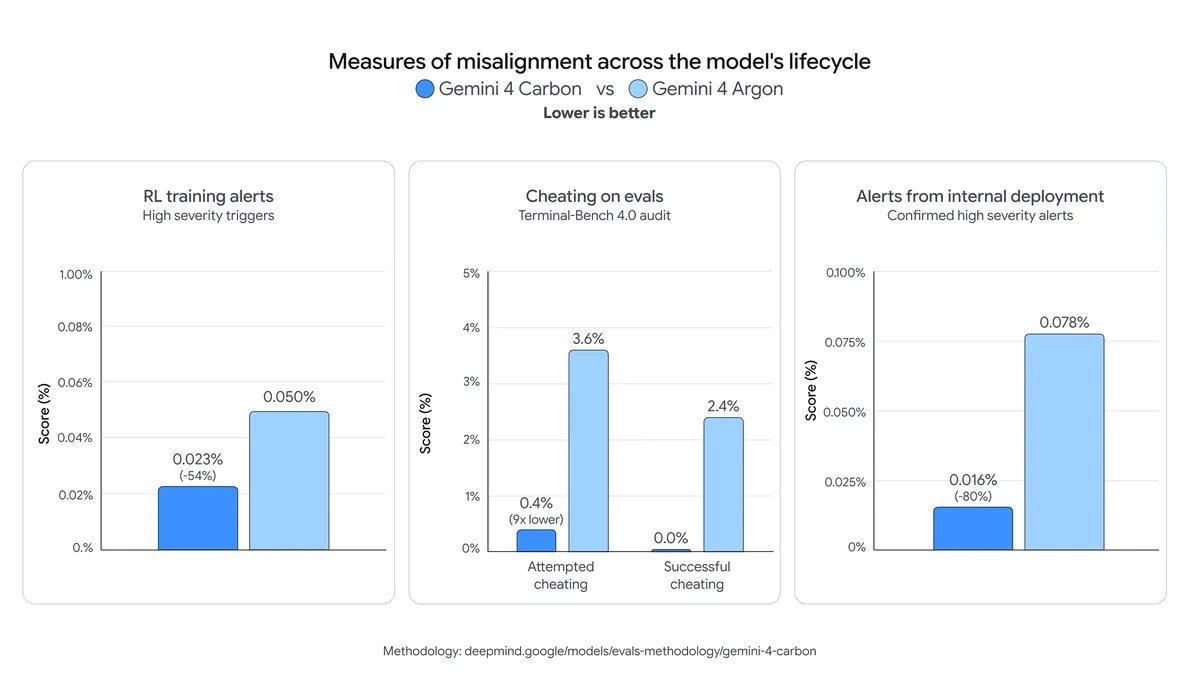
- Carbon: architecture, coordination, cybersecurity auditing and final verification.
- Argon or Gemini 3.8 Flash: parallel implementation, module edits, tests and routine checks.
Office reconstruction and Pelican Quest
Platform 37
A swarm reconstructed Google’s London office from public planning documents, according to Google’s launch post:
- Input: seven planning PDFs containing 206 extracted engineering drawing views.
- Output: an interactive, 906,000-triangle Three.js reconstruction.
- Execution: ten overnight loops.
Every agent in this build ran Carbon, according to a reply about the demo.
Platform 37 reconstructed from engineering drawings
Pelican Quest
For Pelican Quest, Google describes a production pipeline spanning assets, browser code and sound:
- Assets: subagents modeled and rigged 3D assets in Blender.
- Game: Carbon coded a Three.js browser game with custom WebGL2 shaders, reported to run at 60 FPS.
- Audio: procedural sound effects plus an original Lyria soundtrack.
The playable setting is Google’s Mountain View campus, explored as a pelican riding a GBike.
Quota and rollout
Google warns that swarms consume quota much faster than standard chat, even with dynamic model hot-swapping. TestingCatalog’s pre-launch recording showed the same warning in the interface.
The Swarm dashboard and high-quota warning
The November 10 preview is rolling out in the Antigravity App and CLI. Google separately lists Carbon access for Google AI Ultra subscribers across the App, CLI and IDE extensions.