
Google launches Gemini Decisions API with 1,000-question multimodal input
Google's Gemini Decisions API answers up to 1,000 questions over shared multimodal input in one pass. Google lists a 256K context window, 150–250 ms latency and input pricing of $0.10 per million tokens.
TL;DR
- One shared input can drive up to 1,000 independent questions in a single forward pass, according to Google’s announcement.
- Input costs $0.10 per million tokens, with no output-token charges and a free API tier, per the launch details.
- Google advertises a 256K context window and 150-250 ms end-to-end latency in its launch figures.
- Independent results put Decision 1 at 66 on the Decision Index, seven points behind the leaders, according to ArtificialAnlys’s results.
Google’s launch post scopes its near-flat latency measurements to 1-100 questions and contexts up to 16K tokens. Exact multiple-choice ties go to the alphabetically first option in the API documentation. Vercel’s compatibility endpoints support fewer input modalities than its AI SDK integration.
What shipped
- Model and endpoint:
gemini-decision-1powers the new Decisions API in Google AI Studio and the Gemini API, per GoogleAIStudio’s announcement. - Inputs: Text, images, audio, video and PDFs, with a 256K context window, according to the model announcement.
- Outputs: Yes/no probabilities, multiple-choice selections and rubric scores, each with confidence, as described in the API overview.
- Access: A free prototyping tier is available now; Gemini in Google Cloud is coming later, according to the team’s reply.
Benchmarks that moved
First-party
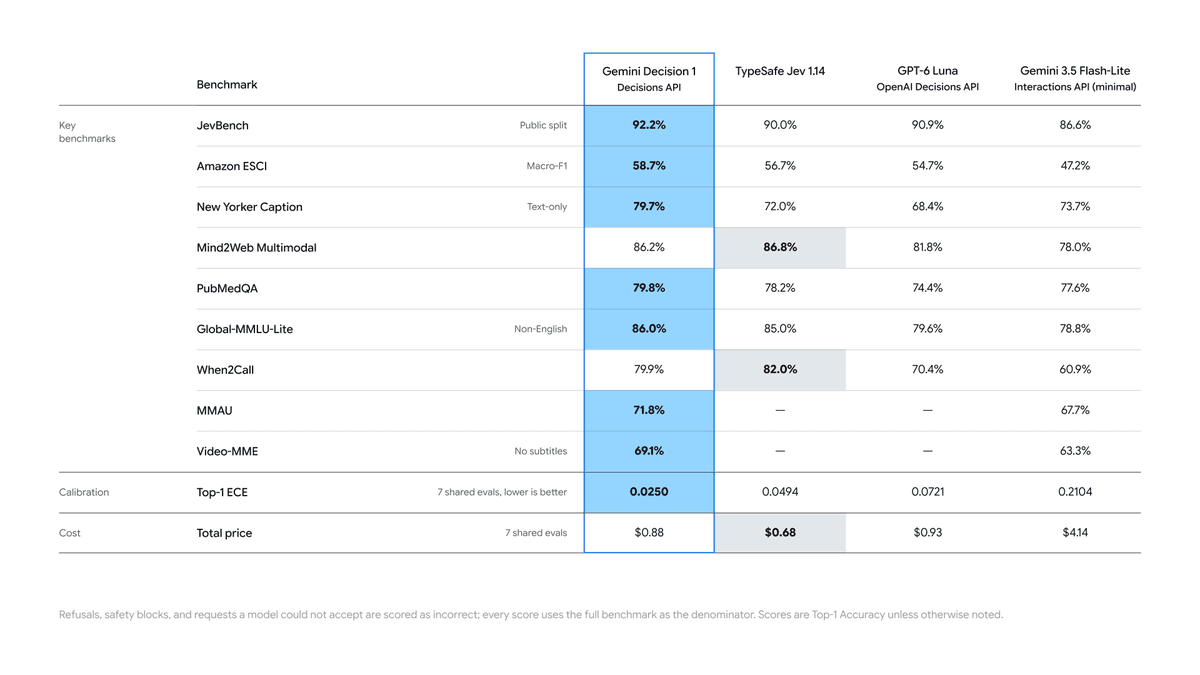
The following comparisons use Jev 1.14 as the baseline except the audio and video tests, which use Gemini 3.5 Flash-Lite.
- JevBench: 90.0% → 92.2%, +2.2 points, per Google’s chart.
- Amazon ESCI macro-F1: 56.7% → 58.7%, +2.0 points, in Google’s results.
- New Yorker Caption, text-only: 72.0% → 79.7%, +7.7 points, per the launch comparison.
- PubMedQA: 78.2% → 79.8%, +1.6 points, according to Google’s measurements.
- Global-MMLU-Lite, non-English: 85.0% → 86.0%, +1.0 point, per the accompanying benchmark table.
- MMAU audio understanding: 67.7% → 71.8%, +4.1 points, in Google’s multimodal results.
- Video-MME, without subtitles: 63.3% → 69.1%, +5.8 points, per the video results.
- Top-1 expected calibration error, lower is better: 0.0494 → 0.0250, -0.0244, across seven shared evaluations in the shared benchmark table.
Third-party evaluators
- AA-Omniscience-Decision score, d1-ultra → Decision 1: 64 → 66, +2 points, according to the evaluator’s comparison.
- HLE-MultiChoice score, Mammoth 27B or d1-ultra → Decision 1: 47 → 49, +2 points, per the reasoning results.
- AA-Omniscience-Decision accuracy, Drex Max v1.1 → Decision 1: 28% → 45%, +17 points, according to the accuracy figures.
Customer-reported
No comparative benchmark numbers accompanied fofrAI’s working sketch-game demo.
Where it regressed
Decision 1’s position on the overall Decision Index
- Overall capability: Drex Max v1.1 and GLiDE v1.2 → Decision 1: 73 → 66, -7 points, on the index in ArtificialAnlys’s comparison. Decision 1 ties Jev 1.14 and Elephant 9B.
- Document reliability: Drex Max v1.1 → Decision 1: 63% → 33%, -30 points, for documents with all 15 answers correct on AA-Paperclip, according to the document results.
- Browser decisions: Jev 1.14 → Decision 1: 86.8% → 86.2%, -0.6 points, on Mind2Web Multimodal in Google’s own tests.
- Tool-call decisions: Jev 1.14 → Decision 1: 82.0% → 79.9%, -2.1 points, on When2Call in the same comparison.
- Calibration varies by task: Drex Max v1.1 → Decision 1: 0.04 → 0.14 Brier score on When2Call, +0.10, worse, according to the independent calibration results.
- Cost per task: Drex Max v1.1 → Decision 1: $103 → $345 per million tasks, +$242, or 3.35×, across the index in the cost comparison.
- Latency: Jev 1.14 → Decision 1: 92 → 211 ms per task, +119 ms, in the timing results. Against Drex Max v1.1, Decision 1 improves from 283 to 211 ms, -72 ms.
Google’s cheaper-than-Flash-Lite claim uses a different baseline: its seven shared evaluations cost $4.14 on Flash-Lite and $0.88 on Decision 1, 78.7% less, according to the launch chart. Jev completes that suite for $0.68, making Decision 1 $0.20 more expensive.
Decision Index scoring
Artificial Analysis assigns its largest weight to document decisions and extraction in the index methodology:
- AA-Paperclip, 30%: Document decisions and fact extraction.
- EvalSafe-O*NET-AA, 15%: Judgments about workplace documents.
- When2Call, 10%: Tool-call decisions.
- AA-Omniscience-Decision, 15%: Knowledge and hallucination.
- HLE-MultiChoice, 15%: Reasoning with an option to decline.
- AA-Symmetry, 15%: Stability under rewording, option movement and negation.
The composite score in the overall results incorporates correctness and reported probabilities. For the five correctness-based evaluations, each question receives:
Decision Score = 50 * (1 + c - (p - c)^2)
Here, c is 1 for a correct answer and 0 otherwise; p is the probability assigned to the chosen answer. Correct answers score between 50 and 100, while incorrect answers score between 0 and 50.
AA-Paperclip combines five decisions and ten extracted facts, collected across two requests, into one document-level result. All 15 answers must be correct, and document confidence is the product of their probabilities, so small per-answer calibration errors compound.
Under the hood
Google’s API documentation requires SDK 3.2 or later and shows client.decisions.create through API version v1beta. Requests contain shared input and a map of questions, with one typed answer returned per question.
Questions are isolated and cannot consume one another’s answers within the same call. The API supports three primitives:
noul: Returns the probability of yes, bounded between 0.01 and 0.99. Confidence ismax(p, 1-p), so a confident negative answer has a low yes probability and high confidence.choice: Selects among 2-255 options and returns normalized probabilities. It distributes probability across the supplied options even when none fits.score: Evaluates 2-255 ordered rubric levels, indexed from zero. The returned score is their probability-weighted average, which can be fractional; confidence reflects the most probable level.
Shared-input billing
Google bills the shared input once per request. Each additional question contributes its own instruction and criteria tokens, according to the pricing explanation.
The model generates zero text tokens. Google also lists no separate thinking-token, transcription or OCR charges.
Latency scope
Google separates 50-100 ms of model compute from 150-250 ms end-to-end in its measurements. The published scaling claim covers a smaller workload than the API’s maximum question count and context window.
Where it shows up
- OpenRouter: Its model page uses a separate Decisions API. Chat-completions SDKs are incompatible; Google AI Studio is the sole provider, and EU in-region routing is unavailable.
- Vercel AI Gateway: The model slug is
google/gemini-decision-1. Its changelog supports PDF, audio and video through AI SDK 7, while the TypeSafe-compatible and Decisions API interfaces support text and images.
Google reports four internal deployments in its launch post:
- Gemini Notebook: Routes queries to model tiers and thinking levels, with up to 40% lower latency on everyday queries.
- Stitch Rapid: Builds playable product-flow wireframes and applies voice or tap edits before handing screens to full Stitch.
- CC from Google Labs: Chooses emoji reactions from more than 200 options.
- Google Search: Screens for adversarial behavior and content in an MCP-tool safety layer.
Phil Schmid, who helped design, build and evaluate the model and API, said the team shipped six weeks after opening an internal prototype to other Google teams in his launch post.
Vibe Check
- Delivery inspection, Google demo. Google reports processing 100 delivery photos in 4.5 seconds, with 16 questions per photo, in its demonstration. The examples cover:
Delivery photos evaluated against a shared checklist
- Live sketch recognition. fofrAI built a game that feeds drawings to the model and selects a guess from a shortlist.
- Video classification. A robot video filmed in Yonkers produced the following yes probabilities in an independent hands-on test: