
Claude Code users report unexplained bans and no appeal path
A 60-seat org and multiple T3 Code users said Anthropic blocked Claude access without warning, and one restored account still lacks a public explanation. Teams that depend on Claude Code should plan for sudden access disruption and keep a fallback workflow ready.
TL;DR
- GergelyOrosz's report said Anthropic revoked a 60-seat paid Claude account without explanation, and his follow-up said the part that stood out was automating bans on a corporate account with no human review or escalation path.
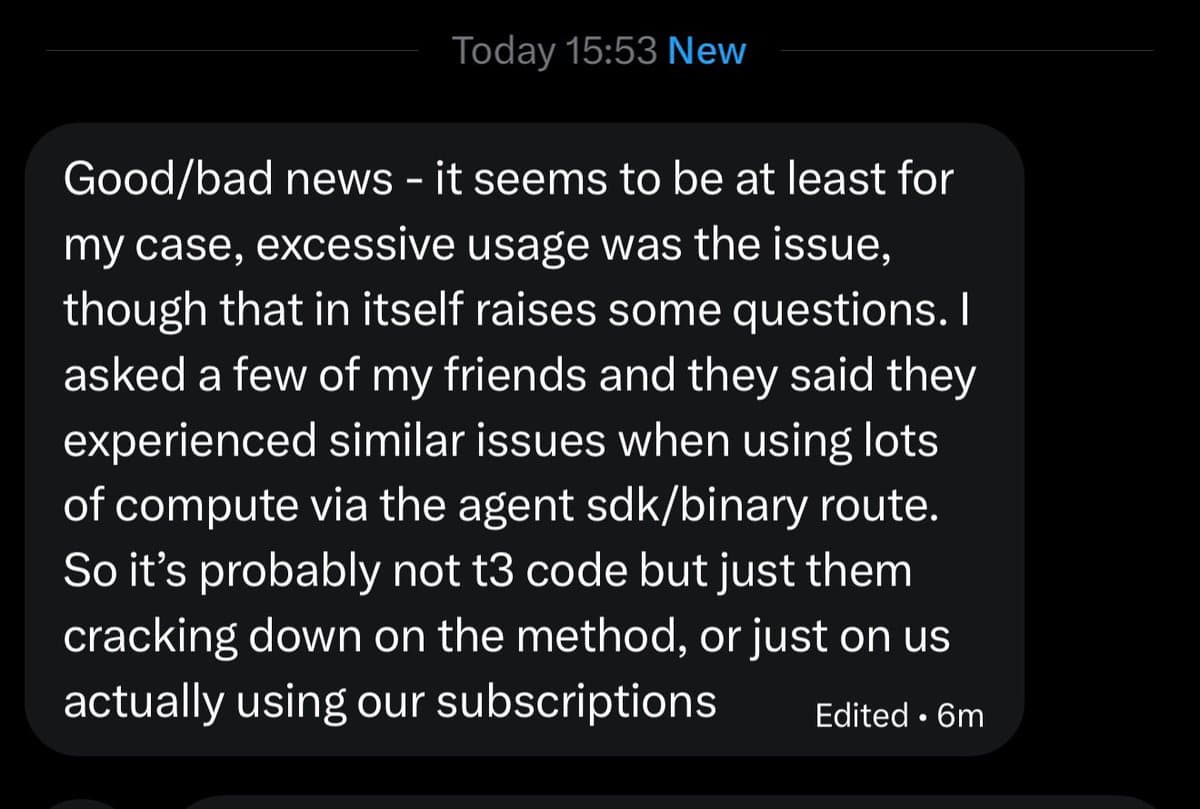
- theo's investigation post said he saw a small number of T3 Code users banned without warning, while his later update said one affected user got the account back but still had no explanation.
- The clearest screenshot in the evidence pool, jxnlco's repost of ImLukeF, shows Anthropic's email citing "suspicious signals," revoking access, and pointing users to an appeal form.
- theo's screenshot of Amol Avasare's reply added Anthropic's only concrete public explanation so far: anti-abuse rules were "over triggering right now," and one org was manually unbanned.
- The broader fight is not only about mistaken bans. theo's policy-clarity complaint said builders have been asking for months what Claude Code subscription use is actually allowed, while Anthropic's new What’s New page and official ClaudeDevs feed show the company trying to tighten communication on Claude Code updates.
You can read Anthropic's Usage Policy, browse the new Claude Code What's New digest, and see a separate Claude Code 2.1.112 changelog entry that fixed false "claude-opus-4-7 is temporarily unavailable" alerts a day earlier. That last detail is useful because the same 72-hour window already had rate-limit resets, launch bugs, and safety-filter misfires in the public timeline, not just ban reports.
The 60-seat org ban
Gergely Orosz, author of The Pragmatic Engineer, said Anthropic banned a 60-person paying org with no justification, no human review, and no human contact path.
His follow-up sharpened the claim: automated individual enforcement is common, but GergelyOrosz's clarification said automating a corporate ban without human escalation was the unusual part.
A later reply from theo's screenshot of Amol Avasare's response showed the org being restored. The same screenshot quoted Anthropic saying anti-abuse rules were over-triggering.
The T3 Code reports
A few hours later, Theo, CEO of T3 Chat, said he had seen a small number of reports of T3 Code users being banned without warning. He added that his Anthropic contacts believed the bans were probably errors, and said his team could not reproduce them despite heavy Claude Code use.
Theo's later updates narrowed the incident without fully resolving it. One update pointed to one of the two user reports, and theo's later post said Luke got the account back but "we still have no clarity on why this happened."
The email and the appeal path
The only primary artifact in the evidence pool is the email screenshot carried in jxnlco's repost of ImLukeF. It says Anthropic ran an internal investigation, found "suspicious signals associated with your account," determined there was a Usage Policy violation, revoked access, and offered an appeal form.
Because the screenshot is an image, the wording matters more than the outrage around it:
- "suspicious signals" is the only stated reason
- the action was immediate revocation, not a warning
- the response path was a form, not a named human contact
That lines up with Anthropic's public Usage Policy, which describes restricted behavior categories, but the evidence here does not identify which rule, if any, these users actually triggered.
The policy black box around Claude Code
The ban story hit a nerve because it landed on top of an older complaint: builders still do not know what kinds of Claude Code subscription use Anthropic permits.
Theo wrote that developers had been "begging for clarity for months" and said he was hearing from builders who wanted to create integrations but did not know whether they were allowed to. His follow-up framed that frustration as the real source of the blowback.
Outside Twitter, the same trust problem shows up in fresh Hacker News discussion on Claude Code Routines, where commenters raised questions about vendor lock-in, hazy ToS boundaries for automation, and whether cloud-hosted routines are stable enough for serious workflows. A separate Hacker News thread on OpenClaw restrictions also centered on what subscription-based Claude Code usage Anthropic permits.
The same week was already full of Claude Code enforcement and quota friction
The ban reports did not happen in a calm week. Anthropic had already fixed a rate-limit bug tied to long-context Opus 4.7 requests, according to the ClaudeDevs repost quoted by trq212, and users were still posting screenshots of rapid quota burn on the $200 Max plan, including bridgemindai's usage screenshot.
Anthropic also pushed Claude Code 2.1.112, which fixed a false auto-mode alert claiming Opus 4.7 was temporarily unavailable, with the public changelog entry confirming the fix. In parallel, LechMazur's screenshot showed Opus 4.7 pausing a harmless word puzzle as a safety false positive, and theo's Claude Design post described a separate product bug that wiped out a project after burning usage.
Anthropic's response to that broader confusion was operational, not explanatory. trq212's announcement introduced an official ClaudeDevs update feed, while the same thread pointed users to monthly "what we shipped" webinars and the new What's New digest. Those new channels are concrete. A public explanation for the mistaken bans still is not.