
Claude Security adds continuous scanning for changed repository code
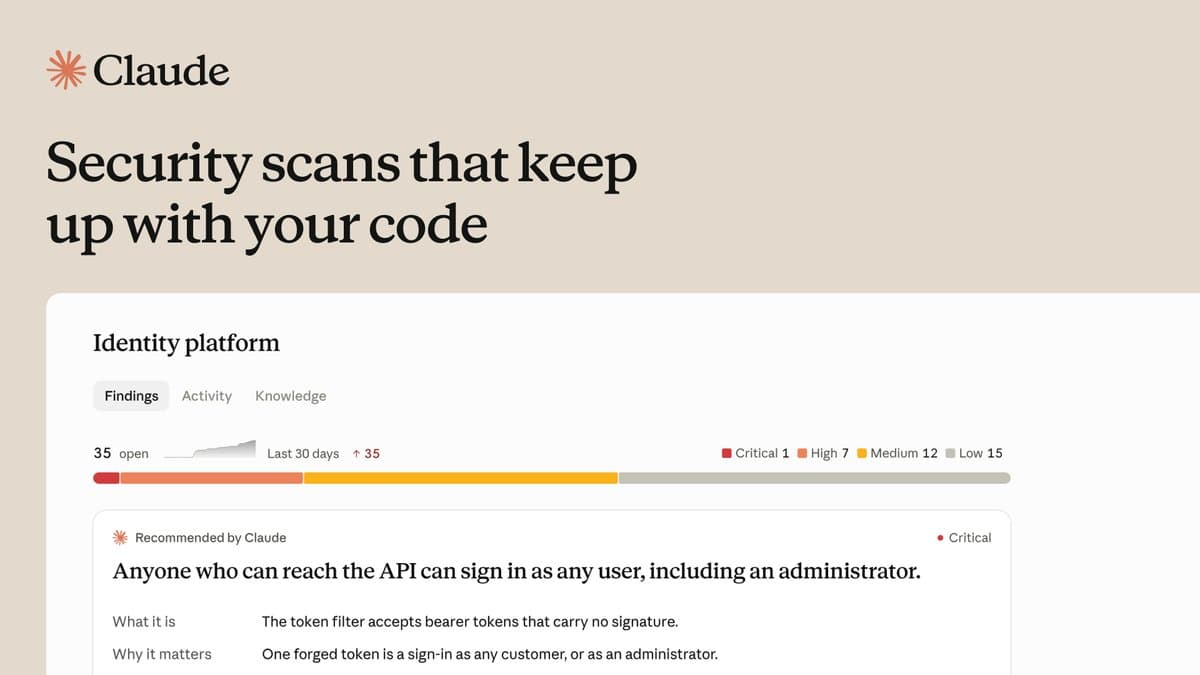
Claude Security now rescans changed code, verifies fixes and reopens recurring findings. The Enterprise public beta also adds editable threat models, cross-repository projects and API access.
TL;DR
- Claude Security now follows repository changes after a deep baseline scan, with an Enterprise public beta announced in the launch post.
- Findings close when repairs land outside Claude and reopen if the vulnerability returns, according to the fix-tracking announcement.
- Cross-repository projects connect to existing workflows through a new API and MCP connector, as described in the integration announcement.
Scanning uses Claude Mythos without granting users direct model access. A backend trusting validation performed only by a client is one of Anthropic's examples of the cross-service bugs the new project structure targets.
Continuous scans
After the baseline scan, follow-up scanning has no fixed schedule. Claude checks for new commits and scans changes according to their risk and complexity; the baseline itself can take minutes or hours.
Repeated scans of identical code can return different findings because, Anthropic says, the scanning agent's analysis is stochastic.
Cross-repository projects
Projects can span multiple services, with branch and scope settings for each repository.
- GitHub: GitHub.com and GitHub Enterprise Server connect through the Claude GitHub app.
- Other providers: GitLab and other Git servers connect using access tokens.
- Capacity: The limit is eight repositories per project.
- Context-only repositories: Claude can read these during analysis without reporting findings in them. They still count toward the eight-repository limit.
Fix verification
Claude checks changed code against open findings and marks them fixed when the repair lands, regardless of where it was written, according to the fix-tracking details. If Claude detects the vulnerability again later, the finding reopens.
Automatic fix verification is the standout feature.
Dismissed findings stay suppressed in future scans. Supported dismissal reasons include false positives, accepted risks and duplicates.
Editable threat models
Claude generates a threat model from project code that teams can review and edit. A project knowledge base also accepts deployment context and security policies.
Subsequent scans use that context to decide what to flag and how to rate severity. Findings explain how an attacker could reach vulnerable code and can include attack-path diagrams.
Nathan Hunstad, director of security at Vanta, said writing the company's risk policy into the threat model, focused on what external users could reach, made findings align with its prioritization.
API and MCP
The new API exposes the finding lifecycle and project configuration:
- List and read projects and findings.
- Resolve or reopen findings.
- Create and manage projects and their repositories.
- Authenticate with personal access tokens that inherit the user's permissions.
- Receive webhook notifications when new findings appear.
The MCP connector in Claude.ai and Claude Code lets engineers read findings and resolve or reopen them within a session.
Enterprise access
The hosted public beta requires an Enterprise plan, a premium seat for each user and consumption billing enabled. It does not support Zero Data Retention.
Project sharing has three roles:
- Full: Manage findings, settings and access.
- Triage: View findings, change their status and start fixes.
- View: Read-only access.
Admins separately control which roles can create projects or view, triage and manage projects organization-wide.
Billing and expiring credits
Claude Security charges direct token cost without an additional platform fee. Organizations can set a separate Security spend limit and inspect daily and month-to-date project costs.
The launch offer has several constraints:
- Allowance: Up to $25,000 per month for two consecutive months, measured from the organization's start date. Unused monthly credits do not roll over.
- Automatic start: Existing Enterprise organizations started on October 21, 2026, whether or not they use Claude Security. New Enterprise organizations start on their signup date.
- Cutoff: The offer ends December 31, 2026, at the end of the day UTC. Organizations signing up after November 1 do not receive two full months.
- Eligible usage: Credits cover the new experience. Earlier projects need migration before their usage qualifies.
Project migration
Existing projects keep their earlier experience until migrated. An owner-triggered migration creates a new project, copies findings and archives the original.
It does not copy:
- Members.
- Webhooks.
- Excluded directories.
- Scan history.
- Scheduled scans.
GitHub Enterprise projects cannot be migrated.