
SemiAnalysis reports 4–5× more API-equivalent value from Anthropic subscriptions
SemiAnalysis treats subscription plans as model-specific credits and reports 4–5× more API-equivalent value for Anthropic plans than OpenAI’s. Task-cost-adjusted comparisons still favor Claude by 1.3–2.9×.
TL;DR
- Anthropic's mid-tier subscriptions deliver roughly five times the API-equivalent value of OpenAI's in SemiAnalysis's agentic-workload comparison, according to the SemiAnalysis report.
- The calculation treats a subscription as a model- and token-specific credit pool, not a flat monthly dollar amount, as the methodology thread explains.
- At the $200 tier, the chart in WesRoth's chart post shows $11,726 of Opus 5.5 API-equivalent value versus $2,084 for GPT-6.1 Sol, with 28.6 billion versus 10.2 billion monthly tokens.
- OpenAI's Pro 200 reset cut the old plan's allowance roughly in half, while ai_for_success's summary puts the new $500 tier at only 21% more Astra usage than the old $200 plan.
- Task-cost normalization narrows Claude's advantage to 1.3x to 2.9x, according to scaling01's estimate for equal-intelligence comparisons.
The report's unusual detail is its measurement setup: analysts used repeated prompts to isolate fresh input, cache writes, cache reads, and output, then watched subscription meters move in response. OpenAI's GPT-6.1 Sol launch post describes Sol as near-Astra intelligence at one-fifth of Astra's standard API input and output prices. Its usage guide says allowance depends on the model, task, and settings. The headline comparison is therefore about subsidized capacity under a particular workload, not just two API rate cards. The result spread through the community via synthwavedd's linked post, which repeated the report's mid-tier claim.
Subscription credits
SemiAnalysis's model the methodology thread treats each plan as a credit pool whose draw depends on the model and token type. Its full methodology separates:
- Fresh input tokens.
- Cache writes that store a conversation prefix.
- Cache reads from earlier turns.
- Output tokens, which are usually the most expensive.
The firm runs repeated calls designed to maximize one token type while minimizing the others. It uses random tags to defeat caching, fixed tags to measure cache reads, and a long technical essay to force output. It keeps measuring until the meter-rate range is within 5%.
The public-facing meters usually cover five-hour and seven-day windows. SemiAnalysis converts each meter movement into tokens per window, applies its September agentic mix, then prices those tokens at first-party API rates. Its rough Tokenomics Model estimate puts Anthropic subscriptions at 10% of revenue but more than 40% of inference compute, lowering blended revenue per megawatt by about $36 million.
Opus 5.5 versus GPT-6.1 Sol
The chart in WesRoth's chart post reports the current API-equivalent comparison across three same-price tiers:
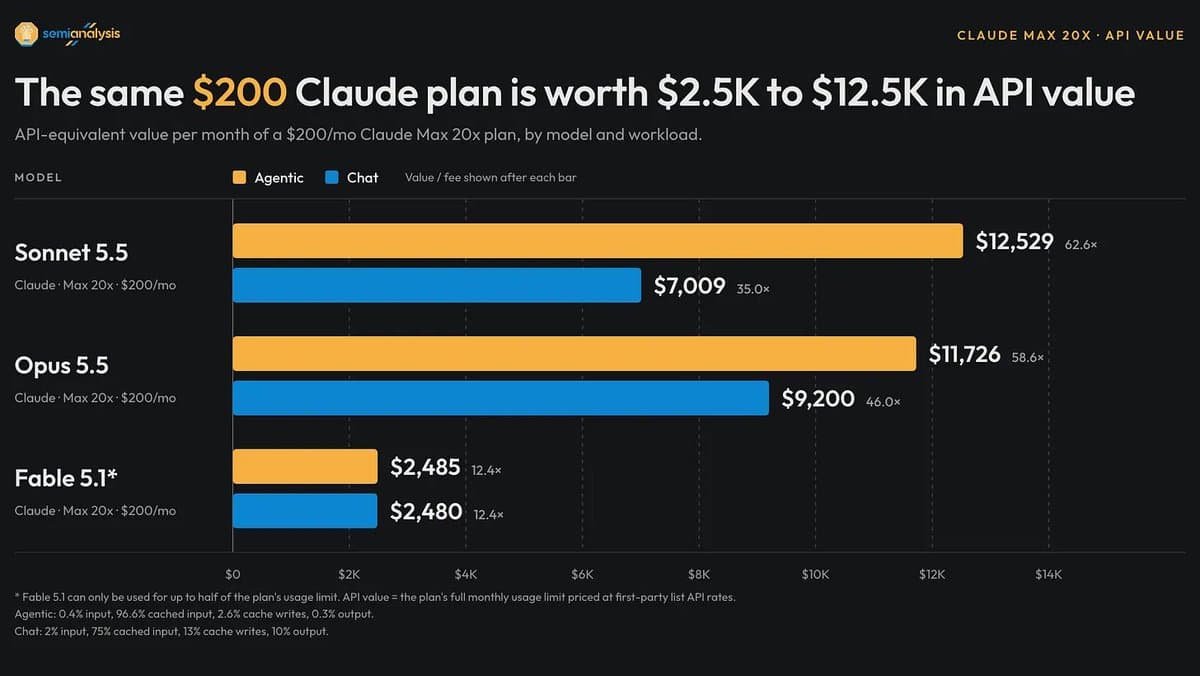
- $200 per month: GPT-6.1 Sol, $2,084 and 10.2 billion tokens; Claude Opus 5.5, $11,726 and 28.6 billion tokens.
- $100 per month: GPT-6.1 Sol, $1,055 and 5.1 billion tokens; Claude Opus 5.5, $5,725 and 14.0 billion tokens.
- $20 per month: GPT-6.1 Sol, $211 and 1.0 billion tokens; Claude Opus 5.5, $1,178 and 2.9 billion tokens.
Claude supplies about 2.8 times as many tokens at these tiers. Pricing those tokens at each lab's API rates expands the displayed dollar gap to roughly 5.4x to 5.6x.
Fable 5.1 versus GPT-6 Astra
The fivefold result is specific to the Opus and Sol pairing. The linked comparison in synthwavedd's post also covers Astra and Fable 5.1, where the result is close:
- $200 per month: GPT-6 Astra, $2,897; Claude Fable 5.1, $2,485.
- $100 per month: GPT-6 Astra, $1,322; Claude Fable 5.1, $1,273.
- $20 per month: Fable 5.1 is not included in Claude Pro.
Fable can use only half of the Anthropic plan's allowance in this comparison. OpenAI's launch post calls Sol near-Astra intelligence at one-fifth of Astra's standard API input and output prices, so a cheaper API model naturally produces less API-equivalent value for the same token capacity. petergostev's objection makes that denominator problem explicit: cheaper API prices and fewer tokens can make an efficient model look worse on this metric.
OpenAI's September reset
OpenAI reopened Pro 200 on September 29 with a lower allowance. Eligible subscribers kept the old level through October 29, while newly purchased plans used the reduced level immediately, according to the AI Resets chronology.
At the meter level, the before-and-after chart shows:
- GPT-6 Astra: $5,734 to $2,897 of API-equivalent value, a 49% reduction; 3.8 billion to 1.9 billion tokens.
- GPT-6 Sol: $5,904 to $2,084, a 65% reduction in API-equivalent value; 19.6 billion to 10.2 billion tokens.
The new $500 plan adds only 21% more Astra usage than the old $200 plan, while its Sol API-equivalent value fell because GPT-6.1 Sol also received a cached-input price cut, according to ai_for_success's summary and the SemiAnalysis report. OpenAI's Tibo Sottiaux separately promised either a relevant Codex improvement or a full reset on each of the next 28 days in thsottiaux's update.
The tier boundary
OpenAI's subscription dispute also became a product-access dispute.
kimmonismus asked why Dots, a keynote feature, was restricted to the $100-plus Pro tiers instead of being made available for lower tiers to try. A separate post summarized the previous terms as kimmonismus's old-plan post showing “our old subscription plans with the old rates.”
His longer analysis attributed the cuts to compute constraints and described Sol as slower and less eager than Astra kimmonismus's analysis. A reply in the same thread reduced the mood to “I worry a lot rn” kimmonismus's reply.
Task cost changes the headline
API-equivalent value measures the tokens a plan can subsidize. It does not measure how many completed jobs those tokens produce.
After adjusting for task cost, scaling01 estimated that Claude still delivered 1.3x to 2.9x more work at equal measured intelligence scaling01's estimate. The countercase is much harsher: haider1's critique says comparable-performance cost can make Opus 5.5 five to ten times more expensive than OpenAI's model.
The attached Artificial Analysis comparison shows why the range is so sensitive to configuration. At maximum effort, it puts GPT-6.1 Sol at $0.72 per Intelligence Index task and Opus 5.5 at $5.98, while scoring them 166 and 167 respectively. SemiAnalysis itself says the benchmark tasks behind that index are not representative of real work in its subscription analysis.
Subscription limits can move silently
During testing, SemiAnalysis found that one of three accounts on the same subscription had limits about 20% below the other two. The provider confirmed that account was in an “extremely tiny” A/B test, describing the experiment as an attempt to balance when users hit limits rather than a wholesale reduction, according to the report's methodology.