
CUA releases Cua-S1-4B-0.2 for computer use
CUA released Cua-S1-4B-0.2, a multimodal decision model trained with supervised learning and task-completion RL in live environments. CUA reports 92.9% on a frozen GUI-360 split and released adapters and training code.
TL;DR
- Cua-S1-4B-0.2 is a 4B multimodal decision model for live computer-use tasks, which trycua's launch post says was trained with RLOO using task-completion rewards.
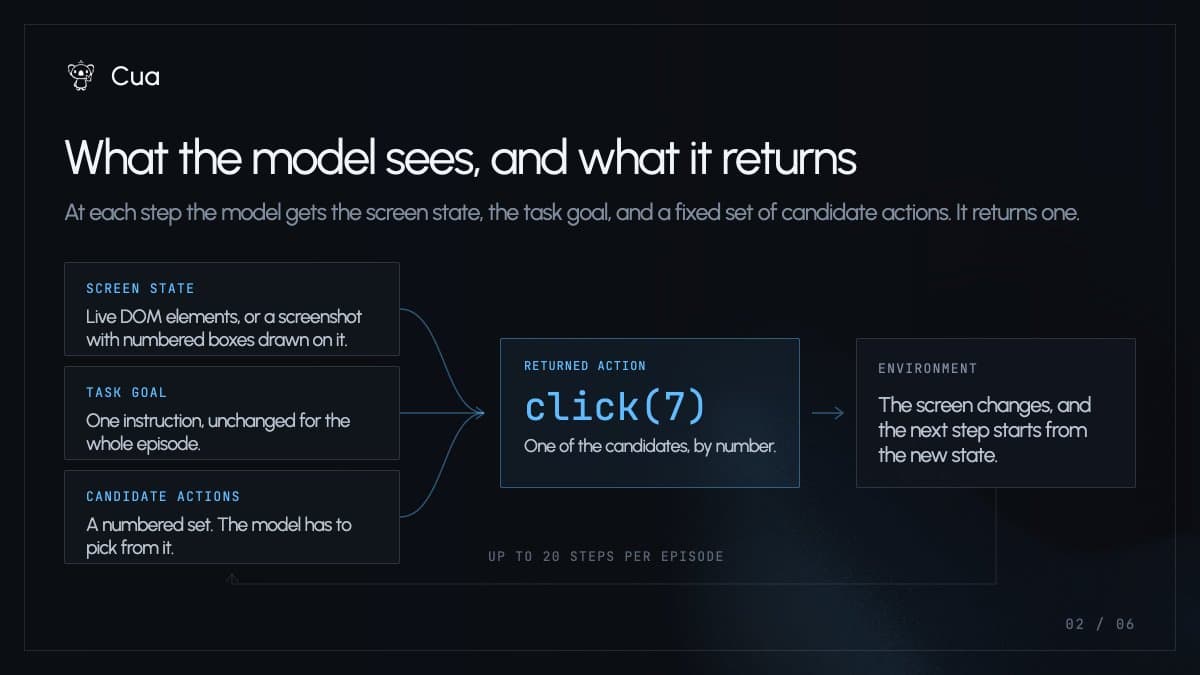
- Each turn is bounded to a screen state, a goal, and a fixed candidate-action set, then the model selects one action, as trycua's action-loop description specifies.
- The training pipeline first teaches that decision format with supervised learning, then runs agentic RL in live environments where completion is the only reward, according to trycua's training recipe.
- Cua reported 92.9% on a frozen 168-task GUI-360 split against 60.1% for untrained djev, a 32.8-point gap in trycua's GUI-360 results.
- Apache-2.0 text and multimodal adapters are available, while trycua's code update says the training code and results have landed in the main project, and its browser demo exposes candidate scores.
The model page keeps text and multimodal adapters separate. Cua's recorded-task viewer walks through mobile and desktop steps and flags whether a choice matches the recorded human action.
Fixed candidate actions
Cua-S1 receives a screen state, task goal, and fixed candidate-action set on every turn. It returns one action, the environment changes, and that new screen state starts the next turn.
Completion comes from a sequence of those state-action calls. The model's command surface is a closed menu per screen state, with the surrounding system supplying candidate UI actions.
An independent release analysis described the early CUA-S1 line as bounded, "System 1" decision models. The interaction contract in the 0.2 release fits that framing.
Supervised learning and RLOO
Cua describes two stages:
- Supervised training teaches the model's input and output decision format.
- Agentic RL runs rollouts in live
cua-bench-basicenvironments, where the environment rewards only a completed task.
The 0.2 model page identifies Qwen/Qwen3.5-4B as the frozen base and exposes separate LoRA adapters for text and multimodal inputs. The adapters carry Apache-2.0 terms; the base model remains governed by Qwen's own license.
GUI-360 and held-out episodes
Cua reported two evaluations:
- On held-out episodes, trycua's episode results reports 17/18 text completions versus 16/18 for zero-shot djev, and 13/18 multimodal completions versus 12/18.
- On a frozen 168-task GUI-360 multimodal split, Cua reported 92.9% for 4B-0.2 versus 60.1% for untrained djev, a 32.8-point difference. Both models used the same inputs and scoring, without an accessibility tree.
The GUI-360 comparison is against an untrained baseline. The episode result covers 18 tasks in each modality.
Cua-Bench-S1
Cua-Bench-S1 is the related offline benchmark for fixed-choice decision models. Its benchmark specification defines each task as one state and one choice from a fixed list, without a planning loop or retries.
Cua's task taxonomy divides the benchmark into four families:
- Interface actions
- Safety decisions about when not to act
- Game control
- Held-out probes: chess, Doom, and JevBench
The same research release includes an approximately 855K-parameter Nano model trained from scratch to score every candidate in one forward pass, plus a Qwen 3.5 4B LoRA that reads text and screenshots to return one choice, per trycua's checkpoint details. Cua's Gen 0 scope draws a hard boundary between the offline Cua-Bench-S1 datasets and the separate live-VM Cua-Bench harness.
Adapters, code, and browser inspection
Cua says the training code and benchmark results are now merged into its main repository, which also houses the broader cross-OS drivers, sandbox, VM, and benchmark stack. The model page says 0.2 remains a separate Cua-S1-family release rather than replacing 0.1.
The browser interface lets users select examples and inspect the model's candidate-action scores. In the step-by-step viewer, recorded desktop and mobile tasks reveal the scores across successive states and whether the selected action matches the human trajectory.