
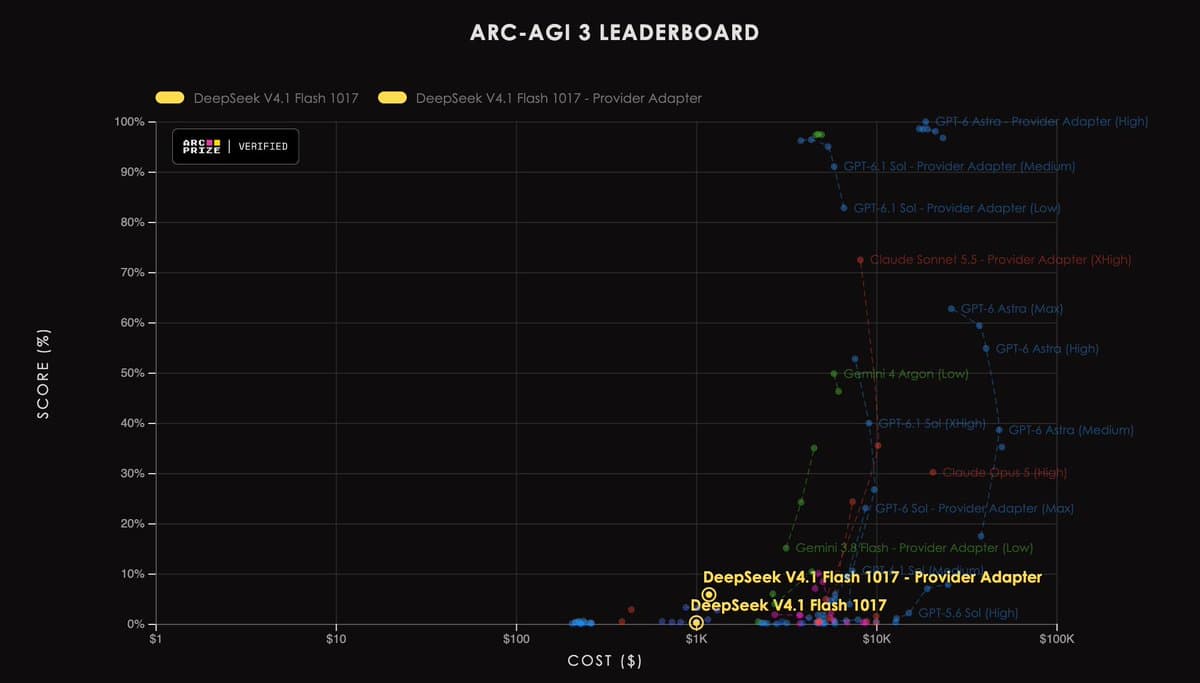
DeepSeek V4.1 Flash 1017 scores 5.81% on ARC-AGI-3 with provider adapter
ARC Prize verified DeepSeek V4.1 Flash 1017 at 5.81% on ARC-AGI-3 with the provider adapter, versus 0.2% with the standard harness. Its semi-private score more than doubled its predecessor’s.
TL;DR
- DeepSeek V4.1 Flash 1017 reached 5.81% on ARC-AGI-3 with the provider adapter, versus 0.2% with the standard harness, in ARC Prize’s verified evaluation.
- Semi-private performance more than doubled, but public performance fell: ARC Prize’s comparison reports 2.68% → 5.81% and 11.05% → 8.97%, respectively.
- First-action reasoning used fewer tokens: ARC Prize measured reductions of 36% on public games and 48.6% on semi-private games.
The public FT09 game score jumped from 4.8% in the original model’s max-reasoning run to 91.4% in 1017, despite the falling public aggregate. ARC Prize’s testing policy also distinguishes model-written notes from opaque reasoning state carried between requests.
Provider adapter
ARC Prize places 1017 first among open-weight models on ARC-AGI-3. Its max-reasoning evaluations cost roughly $1,200 with the provider adapter and $1,000 with the standard harness.
The two harnesses expose different context-management capabilities, according to the official definitions:
- Standard: A minimal, provider-neutral interface that lets the model carry forward notes it chooses to retain.
- Provider Adapter: Provider-designed context management that preserves opaque reasoning state between requests and compacts longer conversations, allowing reuse of prior work.
The harness gap is the bigger engineering result: 5.61 percentage points, versus 3.13 points for the version bump.
Semi-private gains, public regression
The comparison with the September 10 release holds the provider adapter, max reasoning and pricing constant. Both runs used Baseten prices of $0.30 per million input tokens and $1.20 per million output tokens, according to ARC Prize.
- Semi-private: 2.68% → 5.81%, +3.13 percentage points.
- Public: 11.05% → 8.97%, −2.08 percentage points.
The predecessor’s full results put its best provider-adapter score at 3.3% under low reasoning. The headline doubling compares max with max, rather than each version’s best reasoning setting.
First-action reasoning tokens
ARC Prize’s efficiency comparison covers reasoning generated before the first action, at max reasoning with the provider adapter. The averages span 25 public games and 55 semi-private games; they do not measure whole-run token savings.
ARC-AGI-1 and ARC-AGI-2
Higher reasoning effort produced uneven scores on the older benchmarks in the verified results table:
- ARC-AGI-1: High reasoning scored 94.5%, tying the open-weight lead. Max scored 93.5%.
- ARC-AGI-2: Max scored 78.1%, leading open-weight models. Low scored 73.6%, ahead of high at 68.6%.
The ARC-AGI-2 peak is 5.2 percentage points above the predecessor’s 72.9% max-reasoning score.
GPT-6 Sol and Haiku
teortaxesTex compared 1017 with three closed-model reasoning configurations in a post:
- GPT-6 Sol, high: Roughly level with 1017, with both using provider adapters.
- GPT-6 Sol, max: Around 23%, substantially above its high-reasoning result.
- Haiku 5.5, max: Around 2.8%, roughly half 1017’s score.
The cost comparison uses DeepSeek’s peak pricing, which teortaxesTex described as delivering twice Haiku’s score at Haiku’s cost.
Verification and replays
ARC Prize publishes task-by-task replays showing the exact ARC-AGI-3 run, according to its testing policy. Semi-private testing requires zero-data-retention agreements with providers, although the foundation acknowledges possible limited leakage through external APIs.
Each reported score comes from a single run, without averaging across runs, and semi-private evaluations have a $10,000-per-run cap.