
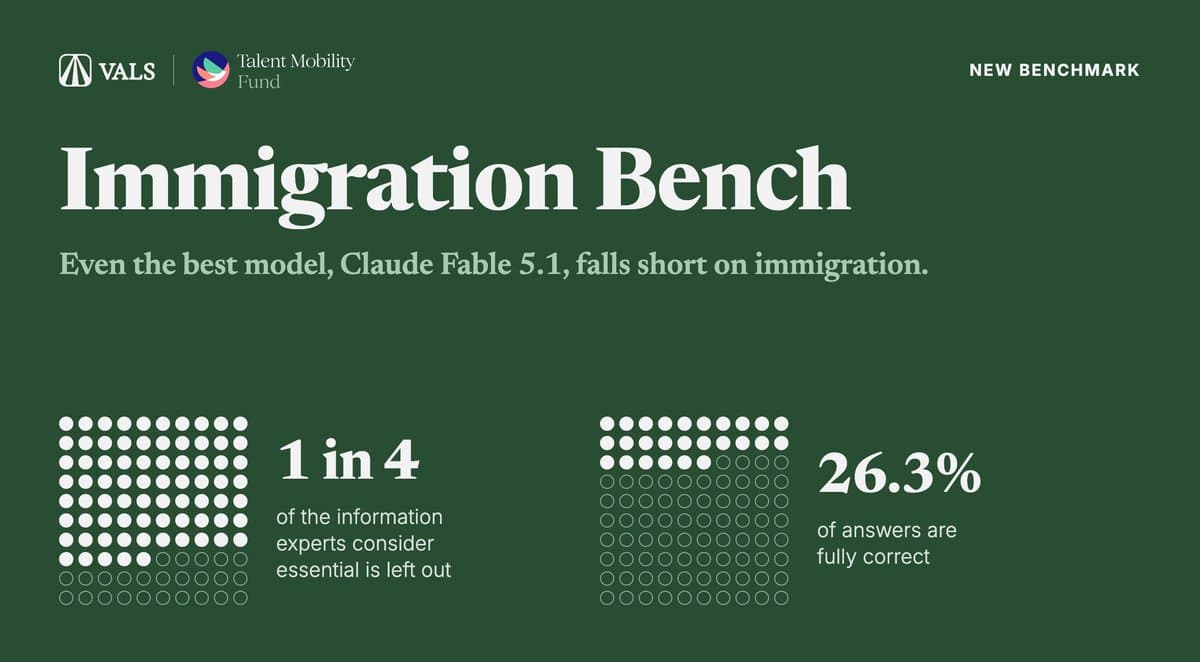
Vals finds Fable 5.1 fully answers 26.3% of 519 immigration questions
Vals tested 25 models on 519 expert-written immigration questions, with Fable 5.1 fully correct 26.3% of the time. Models met just 7.3% of rubric items concerning 2025 and 2026 policy.
TL;DR
- Fable 5.1 satisfied every expert criterion on just 26.3% of immigration questions, according to ValsAI.
- Published results cover 262 private test questions drawn from 519 expert-written scenarios, as ValsAI explains.
- Recent policy was the biggest blind spot: models met 7.3% of criteria concerning 2025 and 2026 rules, versus about 64% for established law in ValsAI's evaluation.
GPT-6 Luna averaged more than 100 web searches per conversation for a 1.8-point gain. Even the winning model lost to another model on 134 of the 262 questions.
Full-credit answers
Claude Fable 5.1 scored 75.4% average rubric coverage, 3.3 percentage points ahead of Claude Opus 5.5 on the official leaderboard.
Partial credit does a lot of work here: that score measures the fraction of required criteria satisfied on each question, averaged across questions. Full-credit rates across the 25 models ranged from 12.6% to 26.3%.
Expert rubrics and simulated users
Vals AI built Immigration Bench with the Talent Mobility Fund, a program of Renaissance Philanthropy. The methodology separates expert-authored requirements from automated conversation grading:
- Dataset: 519 questions, with 262 held private for testing and 257 reserved for labs to license for their own evaluations.
- Expert review: Each question's rubric was cross-reviewed by a second immigration expert.
- Conversations: Models had up to five exchanges with a simulated person, powered by GPT-6 Luna, answering follow-up questions from supplied background facts.
- Grading: Claude Sonnet 5 checked whether each criterion was satisfied anywhere in the transcript. On validation items where two immigration experts agreed, its judgments matched their consensus 88.6% of the time.
Seven user personas
Without web search, average rubric coverage across the 25 models varied sharply by the person asking. The report breaks out seven personas:
- International student: 85.6%.
- International scholar or faculty member: 66.7%.
- University advisor: 48.5%.
- Employer: 64.6%.
- Entrepreneur: 64.2%.
- Self-petitioner: 63.6%.
- Fragile or temporary status: 51.1%.
Fable 5.1 led all seven groups, but reached only 63.9% on questions from people with fragile or temporary status, including Deferred Action for Childhood Arrivals and Temporary Protected Status. University-advisor questions had the longest rubrics, averaging 19.5 criteria each.
Recent policy and web search
The report isolates 65 rubric items citing rules from 2025 or 2026:
- Without search: Models met 7.3% of those items, compared with 64.0% of other criteria.
- Best without search: Fable 5.1 and Claude Opus 5.5 each reached 18.5% on recent-rule items.
- With search: Pooled recent-rule coverage reached about 29%; the best model still remained below 44%.
Employer questions gained 10.4 percentage points with search, the largest improvement by persona. Fable 5.1's overall score gained just 1.2 points.
Fact-finding
Models were better at explaining rules than establishing whether those rules applied to the person asking. Rubric-item completion differed by task in the benchmark results:
- Confirming personal circumstances: 43%.
- Explaining the law or recommending a next step: 63%.
- Items warning against a specific mistake: 86%.
Models that asked questions in their first reply earned about four points more on fact-finding criteria. Their overall scores moved by less than one point, and their legal guidance did not improve.
Best-of-25 upper bound
Vals calculated two hindsight ceilings in the full report:
- Pick the best whole response for each question: About 87% average rubric coverage.
- Combine the best response to each individual criterion: About 92% coverage, with roughly 62% of questions fully correct.
Even the criterion-by-criterion combination covered only about 29% of recent-policy items. Vals cautions that this upper bound also includes items the AI grader incorrectly marked as satisfied.