
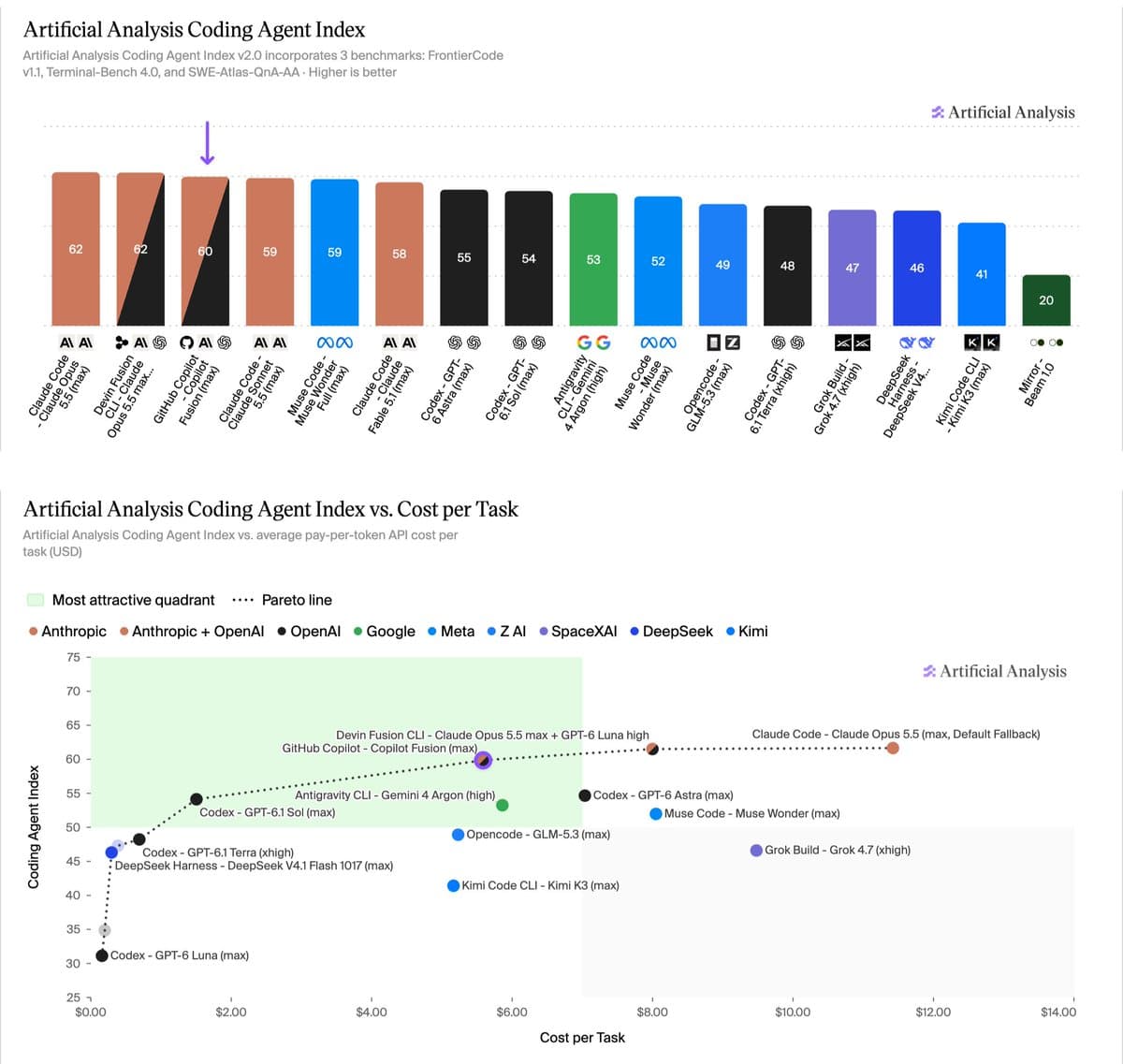
Copilot Fusion scores 60 vs. Claude Code's 62 at half the task cost
Copilot Fusion coordinates Claude and GPT models for coding work. In a GitHub-funded Artificial Analysis test, Fusion Max cost $5.59 per task versus $11.42 for Claude Code.
TL;DR
- Fusion Max scored 60 versus Claude Code’s 62 at $5.59 versus $11.42 per benchmark task, according to the reported comparison.
- Performance varied by workload: Fusion led Terminal-Bench 4.0 but trailed on FrontierCode, as the benchmark breakdown shows.
- Token consumption fell to 7.2 million per task, roughly half Claude Code’s usage, according to the token counts.
A discarded draft can leave its file edits in the workspace. Fusion can also route to locally installed models, and its displayed context window is based on the smallest limits in its model pool.
Benchmark results
Artificial Analysis tested Fusion Max in Copilot CLI, comparing complete agents with different harnesses and model configurations. GitHub funded the evaluation, according to WesRoth.
The comparisons below run from Claude Code with Opus 5.5 Max to Copilot Fusion Max:
- Coding Agent Index: 62 → 60, -2 points, per the reported scores.
- Average API cost per task: $11.42 → $5.59, -$5.83, or 51% lower, according to the reported costs.
Devin Fusion CLI, running Opus 5.5 Max with GPT-6 Luna High, also scored 62. Its $8.00 task cost → Fusion’s $5.59 represents $2.41 less, or 30% lower, in Artificial Analysis’s results.
GitHub additionally reports about 40% less time per task than Claude Code with Opus 5.5 Max. Artificial Analysis defines that metric as active agent wall time, excluding environment startup, verifier time and other harness overhead in its execution-time methodology.
Benchmark limitations
Artificial Analysis gives each benchmark one-third of the composite score under its published scoring rules. Each benchmark score averages three attempts per task.
- Terminal-Bench 4.0: 66 terminal-workflow tasks. Fusion scored 71, a slight lead on the published chart.
- FrontierCode v1.1: 100 software-engineering tasks. Claude Code’s 56 → Fusion’s 51 is -5 points; Devin Fusion’s 54 → 51 is -3 points.
- SWE-Atlas-QnA-AA: 124 technical Q&A tasks. Fusion scored 57, between GPT-6 Astra in Codex and Gemini 4 Argon in Antigravity CLI.
Terminal-Bench and SWE-Atlas-QnA-AA grade attempts pass or fail. FrontierCode awards zero or a score between 70% and 100%, depending on blocking and non-blocking checks, according to the index’s grading rules.
The benchmark explorer includes the component results, costs and token breakdowns, also linked in the original thread.
Single, Cascade and Critique
Fusion chooses models, reasoning effort and an execution pattern for each prompt, according to GitHub’s documentation.
- Single: One model completes the task directly.
- Cascade: An efficient model drafts a solution. A judge accepts it or escalates the task to a stronger model.
- Critique: A model produces a draft, multiple models critique it independently in parallel, and the original model revises using their aggregated feedback.
Follow-up prompts can use different patterns within the same session. The interface exposes each step’s model and progress, while intermediate drafts may be revised or discarded before the final response appears.
Effort levels and availability
GitHub made Fusion generally available on October 28 across all Copilot plans. Supported clients are:
- Visual Studio Code
- Copilot CLI
- GitHub Copilot app
- JetBrains IDEs
Users select among three effort levels; GitHub also documents an internal Fast level in its effort-level table:
- Standard: Selects one model per task, balancing cost, quality and latency.
- High: Adds orchestration for substantial, well-scoped coding tasks, with moderate token savings.
- Max: Prioritizes frontier capability while still considering token efficiency.
- Fast: Used only in VS Code inline chat and not selectable by users.
Administrators can restrict Fusion’s model pool and set its default effort level. Subscription, model-access and compliance policies continue to constrain its choices, under GitHub’s availability rules.
Billing and caching
GitHub bills every underlying model at its standard rate, with no separate Fusion charge.
- Paid Copilot plans receive a 30% discount on model costs through November 30, 2026.
- High and Max can consume more AI credits than Standard because they can invoke multiple models.
- Artificial Analysis’s dollar figures represent pay-per-token API costs, including cache-write charges and cached-input discounts. Subscription pricing and production operating costs are outside that metric.
Fusion keeps the main conversation on the same model where possible to preserve cached tokens; assisting models receive only the context they need. Routing happens at natural cache boundaries or large changes in conversation complexity, according to GitHub’s runtime description.
Workspace limitations
GitHub documents several runtime constraints:
- Discarded drafts leave changes behind: File edits already made in the workspace are not automatically undone when Fusion rejects a draft.
- Subagents run separately: Fusion does not start subagents.
- Context limits belong to individual models: Each step runs within its model’s context window. The displayed Fusion limit is a conservative value based on the smallest limits among its models.
- Routing is mutable: The model pool and execution patterns can change over time.
Local model routing
Local routing is in public preview and limited to Fusion Standard, according to GitHub’s local-model documentation.
- MAI Code 1.1 Flash: Available for local installation on Windows machines meeting its hardware requirements, through Copilot CLI, the Copilot app or VS Code.
- Qwen3.8 Flash Next: Supported locally in Copilot CLI across Windows, macOS and Linux, through a provider such as Ollama. Copilot must identify it as
qwen3.8-flash-next-local.
Copilot CLI exposes the preview through --experimental or /experimental on. The Copilot app has a separate Local model auto routing experimental setting.