
Cognition launched Devin Fusion to cut coding-agent costs
Fusion keeps a lead model in control while routing execution to a cheaper model in Devin CLI. Cognition reported 39% lower benchmark cost, and Artificial Analysis measured 43% lower cost with 31% faster runs at near-frontier scores.
TL;DR
- Fusion ships in Devin Desktop and CLI as a two-model coding harness: the launch announcement describes a frontier lead for planning and review plus a cheaper sidekick for execution.
- Cognition says it evaluated the launch with Artificial Analysis and Vals AI in its evaluation announcement, while its routing explanation says the lead can review delegated work and resume control mid-session.
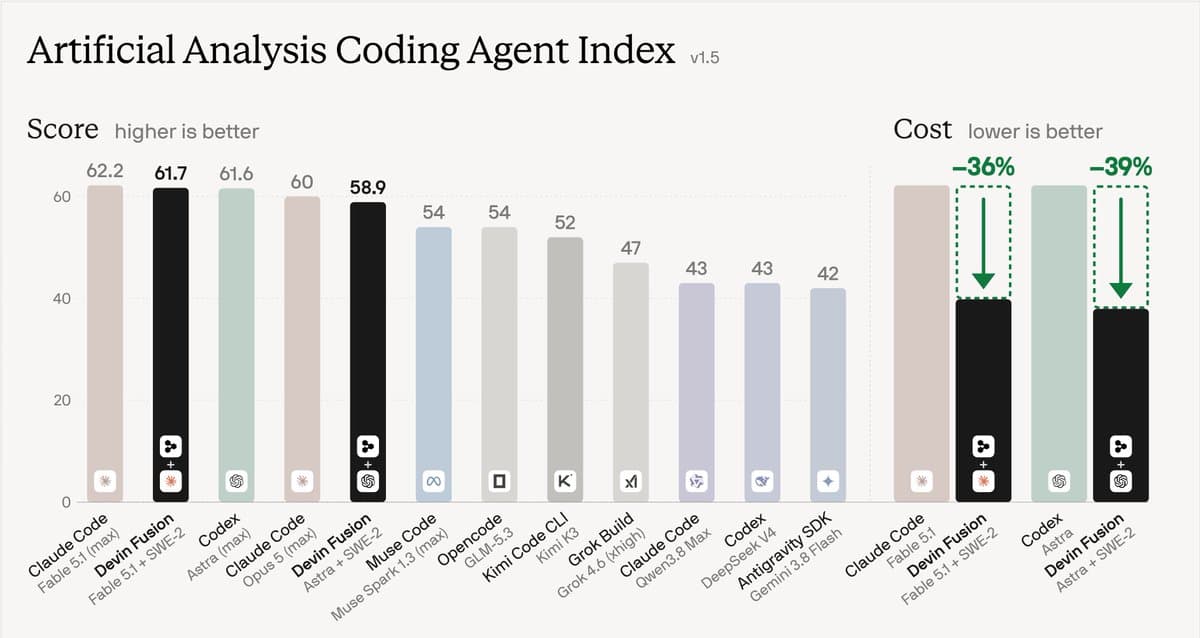
- Artificial Analysis measured the Fable 5.1 plus SWE-2 configuration at 61.7 on its index, 0.5 points behind Fable 5.1 in Claude Code at 62.2, for $7.90 rather than $12.40 per task, according to the independent comparison.
- The Astra plus SWE-2 configuration scored 59 versus 62 for the Fable pairing, but cost 43% less and finished tasks 31% faster in the evaluator's release test.
- The CLI exposes base model, sidekick, speed, and reasoning controls, as dabit3's configuration tour shows.
Fusion's technical breakdown says its agents exchange briefs, results, and feedback instead of full conversation histories, leaving each model with a persistent cacheable context. The same post reports that an Astra Fusion run using SWE-2 at $0.75 per million tokens scored 63.4 for $2.34, while a $0.20-per-million-token Luna sidekick scored 62.0 for $2.39.
Lead and sidekick
Fusion starts two agents with separate tools and persistent contexts. Cognition's technical breakdown assigns the lead the session plan, interpretation of ambiguity, and final review; it assigns the sidekick exploration, implementation, test runs, and a report back to the lead.
The handoff contains three artifacts:
- A task brief with constraints and success criteria
- Results from the delegated work
- Feedback from the lead
Cognition says this arrangement keeps the frontier model in charge throughout the session. In the routing explanation, it says the lead reviews the sidekick's work, flags faults, and can take work back when the delegated task proves harder than expected.
The design targets a routing problem the company identifies in its launch post: a short initial issue description does not reliably reveal task difficulty, and switching models inside a single agent session can invalidate prompt caches. Keeping both contexts alive avoids copying complete tool histories across model boundaries.
Artificial Analysis Coding Agent Index
Artificial Analysis said this was the first multi-model coding agent included in its index. Its methodology builds public results from task-level attempts, then aggregates performance, cost, token-use, and execution-time metrics across the component evaluations.
Its reported comparisons separate two useful configurations:
- Fable 5.1 (xhigh) plus SWE-2 (medium): 61.7 index score versus 62.2 for Fable 5.1 (max, with fallback) in Claude Code. Fusion cost $7.90 per task versus $12.40, a 36% reduction, and took 35.8 minutes versus 34.8.
- Astra (xhigh) plus SWE-2 (medium): 59 index score versus 62 for the Fable Fusion pairing. Artificial Analysis reported 43% lower cost and 31% faster completion for Astra Fusion.
For the Fable comparison, the component scores were 63.1 versus 64.3 on DeepSWE 1.1, 65.9 versus 64.8 on SWE-Atlas QnA, and 56.1 versus 57.6 on Terminal-Bench 4.0. The near-tied composite masks a gain on repository Q&A and declines on the other two components.
Vendor benchmark table
Cognition's benchmark table compares each standalone lead model with its Fusion pairing with SWE-2. Scores and listed dollar cost move together differently by task family:
- DeepSWE 1.1: Fable, 64.3 and $14.63, to Fusion, 63.1 and $7.88, down 46% in cost. Astra, 67.6 and $7.88, to Fusion, 67.3 and $4.69, down 40%.
- Terminal-Bench 4: Fable, 57.6 and $17.46, to 56.1 and $13.37, down 23%. Astra, 55.6 and $10.08, to 50.0 and $6.06, down 40%.
- SWE-Atlas QnA: Fable, 64.8 and $7.57, to 65.9 and $5.00, down 34%. Astra, 61.8 and $5.72, to 59.4 and $3.59, down 37%.
- Vals Code Migration: Fable, 54.6 and $70.97, to 57.3 and $42.00, down 41%. Astra, 67.7 and $44.36, to 61.3 and $35.51, down 20%.
- FrontierCode 1.1 Extended: Fable, 63.6 and $2.68, to 63.5 and $1.67, down 38%. Astra, 63.1 and $2.62, to 63.4 and $2.34, down 11%.
The table has several score regressions alongside the cost reductions, most visibly Astra's 5.6-point Terminal-Bench decline and 6.4-point Vals Code Migration decline. The 39% headline is therefore an aggregate efficiency claim, not score parity on every component.
Pair-specific harness tuning
Cognition says model selection alone does not determine the result. Its technical breakdown describes separate tuning choices for each lead-sidekick pair:
- A weaker sidekick receives a more prescriptive brief from Fable 5.1, spending more lead tokens early to limit later review rounds.
- Stronger sidekicks receive less implementation detail and can be permitted to challenge the lead's instructions.
- Exploration that informs the lead's plan stays with the lead when the sidekick is weak; stronger sidekicks can help with initial exploration.
The Luna and SWE-2 row makes the economic claim concrete. In Astra (high) Fusion on FrontierCode, Luna (high) lists at $0.20 per million tokens and reached 62.0 at $2.39 per task. SWE-2 (medium) lists at $0.75, 275% higher, but reached 63.4 at $2.34. Cognition attributes the lower task cost to fewer turns, fewer tokens, and fewer lead-sidekick correction rounds.
Desktop and CLI controls
Fusion is available in Devin Desktop and CLI, according to Cognition's launch post, which includes a CLI installer command: curl -fsSL https://cli.devin.ai/install.sh | bash.
The configuration menu shown in the launch coverage exposes:
- Base models: Fable, Astra, Sol, or Opus
- Sidekicks: SWE, Luna, Sol, or GLM
- Speed: Normal or Fast
- Reasoning level
The release post calls Fable 5.1 plus SWE-2 its recommended pairing; Cognition introduced SWE-2 the day before Fusion as its own coding model.