
DigitalOcean launches Managed Agents with persistent runtimes in isolated microVMs
DigitalOcean's Managed Agents runs coding harnesses in isolated microVMs that retain workspace and conversation state while paused. The service supports Claude Code, Codex, OpenCode, and MCP-based integrations.
TL;DR
- DigitalOcean opened Managed Agents in public preview, according to its launch post, and omarsar0's launch post names Claude Code and Codex among the harnesses it can run.
- Each agent run gets an isolated microVM and coding sandbox, a design testingcatalog's overview describes as the Harness Runtime.
- Pausing a run retains its workspace and conversation, rather than forcing the next session to reconstruct them, as rohanpaul_ai's description reports.
- The Action Gateway puts 16,000-plus tools behind one MCP endpoint and brokers credentials at execution time, according to testingcatalog's follow-up.
DigitalOcean says a new agent session can reach its first response in under a few seconds in its launch post. The Action Gateway documentation already includes quickstarts for connecting Claude Code or Codex.
Harness Runtime
The runtime adds built-in Chromium alongside the microVM and coding sandbox, according to DigitalOcean's Harness Runtime documentation. Its lifecycle API persists working state and conversational history across sessions.
Pause, resume, fork
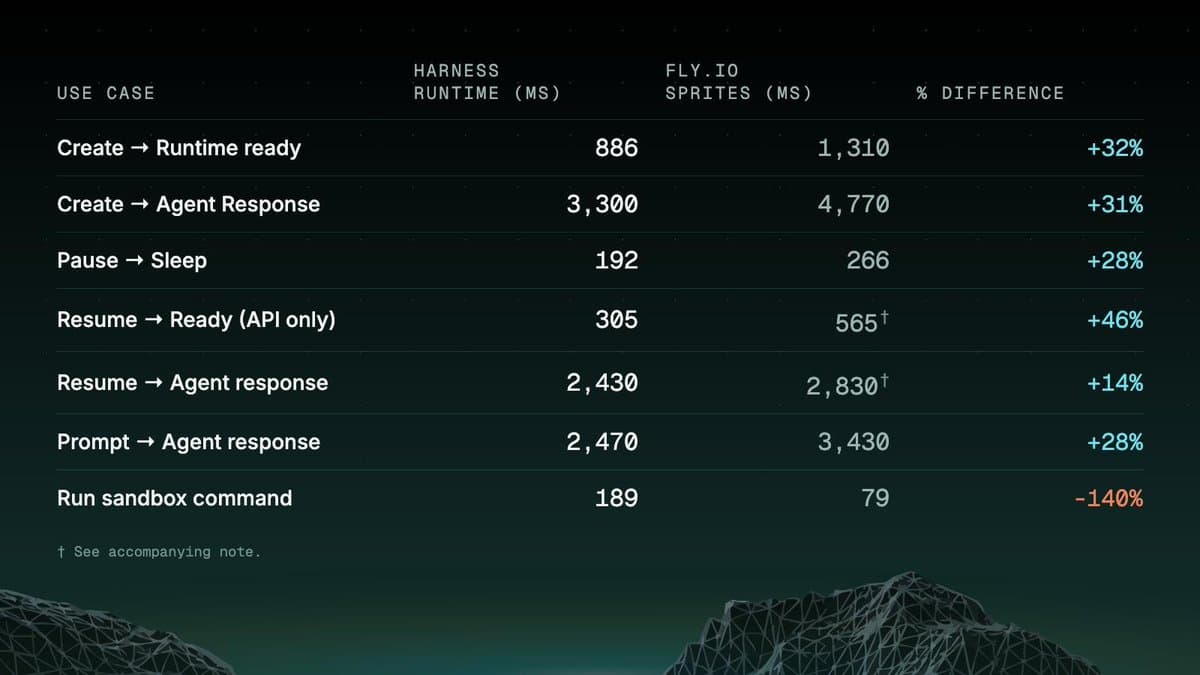
The service makes pause, resume, and fork first-class session operations. A paused session can be resumed from another device with its work intact; DigitalOcean describes the resume path as about 300 ms, while testingcatalog's overview gives the figure as 305 ms.
Active CPU is billed by the second, so paused work stops consuming that metered compute, per the launch post. The model is aimed at agentic runs that alternate between tool execution, human handoffs, and idle time.
Action Gateway
Action Gateway is the managed tool-access layer, exposed as an MCP endpoint or SDK in the official documentation. DigitalOcean says it covers more than 16,000 tools across 500-plus providers and can be extended with an organization's own MCP servers.
Its key separation is credential handling: keys remain in DigitalOcean's secrets service, and the gateway brokers them only when a tool call executes. testingcatalog's follow-up says the tokens are kept out of both the model and the sandbox.
Harnesses and inference
The architecture presents six supported starting points:
- Claude Code
- Codex CLI
- OpenCode
- Hermes
- LangGraph
- OpenAI Agents API
The diagram also connects those harnesses to DigitalOcean's Inference Engine, advertised with 75-plus open and proprietary models, plus storage for artifacts and session state. DigitalOcean's Managed Agents product page describes the two core layers, Harness Runtime and Action Gateway, as public-preview services.
Pricing and preview
Harness Runtime requires a positive prepaid balance, with usage drawn from a team's shared balance and no per-session or per-product spend cap, according to the runtime pricing page.
Action Gateway lists standard SaaS and MCP invocations at $0.10 per 1,000 calls; tool search, credential brokering, policy enforcement, retries, and output handling are included, while code execution and paid tools carry separate charges on the Action Gateway price sheet.