
FastVideo releases a four-bit video generation stack that cuts weights to 30 GiB
FastVideo's FastH3-QAD-v2 and NVFP4 VAE decoders cut weights from 118 to 30 GiB. The team reports generating a five-second 480p clip in 52.7 seconds on one DGX Spark, down from 141 seconds.
TL;DR
- FastH3’s text-to-video stack shrinks from 118 GiB to 30 GiB of weights, according to the team’s announcement, with its text encoder, transformer and video decoder using NVFP4.
- A five-second 480p clip takes 52.7 seconds on one DGX Spark, down from 141 seconds in the team’s timings.
- Two new decoder options offer a quality-speed trade-off: a full-depth 36-layer model and a smaller eight-layer model.
- Community H3 LoRAs run as BF16 side branches alongside the packed four-bit base weights.
The cleverest memory saving is a lookup table that eliminates an entire set of timestep-projection weights from runtime. The checkpoint also keeps sparse-attention gates in BF16 so quantization does not change which video tiles attend to each other.
30 GiB of weights
FastH3-QAD-v2 preserves FastH3 V2’s architecture and file layout. Hao AI Lab’s component accounting gives this breakdown with the 36-layer decoder:
| Component | BF16 baseline | New stack |
| --- | ---: | ---: |
| Transformer linear layers | 39.5 GiB | 11.1 GiB |
| Timestep projections | 24.2 GiB | 0.14 GiB cached outputs |
| Other transformer weights | 1.6 GiB | 1.6 GiB |
| Qwen3-VL text encoder, 50 layers | 48.0 GiB | 15.3 GiB |
| Video decoder | 4.5 GiB | 1.29 GiB |
| Audio VAE | 0.6 GiB | 0.6 GiB |
| Total | 118.3 GiB | 30.0 GiB |
The eight-layer decoder reduces the total to 29.0 GiB. NVFP4 averages approximately 4.5 bits per weight after shared scales; sensitive components, including norms and input/output projections, retain higher precision.
The timestep saving exploits the fixed eight-step sampling schedule: projection outputs are precomputed once into a 155 MB table. These totals describe weights and cached outputs, not peak inference memory.
Hardware placement differs:
- RTX 5090, 32 GB: transformer and decoder remain on the GPU; text-encoder layers stream individually from host memory.
- DGX Spark: the stack stays in its 128 GB unified memory.
DGX Spark and RTX latency
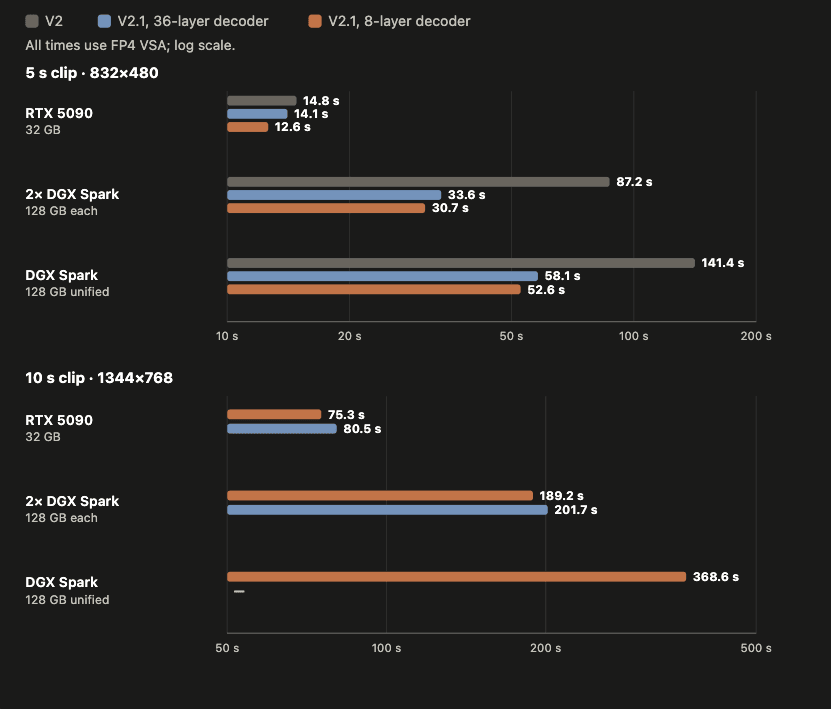
The team’s end-to-end benchmark measures prompt-to-finished-MP4 latency with audio on a warm server, using the median of four runs and excluding model loading. For a five-second, 832×480 clip:
| Hardware | Eight-layer decoder | 36-layer decoder |
| --- | ---: | ---: |
| One DGX Spark | 52.7 s | 58.1 s |
| Two DGX Sparks | 30.7 s | 33.6 s |
| RTX 5090 | 12.6 s | 14.1 s |
Hao AI Lab attributes the gains to four changes:
- FP4 Video Sparse Attention (VSA).
- cuDNN FP4 GEMMs.
- One fewer padding copy.
- Fused decoder kernels.
NVFP4 decoder quality
Both decoders accept the original H3 latents without changing the diffusion transformer or encoder. They were distilled from the original 36-layer H3 decoder using FastH3-generated latents mixed with encoded real video.
Hao AI Lab compared the decoders on 20 held-out clips, split equally between H3 generations and live-action footage, at 1344×768 and 124 frames on one GB200:
| Decoder | Size | PSNR | Decode FPS, eager mode |
| --- | ---: | ---: | ---: |
| Original H3 | 4.5 GiB | 33.73 dB | 17.9 |
| LightVAE-Lite decoder | 1.5 GiB | 31.74 dB | 51.0 |
| NVFP4, 36 layers | 1.29 GiB | 33.63 dB | 70.0 |
| NVFP4, eight layers | 0.31 GiB | 31.73 dB | 274.6 |
The optimized comparison has a wrinkle: LightVAE-Lite reaches 183.7 FPS against the 36-layer decoder’s 104.3 FPS, at lower reconstruction quality. The eight-layer NVFP4 decoder reaches 418 FPS in that configuration.
On DGX Spark, the reported video-decoding stage falls from 43 seconds with the previous lightweight decoder to 1.6 seconds. The new NVFP4 decoders require Blackwell hardware, including RTX 50-series, RTX PRO 6000, DGX Spark or B200/GB200.
QAD training
FastH3 V2 originally used post-training quantization, calibrating activation scales on 1,000 prompts. QAD-v2 adapts the weights through the quantized forward pass, using full-precision V2 as its teacher in the team’s training recipe:
- Quantized layers: all 350 attention and feed-forward linear layers train with deployed four-bit weights and activations.
- Teacher matching: the student learns the teacher’s output at each of eight sampling steps.
- Self-recovery: 25% of samples follow the student’s own trajectory.
- Training budget: 3,000 text prompts, 300 steps, two GB200 nodes and about five hours.
On 30 held-out prompts, per-step video-and-audio error against the full-precision teacher falls from 0.431 to 0.351, a 19% reduction. Final-video error after all eight steps falls from 0.817 to 0.713, a 13% reduction.
The launch reel contains six 10-second, 768p clips generated on two DGX Sparks with synchronized audio and both new decoders.
Community LoRA compatibility
FastVideo loads existing H3 adapters from these layouts:
- ComfyUI.
- fal.
- ai-toolkit.
- musubi-tuner.
The base NVFP4 or FP8 weights stay packed and untouched. Each adapter runs in a small BF16 side branch; strength can change at runtime, and strength zero reproduces the base model exactly.
Adapters matching no layers, or too few layers, fail with a list of unmatched entries. FastH3 Trim remains unsupported because its removed transformer blocks break alignment with full-H3 LoRAs.
Most community adapters target H3’s 50-step schedule, while FastH3 uses eight steps. The team says style and motion adapters usually transfer, although their best strength can differ.
OmniRef preview
Hao AI Lab scheduled FastH3 OmniRef for October 20, promising the general model and BF16 training code alongside a consumer-hardware build. That build is slated to extend the QAD recipe to four-bit attention and use the new NVFP4 decoders.