
MiniMax launches M3.1 Flash at $0.15 per million input tokens
M3.1 Flash costs $0.15 per million input tokens and $0.60 per million output tokens. Artificial Analysis scores it at 42, 13 points above M3, at less than half the cost per task.
TL;DR
- MiniMax M3.1 Flash costs $0.15 per million input tokens, $0.60 for output and $0.015 for cached input, according to the launch announcement.
- Independent launch results improved from M3’s 29 to 42 on the Artificial Analysis Intelligence Index, +13 points, while task cost fell from about $0.51 to $0.22 in the evaluation.
- Knowledge calibration deteriorated: AA’s conditional hallucination rate rose from 18% to 93%, despite higher factual accuracy, according to its detailed results.
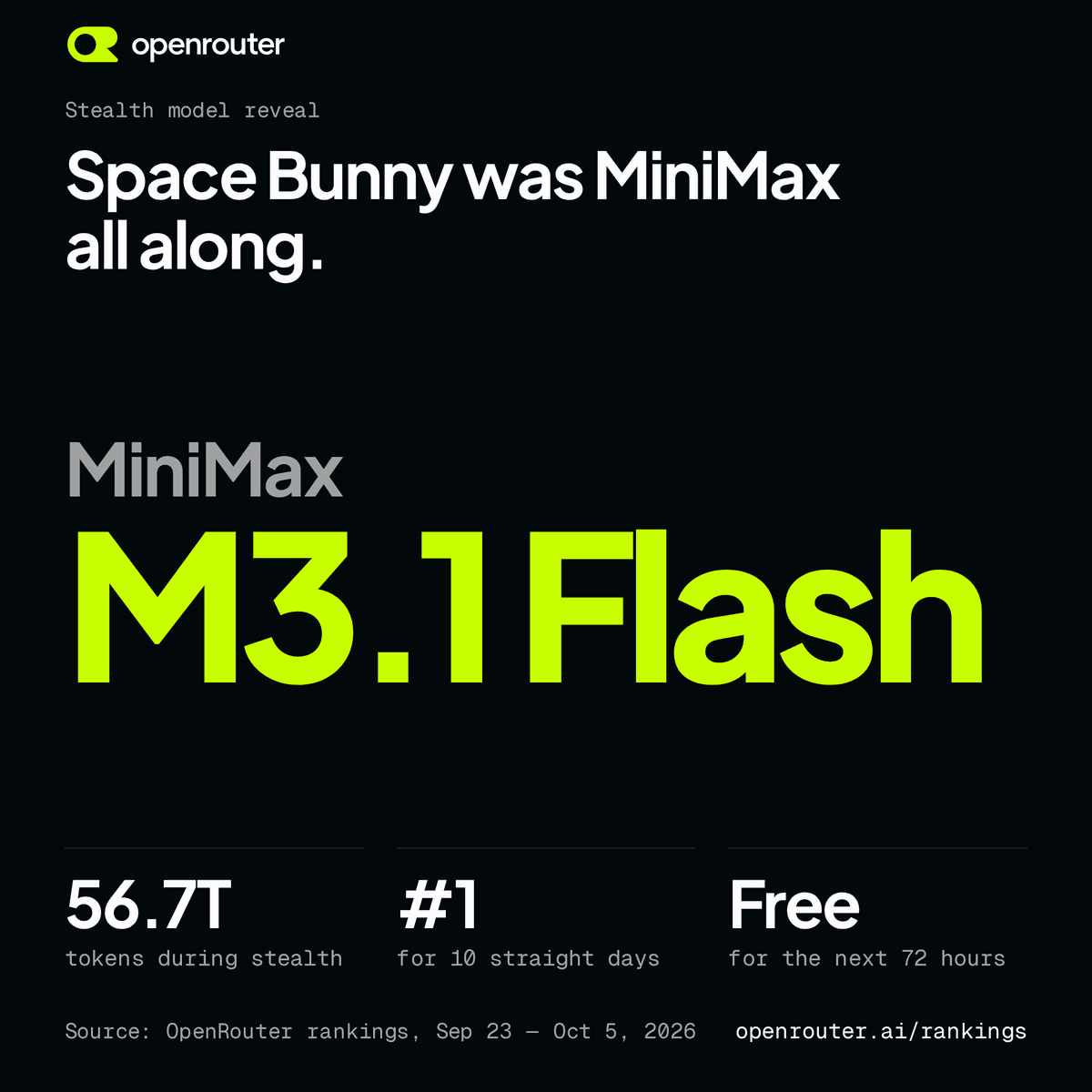
- Space Bunny was an early build of the model. The finished version gets a 72-hour free window on OpenRouter, which announced the reveal.
Requests that disable thinking fail with HTTP 400. Tax and legal evaluations consumed roughly 15 times M3’s output tokens in Vals AI’s tests. The serving work reaches down to Blackwell-specific attention kernels.
Pricing and task cost
MiniMax’s October 19 announcement lists flat token pricing:
| Token type | Price per million |
| --- | ---: |
| Input | $0.15 |
| Output | $0.60 |
| Cached input | $0.015 |
The company claims overall agent-task usage costs are 70% lower than M3. Artificial Analysis measured approximately $0.22 per Intelligence Index task, versus M3’s $0.51, GLM-5.3-Flash’s $0.28 and DeepSeek V4.1 Flash 1017’s $0.26 in its launch cost breakdown.
That AA run generated roughly 189 million output tokens, compared with 324 million for GLM and 224 million for DeepSeek. Those are totals across the evaluation, with all three models tested at maximum effort.
MiniMax’s promotional cost comparison has two pricing wrinkles:
- Peak pricing: The Automation-Bench chart in the launch thread uses DeepSeek’s $0.30/$1.20 peak input/output rates. Its off-peak rates match MiniMax’s, according to one pricing comparison.
- Cache reads: That chart prices DeepSeek cached input at $0.006 per million tokens, making MiniMax’s $0.015 rate 2.5 times higher.
Space Bunny traffic
MiniMax says Space Bunny processed more than 200 trillion tokens globally as an earlier version of M3.1 Flash. The platforms reported separate usage footprints:
- OpenRouter: 56.7 trillion tokens and ten consecutive days at number one, according to its announcement.
- OpenCode: 106 trillion tokens and twelve consecutive days at number one, according to its reveal.
OpenRouter said developer feedback helped MiniMax ship fixes during stealth, with three changes documented in its follow-up:
- Time to first token: 1.95 seconds → 1.22 seconds.
- Output throughput: 70 → 100 tokens per second.
- Error rate: 1.4% → 0.7%.
MiniMax’s launch blog separately advertises output above 200 tokens per second, with median speeds above 170. Those figures describe the vendor’s serving claims; OpenRouter’s measurements cover its stealth deployment.
Coding and automation benchmarks
MiniMax reports 73.7% on DeepSWE v1.1, within 0.3 points of Opus 5, and 62.2% on Automation-Bench v1.0.6, 1.7 points above DeepSeek V4.1 Flash 1017.
Artificial Analysis tested the model at maximum effort and reported these changes over M3 in its launch evaluation:
- Intelligence Index: 29 → 42, +13 points.
- Humanity’s Last Exam: 39% → 48%, +9 points.
- CritPt: 4% → 22%, +18 points.
Its launch score matched GLM-5.3-Flash’s 42 and trailed DeepSeek V4.1 Flash 1017’s 45. AA’s live model page now displays 43, versus 42 in the launch thread.
Other evaluators found substantial coding gains:
- Code Arena: WebDev: 1,482 → 1,588, +106 points. MiniMax moved from number 19 to number 12 among open models, reaching number 32 overall in Arena’s results.
- Terminal-Bench 4: 1% → 25.2%, +24.2 points, in Vals AI’s evaluation.
- Vibe Code Bench: Zero-scoring apps fell from 15 to three; perfect apps increased from six to twelve in the same Vals evaluation.
- Tax Agent calculation questions: 19.4% → 59.9%, +40.5 points, also in Vals’ results.
Hallucinations and regressions
Factual accuracy on AA-Omniscience rose from 17% to 56%, but the model became much more willing to guess. Artificial Analysis reported three accompanying changes in its breakdown:
- Questions attempted: 35% → 98%.
- Hallucination rate: 18% → 93%, a 75-point increase.
- Overall AA-Omniscience Index: 1 → 16.
AA defines the hallucination rate as incorrect answers divided by incorrect answers plus abstentions. The denominator excludes correct answers.
Agentic results also varied sharply in AA’s evaluation:
- AutomationBench-AA: 73%, ahead of DeepSeek’s 67% and GLM’s 60%.
- Terminal-Bench 4.0: 26%, behind DeepSeek’s 34% and GLM’s 33%. MiniMax’s own launch chart reports 38.1% in its separate evaluation.
- GDPval-AA: 1,458 Elo, behind DeepSeek’s 1,746 and GLM’s 1,642.
On Extended Word Connections, M3’s 65.1 score fell to 28.3 for M3.1 Flash at high effort, −36.8 points, in LechMazur’s scoreboard.
Always-on thinking
Omitting the effort setting buys maximum reasoning, a migration gotcha buried in the invocation guide. M3.1 Flash always reasons; M3’s Responses API behavior defaults to reasoning off.
The five supported levels are:
lowmediumhighxhighmax, the default
The request field and response representation differ by protocol:
| Protocol | Effort field | Reasoning output |
| --- | --- | --- |
| Anthropic-compatible | output_config.effort | thinking content blocks |
| OpenAI Chat Completions | reasoning_effort | reasoning_content |
| OpenAI Responses | reasoning.effort | type: "reasoning" output items |
The model supports a one-million-token context window and text, image and video inputs, with text output. Higher effort produces more thinking tokens and higher latency, according to the guide.
API compatibility gaps
Reasoning shares the output budget with the final answer. A small max_output_tokens value can produce status: "incomplete" with no message item, according to the Responses API reference.
The Anthropic SDK documentation requires the complete assistant response to be preserved across tool turns, including thinking, text and tool-use blocks.
That compatibility layer also silently ignores:
top_kstop_sequencesmcp_serverscontext_managementcontainer
Sparse attention kernels
vLLM describes low-precision attention and MoE changes in its serving breakdown:
- Direct KV conversion: NVFP4 KV converts directly to FP8 using CUDA 13.4’s
QMUL4, skipping an FP16 round trip. Reported kernel gains reach 1.7× for indexer QK decode and 1.3× for sparse-attention decode. - Shared-expert fusion: NVFP4 MegaMoE fuses the MXFP8 shared-expert path. Earlier tensor-memory release reduces prefill kernel latency by 20% in the reported settings.
Its long-context and speculative-decoding work adds three separate measurements:
- Context parallelism: Indexer DCP partitions context across GPUs and exchanges local top-16 candidates over NVLink. At 512K context on four GB300s, indexer execution per sparse layer is up to 3.3× faster.
- Projection fusion: Combining QKV projection, normalization, RoPE and KV insertion removes an HBM round trip, reducing median time to first token by approximately 19% on GB300 at tensor parallelism four.
- Draft attention: DSpark uses FlashInfer PrimiTS, reporting 1.3–2× faster draft attention than FlashAttention 4 and 5% lower overall forward time.
vLLM explicitly says these measurements are separate and non-additive. Its published image tags are vllm/vllm-openai:minimax-m31-flash for CUDA and vllm/vllm-openai-rocm:minimax-m31-flash for ROCm.
Day-one access and weights
M3.1 Flash is available through MiniMax’s API, M Plan and MiniMax Code. MiniMax schedules the weight release for October 23 in its announcement.
The launch integrations have different access terms:
| Surface | Launch access |
| --- | --- |
| OpenRouter | Free for 72 hours, per its reveal above. |
| OpenCode | Free for three days, per its announcement above. |
| Cline | Free at launch, according to Cline’s announcement. |
| Ollama Cloud | Free for three days, US-hosted and zero data retention, according to the launch offer. |
| Vercel AI Gateway | Free through October 22 when MiniMax serves the request, according to Vercel’s announcement. |
| Venice | Available anonymously, according to its launch post. |
| GMI Cloud | Available on day one, according to MiniMax’s partner announcement. |
| Command Code | Free for subscribers for a limited time, according to MiniMax’s announcement. |
Vercel’s routing documentation for the launch says the free rate requires sorting MiniMax with the provider order option. Its model slug is minimax/minimax-m3.1-flash; requests served by MiniMax revert to standard pricing after the offer.
Ollama publishes these cloud invocations in its announcement: