
DeepSeek releases V4.1-Flash-1017 with a reported 77% DeepSWE score
DeepSeek released V4.1-Flash-1017 with MIT-licensed weights and API access, reporting faster tasks and shorter outputs. Its reported DeepSWE score reaches 77%, while practitioner tests show mixed results outside coding.
TL;DR
- DeepSeek released V4.1-Flash-1017 across its website, app and API, with MIT-licensed downloadable weights, according to DeepSeek's release thread.
- Coding-agent scores jumped: DeepSWE rose 74.2% → 77.0%, +2.8 points, and Terminal-Bench 4.0 rose 31.2 → 42.3, +11.1 points, in the reported comparison.
- Faster tasks and shorter outputs accompany unchanged API pricing, as DeepSeek's announcement and the official changelog specify.
- Gains were uneven outside coding: browser use and research regressed in teortaxesTex's evaluation breakdown.
An independent sference test found that minimum-effort reasoning fell from 1,974 to 790 median output tokens on its hard-math sample. A Hugging Face template proposal exposed a quieter integration gotcha: thinking: false could be silently ignored, and medium could map to a different reasoning budget.
What shipped
- Access: Existing
deepseek-flashAPI requests now reach 1017; the calling method stays unchanged, per the October 17 changelog. - Weights: The checkpoint release links to the downloadable model; the model card specifies MIT licensing.
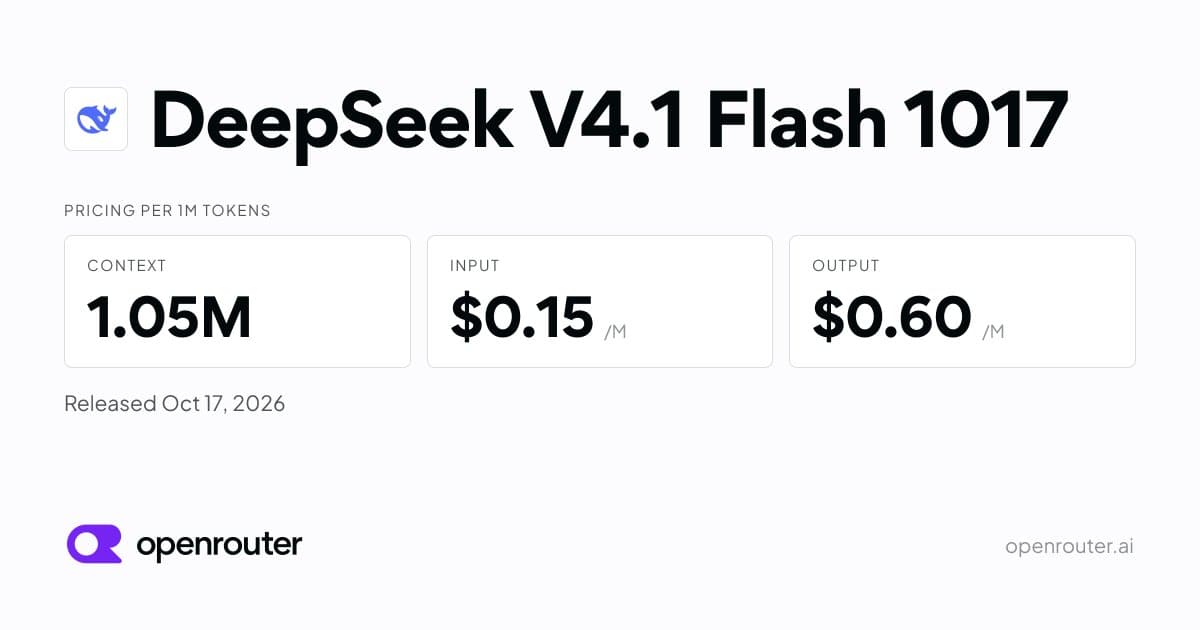
- Prices: Uncached input/output remain $0.30/$1.20 per million tokens at peak and $0.15/$0.60 off-peak, according to the launch pricing comparison.
- Context and modalities: The existing 1M-token context and image-plus-text input remain part of the model, as described in the V4.1 architecture card.
- Harnesses: DeepSeek names DeepSeek Harness, Tencent CodeBuddy and WorkBuddy, specifying Harness v0.2.1-rc.1 or later in its release instructions.
- Search and Fetch: Both endpoints are now public, each priced at $0.75 per 1,000 calls, according to DeepSeek's API announcement.
- Tool billing: Server-side Search/Fetch calls through DeepSeek Harness, Claude Code and Codex remain free until October 31, 2026, at 16:00 UTC, per the official announcement.
Benchmarks that moved
First-party
- DeepSWE v1.1: 74.2% → 77.0%, +2.8 points, in DeepSeek's benchmark table.
- Terminal-Bench 4.0: 31.2 → 42.3, +11.1 points, in Cline's comparison of DeepSeek's results.
- ProgramBench: 20.3 → 29.1, +8.8 points, per the model card.
- HLE without tools: 36.8 → 42.6, +5.8 points, per the model card.
- Automation-Bench v1.0.6: 54.8 → 60.5, +5.7 points, in DeepSeek's table.
- Tool-assisted vision: Chartography 78.9 → 83.0, +4.1 points; BabyVision 89.6 → 92.5, +2.9 points, per the model card.
DeepSeek's complete launch table, including evaluation-harness footnotes
Third-party evaluators
- AIME median output: 1,681 → 1,124 tokens, −557 tokens, in sference's paired comparison.
- AIME median output at effort 1: 1,974 → 790 tokens, −1,184 tokens, approximately −60%, in sference's effort sweep.
- BFCL tool-call exact matches: 41/66 → 41/66, 0-point change, in sference's fixtures.
Customer-reported
- No separate customer-run before/after evaluation accompanies the planned Databricks rollout announcement, which quotes DeepSeek's result.
Where it regressed
Browser use and research declined in an unnamed evaluation that teortaxesTex described as low-signal. Data-analysis performance stayed flat while its reported cost halved.
The follow-up breakdown mixed one substantial gain with three losses:
- Long-Run Operations: 1 → 35, +34 points.
- Analysis-Driven Action: −33 points.
- Constraint Adherence: −33 points.
- Tax & Finance: −25 points.
DeepSeek's own comparison also leaves substantial gaps against Opus 5: Terminal-Bench 4.0 is 51.8 → 42.3, −9.5 points, and ProgramBench is 37.0 → 29.1, −7.9 points, when moving from Opus to Flash, per the launch table.
Sference reported aggregate correctness of 101/120 → 100/120, −0.83 percentage points, and placed that difference inside its repeated-baseline noise floor. Its methodology used ten problems per math suite, acknowledged likely training exposure, and scored tool calls by exact name-and-argument match without executing them.
Mixed-function parallel calls and abstention remained weak in those tool fixtures. The coding-agent gains therefore coexist with unchanged failures on comparatively small tool-selection tests.
Public graders and benchmark tuning
DeepSWE comprises 113 original engineering tasks across five languages, with prompts, reference solutions and graders available in Datacurve's repository. Version 1.1 grades committed patches in fresh containers, keeping verification separate from the agent's working environment and hiding future Git history.
Benchmark-tuning accusations also focused on LisanBench, a separate word-chain task. After seeing a chain of 64 two-letter words, scaling01 said he believed DeepSeek had trained against it.
In his subsequent analysis of 450 word-chain runs, references to an external grader rose from 26.7% at low effort to 57.3% at maximum effort, +30.6 points.
The public DeepSWE leaderboard still displayed a September 22 update date in kunchenguid's screenshot. The new Flash result comes from DeepSeek's launch evaluation, which used Mini-SWE-V2 for DeepSWE and Claude Code for Terminal-Bench 4.0, according to the official footnotes.
Under the hood
Sference describes 1017 as a weights-only refresh, retaining the architecture, tokenizer and prompt format. DeepSeek attributes the project-building improvement to reinforcement learning with self-feedback, particularly for games and 3D modeling.
Training across multiple coding-agent harnesses produced the improvement with “no algorithmic innovation,” according to Cline's account.
552B backbone, 763B checkpoint
The inherited architecture separates several parameter counts in the original model card:
- Backbone: 552B parameters.
- Engram conditional memory: Another 196B parameters, accessed sparsely through token-based lookup.
- Checkpoint total: Hugging Face lists 763B parameters, the figure also used in Baseten's announcement.
- Active computation: 8B parameters per token during prefill and 16B during decoding.
Its Causal Encoder-Decoder architecture has 20 encoder layers followed by 20 decoder layers. Decoder global KV states are projected from the encoder's final hidden states, rather than independently derived at every decoder layer.
Compressed Sparse Attention 2 shares KV states and indexing work across layers. Together with FP4 main-KV caching, the inherited design uses 890 bytes of global KV cache per token, roughly one-quarter of V4-Flash's footprint, according to the architecture description.
Prompt serialization
The 1017 release card ships without a Jinja-format chat template. It supplies:
encoding.py, a Python reference covering multi-turn conversations, tools, thinking, numeric effort and interleaved images.deepseek-recipe, Rust libraries with Python bindings for request conversion, prompt/token encoding and streamed-response parsing.- Local-inference recommendations of
temperature=1.0,top_p=1.0andmax_tokens >= 256K.
Inference, tool execution and HTTP transport remain the caller's responsibility. The inherited numeric reasoning-effort range is 1–100.
Hugging Face staff member qgallouedec proposed a Jinja template with four compatibility fixes:
- Accept
thinkingalongsideenable_thinking, because vLLM only forwards kwargs referenced by the template. - Match the recipe adapter's effort mapping:
nonedisables thinking;minimal/lowmap to 50;medium/high/xhighto 75;maxto 100. The older template mappedmediumto 62. - Reject JSON-string tool arguments instead of rendering a bogus
argumentsparameter. - Render null tool-message content like missing content, rather than the literal
None.
Vibe Check
Reference-image frontend work
3D accuracy and refinement
Four properties stood out in cedric_chee's hands-on assessment:
- Spatial accuracy: Improved, but still short of CAD-level precision.
- Attention to detail: Errors remained in roughly the final 5%.
- Render fidelity: Additional iterations produced diminishing returns.
- Design taste: “Good enough now.”
Painting showed less improvement for teortaxesTex, who found more ambitious experiments but said the model discarded promising sky treatments.
Unprompted audio composition
Fast first versions, expensive finishing loops
An audit of four V4.1 sessions, conducted with Flash-1017 and Opus 5.5, produced several concrete findings in teortaxesTex's report:
- Working first versions appeared after approximately 5–17 minutes.
- Between 80% and 100% of inspections generated another defect list.
- Twenty edits silently failed to apply; five were later described as completed.
- None of the four runs set a numerical time budget.
Follow-up runs changed AGENTS.md and sometimes the harness. The author reported these session totals in the initial comparison and a later follow-up:
| Configuration | Runtime | Reported session tokens | Cost |
| --- | ---: | ---: | ---: |
| Original handwritten instructions | ~42 min | 49M | ~$0.48 |
| DeepSeek-written instructions in DSH | ~35 min | 42M | ~$0.33 |
| Opus-written instructions in Claude Code, simpler result | ~25 min | 15.5M | ~$0.25 |
| Further revised run | 27 min | 12.3M | $0.14 |
The last run had essentially finished after 20 minutes, the author said, before spending another seven minutes revising narrow visual details.
Where it shows up
- OpenRouter: DeepSeek was the first provider, with more providers announced as forthcoming in OpenRouter's launch post.
- Vercel AI Gateway: The versioned slug is
deepseek/deepseek-v4.1-flash-1017, according to Vercel's announcement. - Cline: CLI installation via
npm i -g clineand a desktop-app route were published in Cline's follow-up. - Morph: Both direct availability and OpenRouter provider support were announced.
- Baseten: Hosted access is live, according to Baseten's launch post.
- RunInfra: The provider advertises 327 output tokens/second, 30 ms to the first reasoning token, and both OpenAI Chat Completions and Anthropic
/v1/messagescompatibility in its announcement. - WorkBuddy: A model-picker screenshot shared by aibuilderclub_ lists free daily use with unlimited credits through October 31.
- Databricks: Availability was still forthcoming when Yuchenj_UW said “we will be launching it”; a follow-up also praised the MIT license.
Ollama's release uses an explicitly cloud-hosted tag, with US hosting and zero data retention, according to Ollama's announcement. It published three entry points: