
Agent log audits link unnecessary revisions to token waste, with usage falling to 12.3M
Teortaxes reports that log audits found agents repeatedly tweaking work after completion. Tests with revised Agents.md instructions reduced usage from 49M to 15.5M tokens, with a later run using 12.3M.
TL;DR
- Rewritten
AGENTS.mdfiles cut reported usage from 49M to 15.5M tokens in teortaxesTex's tests, roughly 68% fewer, though he called the leaner result “simpler.” - Four audited sessions reached working versions in roughly 5-17 minutes, but inspections produced fresh defect lists 80-100% of the time, according to his audit.
- A later run used 12.3M tokens and cost $0.14. It still spent seven minutes revising video after Teortaxes considered it finished, he reported in a follow-up.
One agent built sky_lab.py for cloud experiments, then discarded promising ideas, Teortaxes reported. A critic's review also prompted an agent to interrupt rendering for more changes, according to the log analysis.
The revision loop
Teortaxes had V4.1-Flash-1017 and Opus 5.5 audit four V4.1 Flash sessions. He had already described competent preparation and core implementation in under ten minutes, followed by repetitive tweaking, in an earlier hands-on report.
The audit counted how often inspecting an output produced another defect list:
- Vaporcat: 51 of 53 inspections, 96%.
- Pagoda: 34 of 34, 100%.
- SW game: 28 of 35, 80%.
- Image recreation: 52 of 59, 88%.
None of the four runs established a time budget expressed as a number of minutes.
Phantom edits
Agents praised changes that never landed, a particularly daft form of self-review. In the audit's accounting, 20 intended edits failed to apply:
- 5 failures were noticed.
- 10 went unnoticed.
- 5 went unnoticed and were later described as present.
One final review praised a “hot silhouette rim” even though the corresponding rim code was absent.
Missing visual effects also triggered repeated adjustments before the underlying bugs were found:
- Water sparkles and sun path: five adjustments over 3.0 minutes before resolving coordinate and row-indexing problems.
- Pagoda pond: four adjustments over 10.6 minutes; diagnostic recoloring was being reset every frame.
- Wet shoreline band: three adjustments over 3.5 minutes before finding an incorrect
max(lf, 0)whereabs(lf)was needed.
Sky labs and canceled renders
The audit identified three more ways sessions kept reopening work:
- Attention followed image area. The image-recreation run spent 36 steps on seven sky recipe sheets and 29 steps in a “let me finalize” loop. The user pointed out the central idea at step 69.
- Stopping declarations had no force. Agents continued making changes after saying the result was good or that they should stop.
- Critics reopened finished work. An agent interrupted rendering to act on an audit; the analysis judged the resulting output worse.
Seven stopping rules
DeepSeek Harness supplies workspace guidance from user-global and project-level AGENTS.md-compatible files, loading the applicable chain for the first request, according to its instruction-loading documentation.
The audit proposed seven instruction-level controls:
- An explicit finish line: a deliverable, a short yes/no acceptance check with the defining property first, and a budget in minutes.
- Bounded reviews: pass or fail first, followed by at most three improvements visible at delivery size. Crops serve only to locate a known bug.
- Diff-based confirmation: evidence that an edit applied comes from the diff, rather than an apparently changed render.
- Debugging invisible effects: proof that the effect renders and the diagnostic probe took effect precedes increases in strength.
- Three attempts per element: after that, one change of approach, acceptance, or removal, with the defining property taking priority.
- SHIP or BLOCK reviews: one review at a time on the exact artifact, without stopping an active render.
- A deadline cutoff: no new work after three quarters of the budget; after “final,” only build, verify, commit, and report remain.
These were the audit's proposed rules. The comparison post separately identified who wrote each tested instruction file.
49M to 12.3M tokens
Teortaxes compared three AGENTS.md variants, reporting approximate elapsed time, usage, and cost:
- His handwritten file: 42 minutes, 49M tokens, $0.48.
- A file written by DeepSeek in DeepSeek Harness: 35 minutes, 42M tokens, $0.33.
- A file written by Opus 5.5 in Claude Code: 25 minutes, 15.5M tokens, $0.25, with a “simpler” result.
The subsequent update still had a seven-minute tail: Teortaxes considered the work done at 20 minutes, but the run continued to 27 minutes over narrow color changes. Its reported totals were 12.3M tokens and $0.14.
Cached token traffic
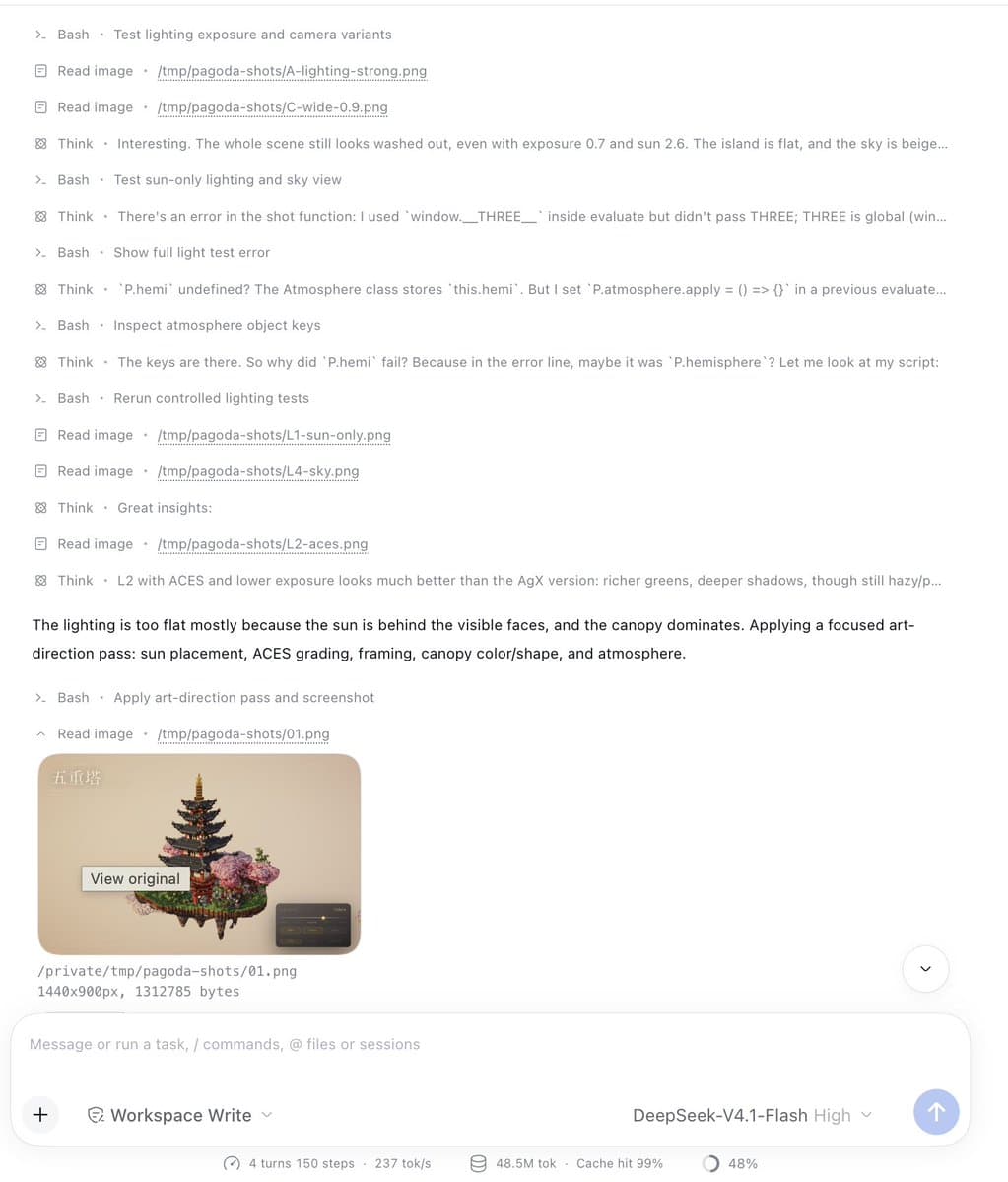
An earlier session screenshot displayed 43.5M tokens with a 99.8% cache-hit rate, alongside the agent's camera and lighting experiments, in Teortaxes's hands-on report.
DeepSeek Harness's token-meter implementation tracks uncached input, output, cache reads, and cache writes separately. DeepSeek's caching documentation distinguishes cached input from freshly generated output and exposes prompt_cache_hit_tokens and prompt_cache_miss_tokens in API usage responses.
The reported session totals therefore include an important accounting distinction: cached input traffic and generated output are separate token categories.