
OpenRouter launches Jev Router for cache-aware model routing
OpenRouter launched Jev Router, which selects a model and reasoning effort per turn while weighing the cost of losing cached context. OpenRouter reports 237 of 423 tasks solved; invalid Jev outputs or timeouts fail without fallback.
TL;DR
- Jev Router selects a downstream model and reasoning effort for each request, according to OpenRouter's launch post.
- Cache retention governs switches: OpenRouter's session policy says the router keeps a working model through the session and changes it only when the expected gain exceeds the cost of discarded cached chat.
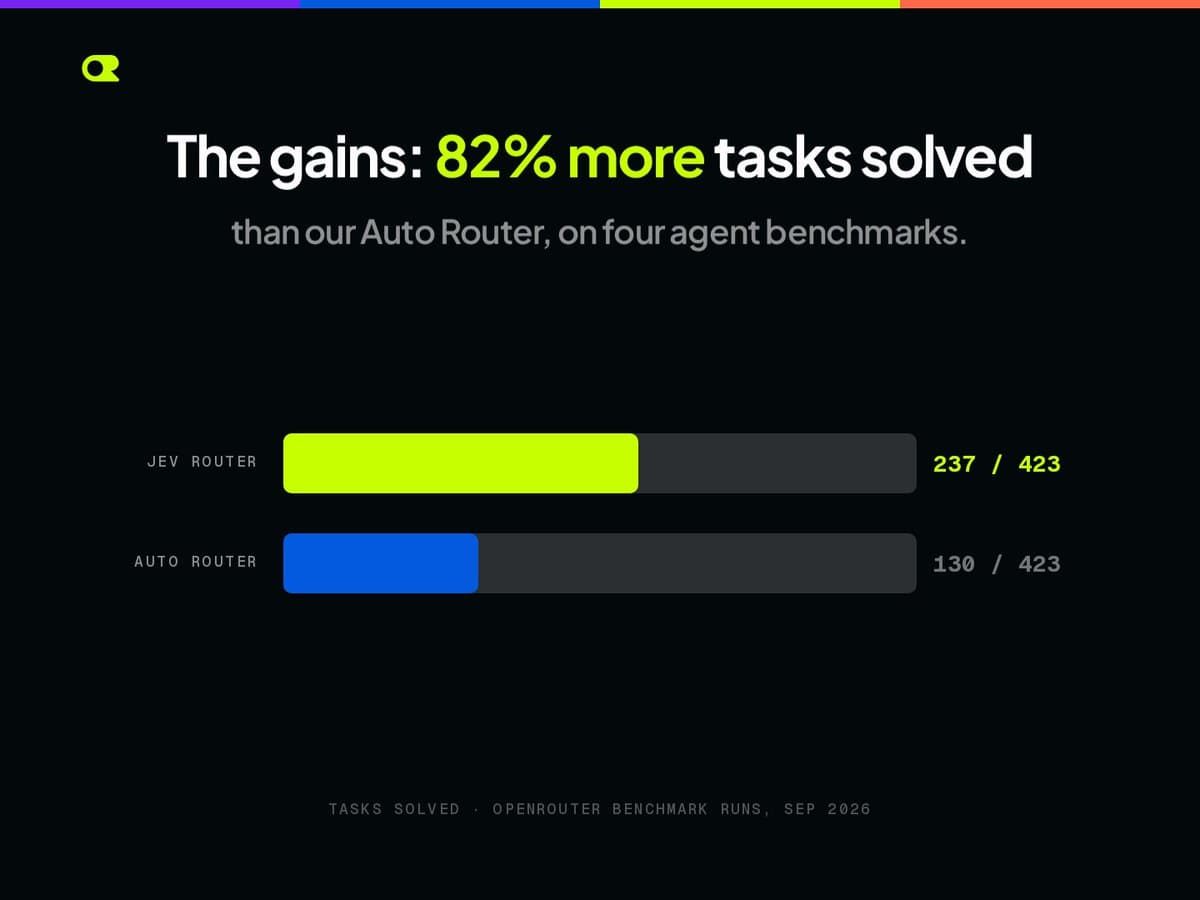
- OpenRouter's four-benchmark result reports 237 of 423 tasks solved versus Auto Router's 130, an 82% relative gain, while its first-token claim says Jev Router led every router tested on median time to first token across five benchmarks.
- Jev reads conversation text under zero-data-retention terms, while OpenRouter's privacy note says attachments are never sent; OpenRouter's failure note says an invalid or timed-out Jev decision fails the request instead of falling back.
The official model card lists a zero token price and a one-million-token context window. In Pydantic AI's TypeSafe integration, each typed output field becomes a Jev question, exposing the decision primitive OpenRouter has put ahead of general-purpose models.
Cache-aware sessions
Jev checks these signals before each turn, according to OpenRouter's scoring description:
- Task difficulty and precision
- Whether a larger model or more reasoning effort would help
- Whether a cheaper model is sufficient
- Whether the task has changed
Rather than changing providers on every message, the router can alter effort without replacing the model. A provider switch occurs only when its expected benefit beats the cached-context cost, as OpenRouter's session policy describes.
Benchmark claims
The success claim covers four agent benchmarks, while the latency claim covers five. OpenRouter's first-token result gives no raw latency figures in the post.
theo called the comparison opaque in his benchmark reply and asked OpenRouter to publish results with no router in the path before he would assess it.
ZDR text-only routing
OpenRouter says Jev receives only conversation text to select a model and effort level. It says that routing call runs under ZDR terms, stores and trains on nothing, omits attachments, and accepts requests marked zdr: true.
Failure semantics
An invalid or timed-out Jev result terminates the request instead of invoking another router, as OpenRouter's failure note states. The typesafe/jev-router response includes metadata explaining the routing choice, making the decision service a hard dependency for each routed turn.
Context limits
Matt Doughty argues in a Prefactor analysis that a bad cheap-model assignment can return HTTP 200 and appear in cost telemetry as a saving, while the answer-quality failure escapes router-level signals.
The central critique from theo is that prompt text cannot reveal the codebase, available tools, or environmental constraints that determine how difficult an agent task will be. theo adds in a follow-up that Jev is limited to 32K tokens of text, has no vision, and cannot request more context.
He also argues in his cost critique that downgrading a model mid-task often saves little because cache writes already account for a large share of cost.
Routing insights
OpenRouter says in its routing-insights post that Chat lists the selected model for each turn alongside task, difficulty, precision, and larger-model-benefit scores. The company directs users to OpenRouter Chat as the public test surface.