
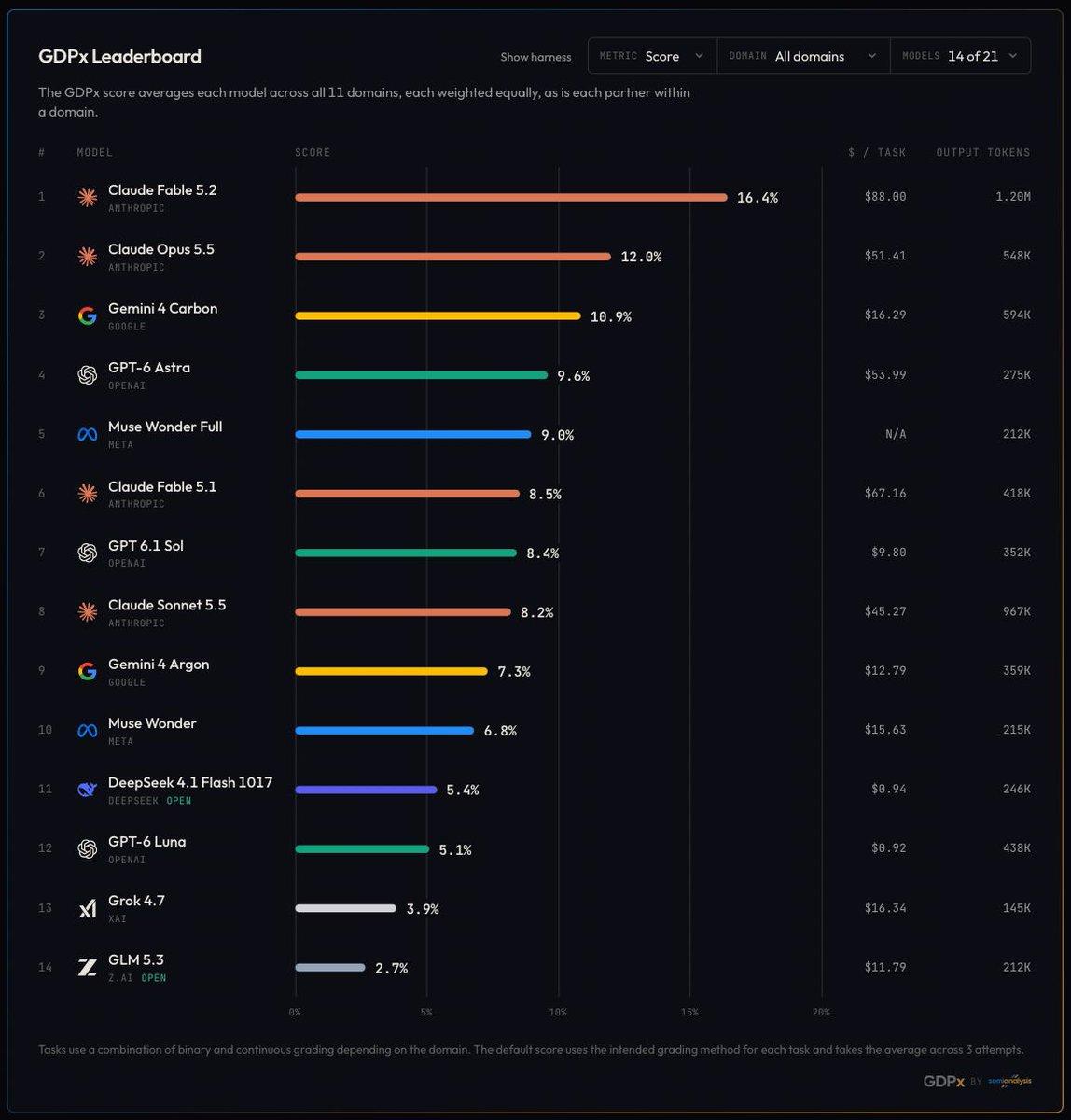
Fable 5.2 ranks first on GDPx at 16.4%
Fable 5.2 leads GDPx at 16.4%, with gains concentrated in chip design and software engineering. SemiAnalysis reports average task costs rose 31% over Fable 5.1.
TL;DR
- Fable 5.2 leads GDPx at 16.4%, according to SemiAnalysis's results.
- Average task cost rose 31% over Fable 5.1 despite 20% cheaper tokens, per SemiAnalysis's comparison.
- More comprehensive self-testing explains most of the improvement, according to SemiAnalysis's rollout analysis.
Fable 5.2 is a token glutton: the GDPx leaderboard lists 1.23 million output tokens per task, against 418,000 for Fable 5.1. It also wrote its own PCB router after deciding that directing KiCad one track at a time would require too much step-by-step guidance.
GDPx scoring
At 16.4%, Fable 5.2 leads Opus 5.5 (12.0%) by 4.4 percentage points and Fable 5.1 (8.5%) by 7.9 points on the leaderboard.
GDPx comprises 206 tasks from 14 partners, and SemiAnalysis publishes examples of the tasks. Its scoring rules give equal weight to each of 11 domains and to each partner within a domain.
Tasks use binary or continuous grading depending on the domain, and the default score averages three attempts.
Chip design and software engineering
SemiAnalysis reports these improvements over Opus 5.5 in its domain breakdown:
- Chip design: +10.8%.
- Software engineering: +15.5%.
- Biology: +7.7%.
- Materials science: +5.3%.
The gains did not extend to finance, legal, quantitative trading or hardware design, according to dylan522p's summary.
Tests and subagents
After examining the rollouts, SemiAnalysis identified two recurring behaviors:
- Larger test suites: Hundreds or thousands of test cases, versus roughly 20 for Opus 5.5 and Fable 5.1.
- Independent checks: More frequent subagent launches for re-derivation and auditing.
Task costs
Average GDPx task cost increased from $67.16 to $88.15, a $20.99 rise. Anthropic's launch announcement lists the new standard API prices at $8 per million input tokens and $40 per million output tokens.
Per-task costs were roughly unchanged in addyosmani's testing, where additional token use absorbed the price cut.
AI research limits
On GDPx's recursive self-improvement (RSI) tasks, Fable 5.2 scored about level with Sonnet 5.5.
Anthropic's safeguards text says training-time limits left both Fable 5.2 and Mythos 5.2 around Opus 5.5-level performance in two areas:
- Accelerator kernel optimization.
- Improving large language model architectures.
Anthropic's stated AI-research restrictions
Separately, kernel and LLM-optimization requests frequently triggered refusals in omarsar0's testing, including with Opus 5.5.
Circuit-board prototypes
In Anthropic's electronics experiment, circuit-board manufacturer Diode Computers built three prototypes from Fable 5.2's designs:
- A USB-C and Bluetooth speakerphone.
- A home voice-assistant hub.
- A handheld virtual pet.
The voice-assistant hub built from Fable 5.2's designs
Each board was ready for manufacture in under a day, and all three devices worked without modifications, according to the project's update.
On Diode's internal PCB Gym benchmark, Fable 5.2 scored 69%, up from 25% for Fable 5, a 44-point gain, according to Anthropic's report. The report says the prototypes' long-term durability and ability to pass commercial certifications remain unknown.