
OpenRouter reports agents consumed 76% of October tokens
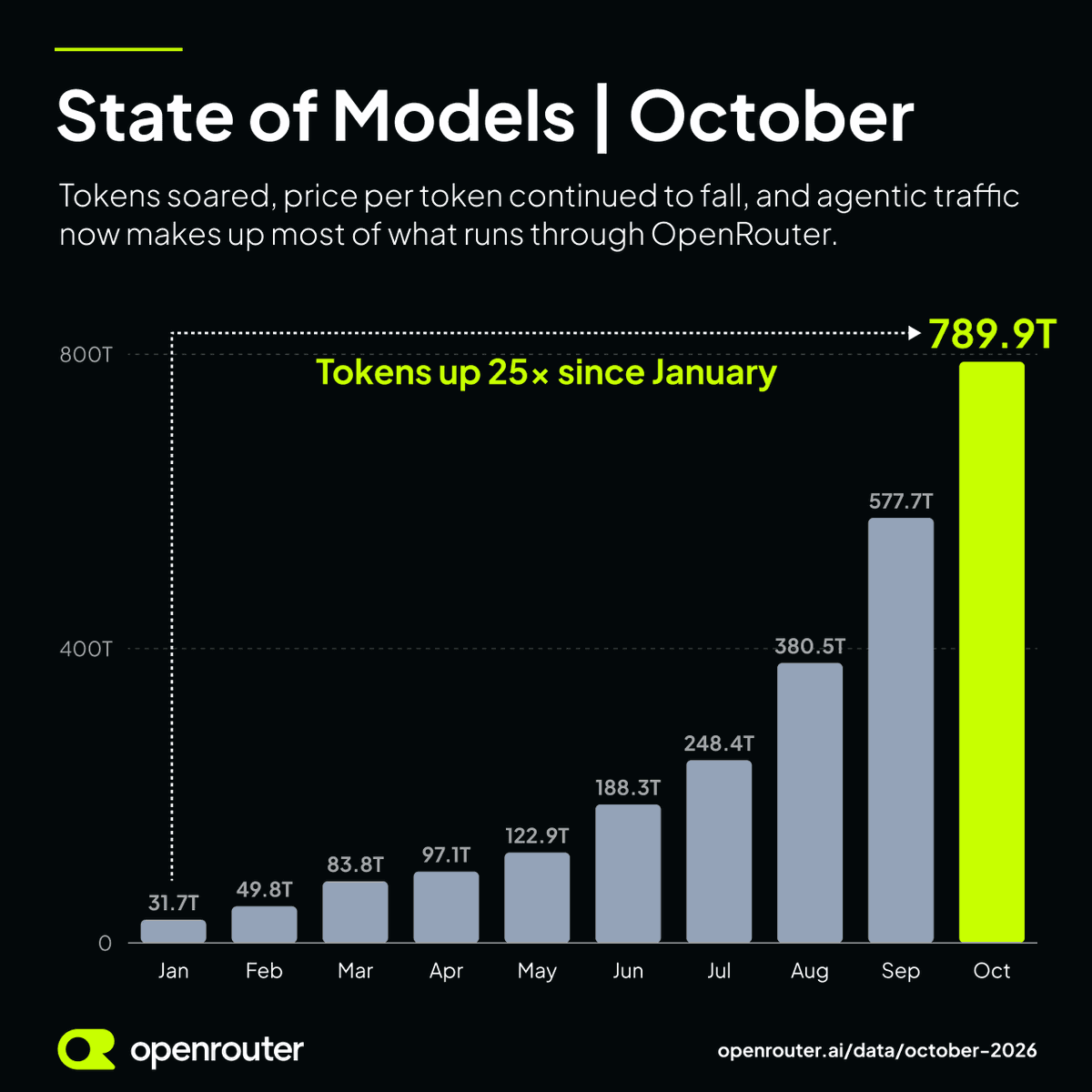
OpenRouter reports that agents consumed roughly 600T of its 790T October tokens. Agent cache hit rates exceeded 90%, while effective token prices fell 57–70% from January.
TL;DR
- Agentic API keys consumed roughly 600T tokens in October, 76% of OpenRouter's total, according to OpenRouter.
- Median provider cache hit rates on agentic traffic exceeded 90%, up from 76.1% in June, in OpenRouter's cache data.
- Effective token prices fell 57% for closed weights and 70% for open weights since January, widening their price gap to 6.2× in OpenRouter's comparison.
OpenRouter's October 8 analysis already had agentic keys consuming seven times as many tokens as human keys in late September. October's cache chart is the sleeper hit: most providers reused cached prefixes for 85–97% of agentic prompt tokens.
Agentic traffic and seven classification signals
October token volume rose 37% from September. These figures cover traffic through OpenRouter, with tokens counted as prompt plus completion tokens.
OpenRouter classifies each API key monthly using seven weighted signals, according to its methodology:
- Tool-call rate
- Input-to-output ratio
- Turns per request
- Cache hit rate
- Tools offered per request
- Time between requests
- Cancel rate
A score of at least 0.50 puts a key in the agentic category. Lower-scoring keys fall into mixed or human groups, so the 76% figure measures traffic from behaviorally classified keys.
Prompt caching above 90%
Cache hit rate measures cached prompt tokens divided by prompt tokens. The provider chart includes endpoints serving at least 1T agentic tokens with a hit rate of at least 50%, and excludes bring-your-own-key traffic and stealth models.
The year's starting median was in the mid-60s, according to an earlier OpenRouter update. Agents repeatedly resend extensive context, giving providers a large reusable prompt prefix.
OpenRouter's caching documentation describes automatic sticky routing: follow-up requests for the same model stay with the provider that served the cached request. Stickiness activates only when that provider's cache-read price is lower than its ordinary prompt price.
Effective token prices
Both model categories became cheaper per counted token in OpenRouter's price comparison:
- Closed weights: $1.21 → $0.52 per million tokens, down approximately 57% since January.
- Open weights: $0.28 → $0.084 per million tokens, down 70%.
- Closed/open price ratio: 4.3× → 6.2×.
Effective price is billed usage divided by prompt plus completion tokens. The recap attributes changes to model mix and cache hit rates as well as list prices; its calculation excludes free variants, BYOK, stealth models and non-chat APIs.
August supplies a concrete example: most of that month's closed-weight price drop came from a mix shift toward GPT-5.6 Luna, priced at about $0.07 per million tokens, after it became the most-used paid closed model.
Open-weight share and lab growth
Open weights accounted for roughly a quarter of paid spend in October, up from 11% in January. Their token share rebounded much more sharply after the late-September closed-model launches.
Growth since May diverged between token volume and billed spend in OpenRouter's full recap:
- Z.ai: monthly tokens grew about 20×; spend grew about 6×.
- DeepSeek: monthly tokens grew about 12×.
- Anthropic: monthly spend rose 76%.
- MiniMax: monthly spend fell 20% despite substantial token growth.
Task leaders by tokens and spend
DeepSeek and Claude led different usage rankings in OpenRouter's task breakdown:
- Coding and agent tokens: DeepSeek V4.1 Flash led most tasks.
- Spend: Claude Opus 5.5 led most of the board.
- Data extraction and transformation: Jev 1.13 and GLM 5.3 Flash also featured prominently.
The task chart reports sample-weighted shares of usage. DeepSeek V4.1 Flash took 23% of code-generation tokens and 24% of shell-execution tokens; MiMo V2.6 Flash led memory extraction with 17%.
Lab retention
Accounts qualified for the September cohort after sending at least 100 paid requests to a lab. A single paid request to that same lab in October counted as retention under OpenRouter's definition; banned accounts were excluded.
Decision models reach 21% of requests
Decision models answer narrow questions, such as moderation judgments, through a dedicated decisions API. Their shares of tokens and spend were substantially smaller than their request share, according to the recap.
The comparison's “text models” category covers all chat-completions requests, including those with image inputs.
Together leads open-weight serving volume
Together took first place by tokens served in OpenRouter's open-weight provider rankings:
- Together: 18th in June → first in October.
- DeepSeek: ninth in September → second in October, following V4.1 Flash.
- InferenceNet: entered the top ten at fourth.
The provider ranking covers open-weight traffic routed through OpenRouter and excludes BYOK and stealth endpoints.