
Firecrawl adds Question format to /scrape with grounded answers and 100x fewer tokens
Firecrawl introduced a /scrape mode that answers a question directly from a URL instead of returning chunks for a separate retrieval loop. It targets docs and pricing pages, and teams should use it when they want grounded answers with lower token usage.
TL;DR
- Firecrawl added a new Question format to
/scrapethat lets you pass a URL plus a natural-language question and get back what it describes as a grounded answer, according to firecrawl's launch post and the linked Question format docs. - In firecrawl's thread, the pitch is to skip the usual scrape, chunk, embed, retrieve pipeline and ask docs or pricing pages direct questions instead.
- Firecrawl claims the mode can return answers with up to 100x fewer tokens than stuffing page content into context, per firecrawl's launch post.
- The examples in firecrawl's thread center on operational lookups like API rate limits, plan details, and support SLAs, which makes the feature look more like a web-native extraction primitive than a generic summarizer.
- A day earlier, firecrawl's PHP SDK launch showed the same question-answering flow inside a new PHP and Laravel package, with setup in the PHP SDK docs.
You can jump straight to the Question format docs, watch firecrawl's demo video answer a page-level question, and see the same pattern appear in the new PHP SDK docs. The notable bit is the product boundary: Firecrawl is packaging retrieval as a single scrape-time query instead of handing you raw page content and making your agent do the rest.
Question format
Firecrawl's new format changes the /scrape response from page content to answer extraction. The launch copy says you ask any web page a question and get a grounded answer back, with the company explicitly framing it as a way to reduce hallucinations and context bloat.
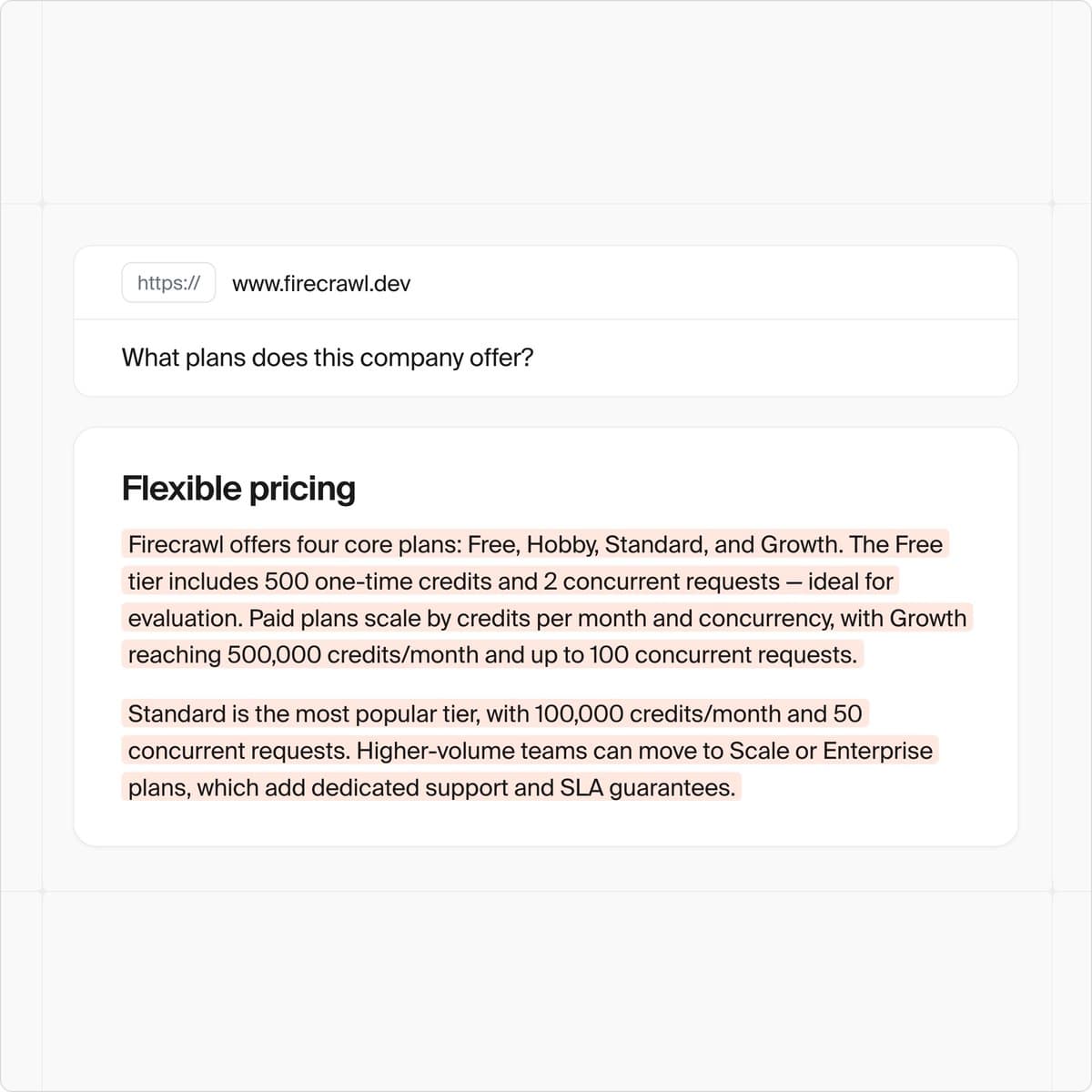
The attached demo in firecrawl's demo video shows the flow as a single prompt over one URL, then a bulleted answer. The public docs live at Question format docs.
Retrieval loop
Firecrawl spelled out the workflow it wants to replace in its thread: scrape, chunk, embed, retrieve. The replacement is narrower and cleaner: pass a URL, ask a question, get back an answer tied to that page.
The concrete examples in the thread are all lookup tasks:
- "What's the rate limit?" from API docs
- "What plans does this company offer?" from pricing pages
- "What's the support SLA?" from a vendor site
That scope matters. Firecrawl is not pitching a broad agent memory system here. It is shipping a shortcut for cases where the answer is already on one page and the overhead of a retrieval stack is mostly ceremony.
Token budget
The loudest claim in the launch post is up to 100x fewer tokens. Firecrawl ties that savings to not returning a full scrape payload or feeding large chunks into downstream model context.
The tradeoff is implied by the product shape. This mode is strongest when the source page already contains a specific answerable fact pattern, not when you need multi-page synthesis or your own custom retrieval logic.
PHP SDK
The PHP SDK shipped one day before the Question format announcement, and Firecrawl's launch video for that package already flashes a "Question Format" step alongside scraping and search. The package targets PHP 8.1+ and Laravel, and the PHP SDK docs document Composer install, facade support, config publishing, and environment-based client setup.
That makes the feature less of a one-off API flourish. Firecrawl is wiring the same scrape-then-answer pattern into its language SDK surface, including the part of the stack that still lives in PHP shops.