
Anthropic launches Claude Managed Agents with Dreaming, Outcomes, and multiagent orchestration
Anthropic added Dreaming in research preview plus public-beta Outcomes, multiagent orchestration, and webhooks to Claude Managed Agents. Teams should try the new grader loops and shared-container sub-agents if they want more control over long-running agent work.
TL;DR
- Anthropic added four new Claude Managed Agents features at once: Dreaming in research preview, plus public-beta Outcomes, multiagent orchestration, and webhooks, according to claudeai's launch post and claudeai's availability note.
- The most concrete systems change is that a lead agent can now delegate work to specialist subagents in parallel, and WesRoth's breakdown says those subagents keep isolated context windows while sharing one container and filesystem.
- Outcomes turns agent runs into a rubric loop: as claudeai's Outcomes post describes it, you define the quality bar, a separate grader checks the result, and the agent keeps iterating until it passes.
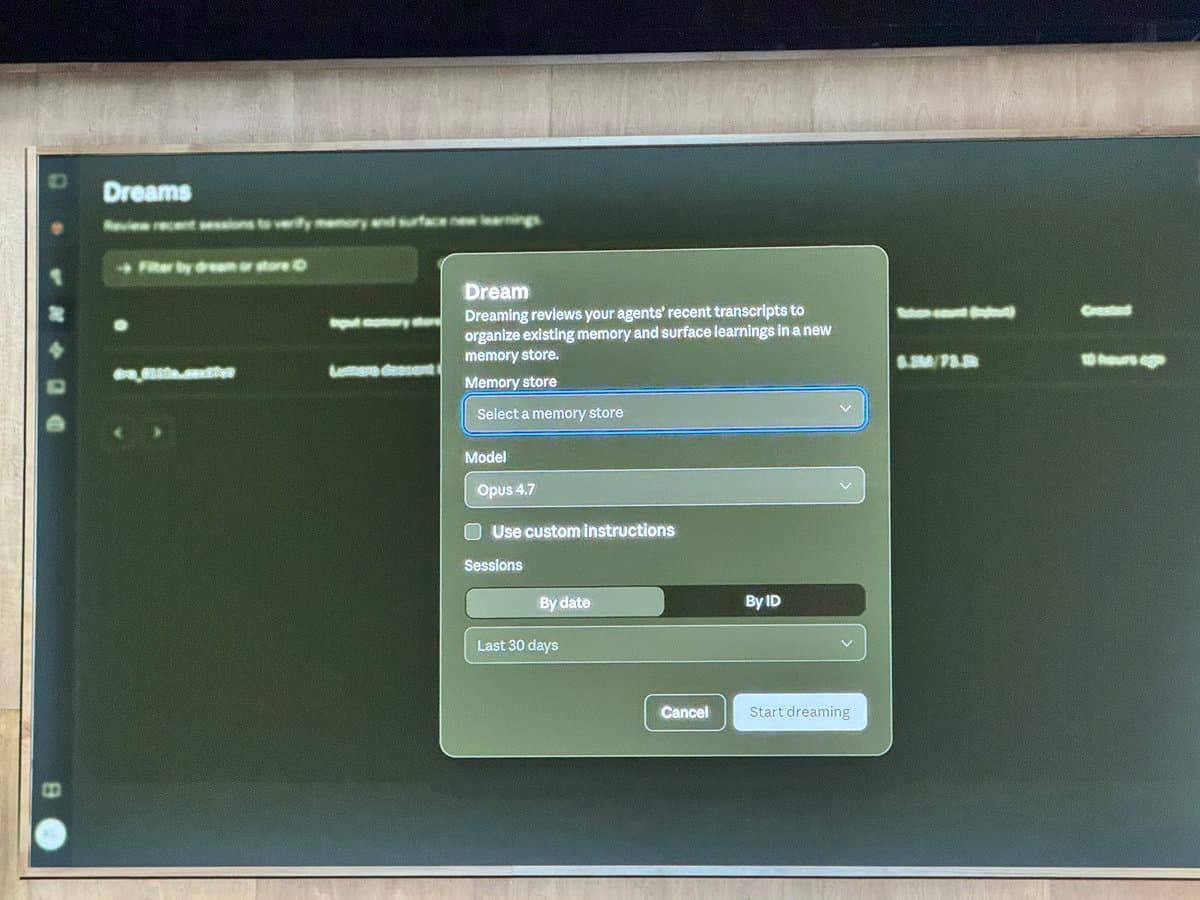
- Dreaming pushes memory curation into a background job. claudeai's Dreaming post says it reviews past sessions, extracts patterns, and curates memories over time, while latentspacepod's event notes compared it to the Dreaming feature Anthropic already shipped in Claude Code.
- The bigger pattern is Anthropic packaging agent infrastructure, not just model access: claudeai's orchestration demo showed a session timeline with delegated workers, and claudeai's finance templates post tied the same managed-agent stack to prebuilt finance workflows.
You can read Anthropic's launch post, jump straight to the Dreaming docs, and the screenshots are unusually revealing: claudeai's orchestration demo shows a lead agent handing work to three named subagents inside one run, claudeai's Dreaming UI screenshot shows Dreaming operating on named memory stores with a selectable model, and latentspacepod's Outcomes note spotted a dashboard UI around the grader loop.
What shipped
Anthropic split the release into one preview feature and three beta features. The official breakdown in claudeai's launch post and claudeai's Outcomes post is:
- Dreaming: research preview, request-access flow, aimed at extracting patterns from prior sessions and curating memory.
- Outcomes: public beta, rubric-driven iteration with a separate grader agent.
- Multiagent orchestration: public beta, one lead agent delegating to specialists in parallel.
- Webhooks: public beta, completion notifications instead of polling.
Anthropic said the features are available on the Claude Platform in claudeai's follow-up post. The official docs and blog links surfaced immediately in testingcatalog's docs-link post and Anthropic's launch post.
Multiagent orchestration
The orchestration demo is the sharpest evidence in the whole drop. In claudeai's orchestration demo, the transcript shows one orchestrator unzipping data, preparing CSVs, then handing work to three subagents named reporter, analyst, and forecaster.
That same screenshot matters because it exposes the shape of the run: one long-lived session, a timeline view, delegated workers, and shared execution state visible in one UI. latentspacepod's event notes summarized the onstage pattern as "spin up 3 agents, nominate one to be coordinator," while WesRoth's breakdown added the implementation detail that the agents keep separate context windows but coordinate through a shared container and filesystem.
Elie Bakouch argued in eliebakouch's reaction that delegation and grader loops both help preserve the main agent's context window on long-horizon jobs. That read lines up with the product framing, but the product evidence is already concrete enough: Anthropic is moving from a single-worker agent to a small managed team.
Outcomes
Outcomes formalizes the "LLM judge" pattern into the managed-agents product. claudeai's Outcomes post describes a loop where you write the rubric, a separate grader checks the output, and the agent iterates until it clears the bar.
Two details stand out in the evidence:
- The grader is explicitly separate from the worker agent in claudeai's official description.
- The product has a dashboard UI, according to latentspacepod's event notes.
- Anthropic paired Outcomes with webhooks, so long-running rubric loops can finish asynchronously and notify on completion, per claudeai's Outcomes post.
That makes Outcomes less like a prompt tweak and more like a built-in evaluation harness around a managed run.
Dreaming
Dreaming is the only part of the release still gated as a research preview. Anthropic's description in claudeai's Dreaming post is concise: review past sessions, extract patterns, and curate memories so agents learn over time.
The screenshot adds more than the copy. It shows Dreaming operating against named memory stores, including support-agent-memory, workspace-knowledge, and user-preferences, and it exposes controls for selecting sessions by date or explicit session IDs. The same UI also shows a model selector set to Opus 4.7 in claudeai's Dreaming UI screenshot.
Latent Space's live notes in latentspacepod's Dreaming note called it "the same thing as shipped in claude code" and said the demo paired it with Outcomes for automatic hill climbing. That is the most interesting product connection in the evidence pool: Dreaming handles memory curation between runs, while Outcomes handles iterative correction inside a run.
Access and memory portability
Anthropic is separating access and control pretty clearly. claudeai's Dreaming post sends Dreaming users to a request-access form, while claudeai's availability note says the broader feature set is live on the Claude Platform today.
One other line from the event chatter is worth keeping. latentspacepod's memory-portability note said Anthropic emphasized that managed-agents customers "get back your own memories," framing the memory layer as portable rather than locked to the platform. That did not get the headline treatment in the main launch thread, but it fits the wider packaging move Anthropic started a day earlier with claudeai's finance templates post, where the company pitched managed agents as the production runtime behind reusable task-specific agents with connectors, skills, and subagents already wired in.