
Firecrawl launches Alexandria API/MCP interface for 100+ external data providers
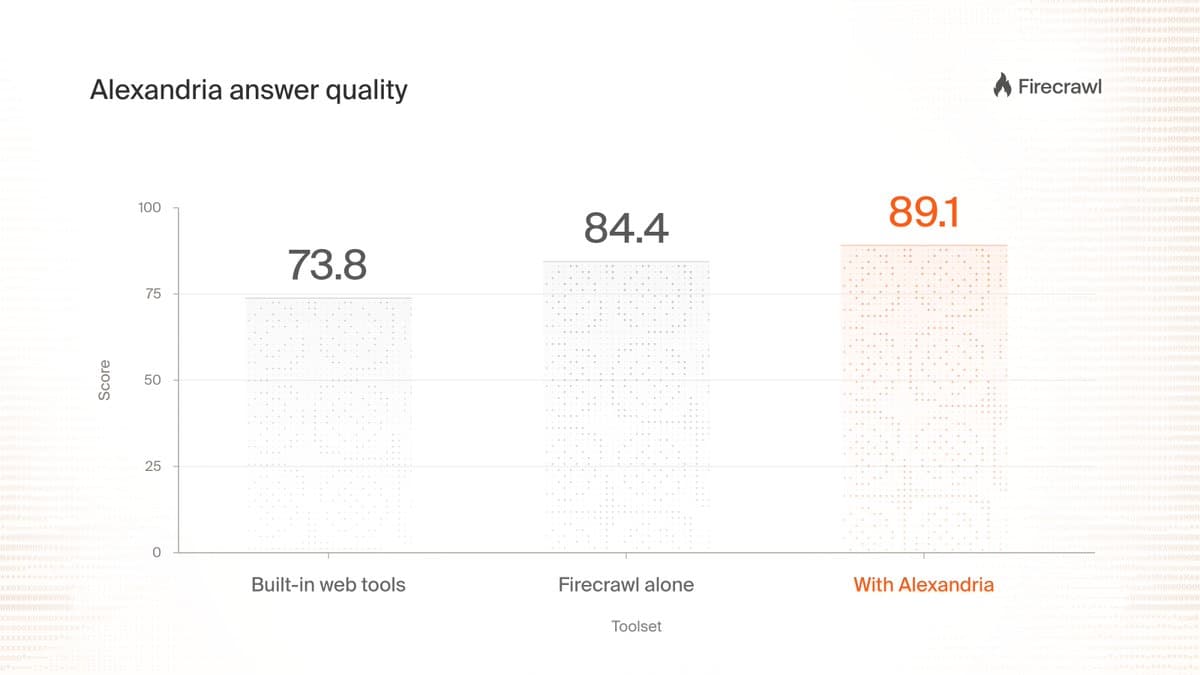
Firecrawl launched Alexandria, an API and MCP interface for querying more than 100 external data providers, plus site-specific connectors and Firecrawl indexes. Firecrawl says Alexandria improved results by 21% on its external-data benchmark.
TL;DR
- Alexandria puts official providers, site-specific connectors, Firecrawl indexes and the live web behind one agent-facing interface, as firecrawl's catalog post describes.
- Firecrawl paired the product with a $75 million Series B led by Smash Capital, which it announced in firecrawl's launch post.
- Firecrawl reports a 21% answer-quality gain over built-in web tools in an internal test across more than 10 verticals, according to firecrawl's evaluation note.
- Agents can reach Alexandria through MCP, the API or a CLI and installed skill, as firecrawl's setup prompt says.
- The funding is tied to paying data contributors: in firecrawl's contributor announcement, the company says researchers, publishers, experts and creators will be able to earn through Alexandria.
firecrawl's "doors open tomorrow" teaser preceded the launch, and kylejeong's follow-up pointed readers to the company blog. The official announcement says Firecrawl already pays Wikimedia Enterprise for direct Wikipedia access and handles millions of those requests each month. Its MCP tool reference draws a useful access boundary: hosted OAuth and API-key connections expose the full tool surface, while keyless hosted access gets search, scrape and parse.
$75M Series B
Firecrawl says Smash Capital led the $75 million round, with Altos Ventures, Nexus Venture Partners, Y Combinator, Freestyle and Offline Ventures participating. The company says part of the money will fund paid access to knowledge held by people and organizations, alongside deeper indexes, better retrieval and more first-party sources.
A same-day recruiting post frames the work as building a knowledge library for superintelligence.
One catalog
Alexandria groups several kinds of source behind the Firecrawl interface:
- Official data providers
- Site-specific connectors and workflows
- Firecrawl-operated indexes
- The live web
Firecrawl advertises more than 100 providers in its catalog post, while its product homepage displays 82 providers and 471 capabilities. The two public materials give different provider counts.
The advertised catalog includes research papers and code documentation, housing and rental listings, professional profiles, and product and pricing data.
Discovery and retrieval
The launch post describes a common sequence: an agent finds a source, sees what it contains, then retrieves data through the Firecrawl API. It says the agent can read a page, search an index, query a provider, or use specialized tools to collect an entire dataset.
Firecrawl's example combines a salary floor and rent ceiling with direct searches of housing and job datasets, rather than relying on a small set of web-search results.
Research, Developer and Government indexes
Firecrawl's catalog includes three first-party collections:
- Research Index: tens of millions of scientific-paper abstracts.
- Developer Index: tens of millions of primary sources across documentation, READMEs, issues and merged pull requests.
- Government Index: laws, regulations and ordinances.
The Developer Index documentation specifies that coding-agent queries draw from public-repository issues, merged pull requests, READMEs and curated documentation sites. The search documentation describes source selection through its sources parameter, alongside ordinary web, news and image search.
The 21% evaluation
Firecrawl says Alexandria scored 21% higher on answer quality than built-in web tools across finance, real estate, shopping and more than 10 verticals. It says the comparison held model and prompts constant and used blind AI judging.
The task-count description differs between the launch materials. The tweet describes about 1,000 catalog-based questions; the official announcement says 845 tasks. Neither names the model, publishes raw scores or describes the judging rubric beyond blind AI evaluation.
MCP, API and CLI
The tweet's agent-directed path is to install firecrawl-cli, authenticate with Firecrawl, and read the installed skill before querying Alexandria. It also says Alexandria is live through MCP and the API.
The launch post gives this CLI bootstrap command, then says to restart the agent so it loads the skills:
The MCP reference says a connected client receives each available tool's input schema. It also notes that tool availability varies by connection mode and team policy.
Provider payments
Firecrawl says it currently pays official providers through individual agreements, naming Wikimedia Enterprise as the prominent example. Its announcement says a self-service system for individuals, creators and organizations is planned to open soon, and the provider waitlist is open now.