
Epoch adds 50 unsolved problems to FrontierMath Open Problems
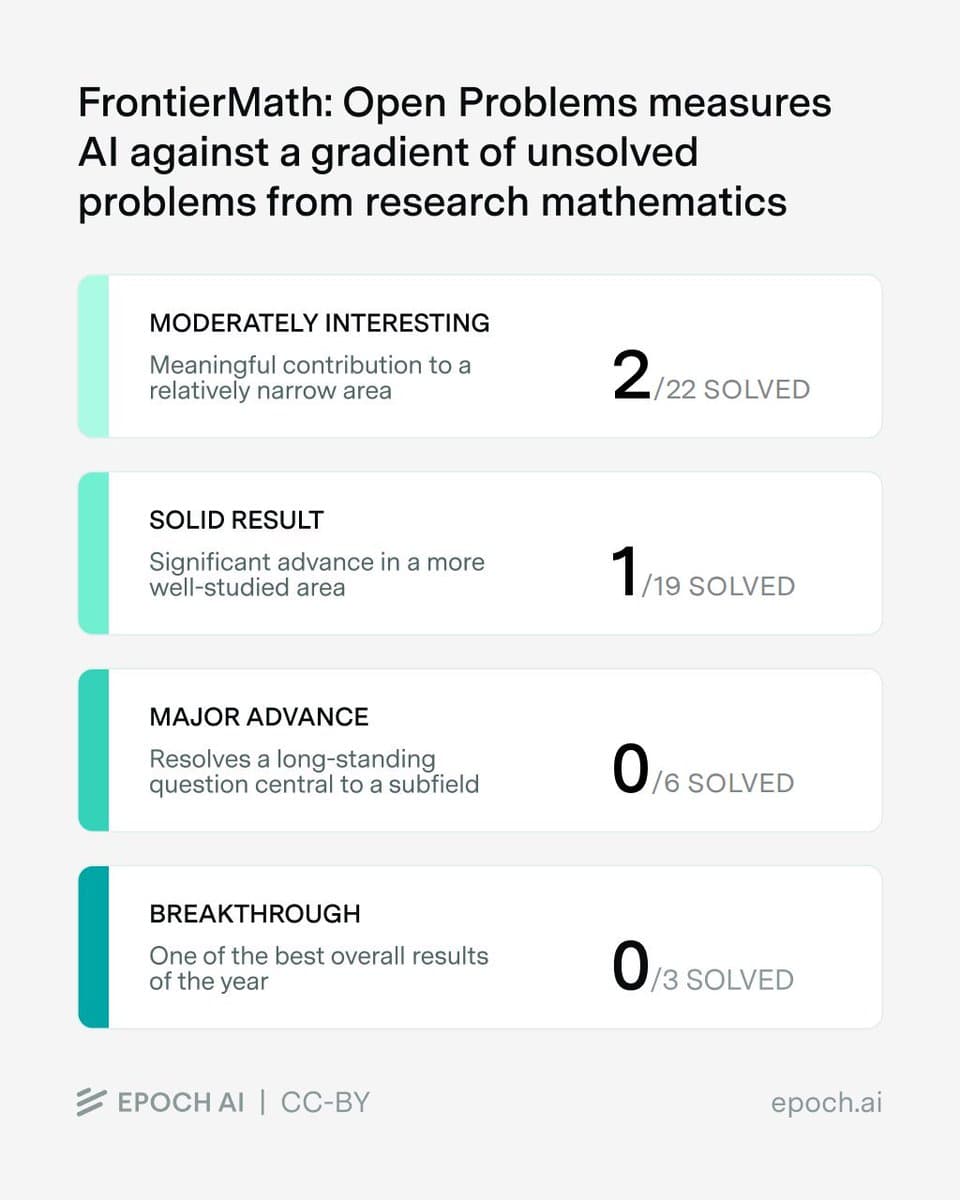
Epoch added significant research problems to FrontierMath Open Problems, bringing the set to 50 unsolved math problems. Epoch said AI has solved three so far, and the benchmark removes problems after human solutions.
TL;DR
- Epoch expanded FrontierMath: Open Problems to 50 unsolved research problems; Epoch's launch thread says AI has solved three so far.
- The benchmark is verifier-heavy by design: Epoch's site link points to the live problem set, and the official submission spec requires laptop-checkable solutions rather than informal proof sketches.
- The new solves are uneven in provenance: Epoch's superpermutation note describes fresh shorter constructions, while Epoch's genus-2 note says one torsion-31 curve was already latent in a public database.
- The problem set churns by design: Epoch's human-solve note says human-solved problems are removed, and Epoch's notability note says one pilot-phase AI solve was cut for missing the benchmark's bar.
- The work is already turning into agent infrastructure: doodlestein's workspace post shows an automatically maintained problem workspace, while Teortaxes' judge analysis breaks the judge role into scoring, robustness, and feedback.
The official FrontierMath page splits the program into unpublished Tiers 1-4 and Open Problems, which are research problems that remain unsolved by mathematicians. The submission spec says accepted problems must be open, hard, interesting, verifiable, and plausibly solvable. The weird launch detail is churn: a Major Advance problem was solved by humans before release, while a pilot-phase AI solve was removed for not meeting the notability bar. The superpermutation page names exact caps for n=8, 9, and 10; the genus-2 page says one solved problem was hiding in a public curve database.
50 unsolved problems
Epoch says Open Problems now contains 50 significant unsolved problems from research mathematics, with three AI solves so far. The benchmark's promise is unusually direct: a passing run can advance math, not just raise a leaderboard number.
The expanded set was vetted by mathematician contributors and an editorial board that Epoch's board note names as Thomas Bloom, Littmath, and Dan Romik. Epoch's program overview frames Open Problems separately from FrontierMath Tiers 1-4, which are unpublished expert-authored problems.
Laptop-hour verifiers
The engineering constraint is the interesting part. Epoch's submission page says proposed Open Problems must satisfy five criteria:
- Open: no known solution.
- Hard: at least two professional mathematicians have tried to solve it.
- Interesting: a solution would be publishable in at least a standard specialty journal and likely to generate further mathematics.
- Verifiable: a typical computer program, not Lean, can check a solution on a typical laptop in under an hour.
- Solvable: a verifiable solution is likely to exist.
The pilot announcement said the first release had 14 problems, with write-ups, precise prompts for AI systems, and initial AI attempts. The live Open Problems page also advertises purchasable verifier access, with proceeds funding expansion and mathematician compensation.
Three AI solves
Epoch said one AI-solved problem had already been announced, then added two new solves at launch. The three public examples now matter more as case studies than as a single aggregate score.
- The 2-adic Absolute Galois Group: Epoch's problem page says David Roe and David Turturean wrote up the solution, and that multiple AI-generated solutions were accepted by the verifier.
- Short superpermutations: Epoch's superpermutation note says AI-assisted work found shorter superpermutations than the best-known constructions, with mathematicians still digesting the result.
- Genus 2 torsion: Epoch's genus-2 note says the curve had already been found by humans in a related project, but had not been recognized as solving this benchmark problem.
Short superpermutations
The superpermutation task asks for strings over n symbols that contain every permutation as a consecutive window. Epoch's problem page gives the verifier caps:
- seq8: length at most 46,204.
- seq9: length at most 408,965.
- seq10: length at most 4,037,046.
The page credits Uku Raudvere with posting the n=8 construction to GitHub and the Superpermutators group on July 26. It credits William Echols with n=9 and n=10 constructions developed in an interactive Codex session using GPT-5.6-Sol at xhigh reasoning, then says GPT-5.6 Sol sourced the sequences and passed Epoch's verifier during a July 27 pre-release test.
Genus 2 torsion-31
The genus-2 task asked for a curve over Q whose Jacobian has a rational torsion point of prime order at least 31. Epoch's solution update says GPT-5.6 Sol found a curve from a public repository maintained by Edgar Costa and Timo Keller.
That provenance changes the shape of the solve. The object existed in public data, but the torsion subgroup had not been checked against this problem; Epoch says the next target is a rational torsion point of order 37.
Removal rules
Open Problems has a garbage collector. Epoch says it removes a problem when humans beat AI to solving it, and one accepted Major Advance problem was solved by humans before launch.
Epoch also removed a problem solved by AI during the pilot phase after deciding it missed the minimum notability bar. That notability filter matches the submission spec's journal-worthiness criterion, not the mere existence of a verifier pass.
The social layer formed immediately around significance auditing. nrehiew_ asked whether field experts could judge how significant the new AI math results were, _lewtun suggested citation record as a crude proxy, and _lewtun's follow-up suggested whether a conjecture has its own wiki page.
Agent workspaces
The launch landed into a community already packaging open math as agent work. doodlestein said his skill creates and updates a problem-specific workspace automatically, in that thread for the Zero Divisor Conjecture, after his launch post called the skill his strongest skill-crafting work yet.
The Hyra screenshot shows the other pattern: a ContextAgent feeding an inspiration queue, ProposalAgent workers calling solve.sh, fresh sandboxes evaluating outputs, and an Experience Bank feeding the loop. In Teortaxes' judge analysis, the Sol judge role splits into scoring and filtering, adversarial robustness, and feedback generation; the analysis argues executable artifacts can shrink the scoring role, while feedback is the hardest part to downgrade.