
Gemini users report Canvas and Fast mode routing to 3.2 variants ahead of I/O
Multiple users posted reproducible steps and videos showing Gemini app UI changes, Thinking Level rollout, and Fast mode or Canvas sessions that look like 3.2 or 3.5-class routing. This matters because Google appears to be testing new model paths and app surfaces in production ahead of I/O, though the exact model names remain unconfirmed.
TL;DR
- Thinking level screenshots show Google rolling out a new Gemini app control with
StandardandExtendedoptions inside Thinking mode. - According to Fast mode routing demo and updated app walkthrough, some users could reproduce sessions where Fast mode or Canvas appeared to route to a newer Gemini 3.2-class model.
- Cloud Console model string and another Cloud Console sighting both surfaced
gemini-3.2-flash-lite-live-preview, which is the strongest breadcrumb that a 3.2 family is being staged somewhere inside Google systems. - Hands-on posts like Flash checkpoint notes, Windows 98 arena demo, and Minecraft one-shot demo all describe a model that feels more capable than the current public Fast path, especially on coding and interactive generation.
You can open the Gemini web app, watch the new mobile UI walkthrough, and click through the Windows 98 arena build or Minecraft arena build that users tied to these newer Gemini checkpoints. Christmas came early for Gemini leak watchers: one post shows a fresh Thinking level control, another shows a reproducible Fast mode toggle path, and the noisiest breadcrumb is a Cloud Console string for gemini-3.2-flash-lite-live-preview.
Thinking level
The cleanest product change is not the rumored model name. It is the new settings surface.
The screenshots show Thinking mode gaining a second control called Thinking level, with Standard described as "Best for most problems" and Extended described as "More time for complex topics." The same settings page also places Fast, Thinking, and Pro side by side, which suggests Google is separating latency tier, reasoning mode, and base model choice more explicitly inside the app.
Fast mode
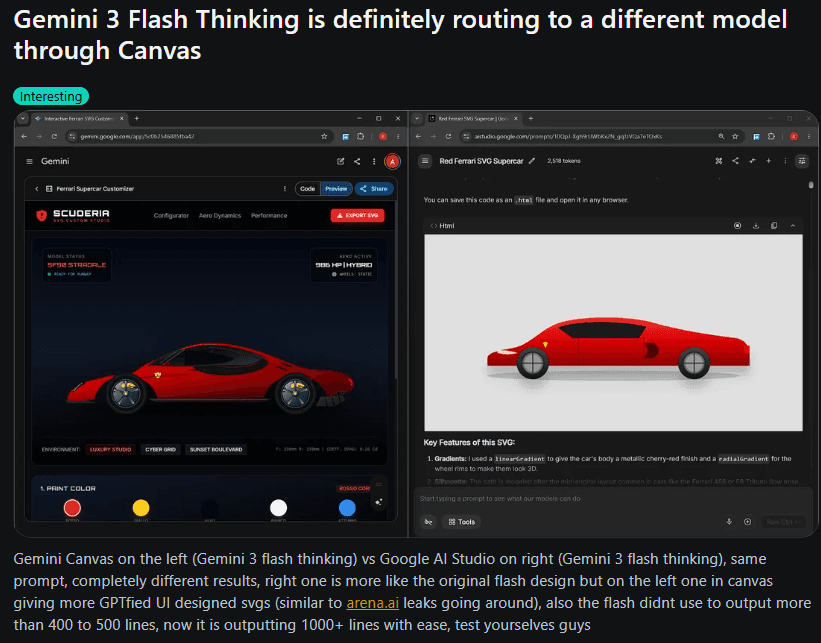
The reproducible claim is simple: open Gemini, toggle Canvas, switch to Fast mode, then run a prompt.
One demo post says that path was routing to "what looks like a new Flash model," while a second walkthrough says the app's Fast path was showing Gemini 3.2. A Reddit-linked report adds the same pattern from user testing, with claims that Flash in Thinking plus Canvas felt less lazy on code and more detailed than the older behavior.
That still leaves the naming unresolved. One summary post frames it as 3.2 / 3.5, an Arena comparison post argues Google may be moving to a 3.2 line instead of 3.5, and a web app test only says the outputs looked unusually strong under Thinking plus Canvas.
Cloud Console
The best hard artifact is the quota console string, not the app UI.
Across AiBattle_ screenshots, testingcatalog's screenshot, and WesRoth's later repost, users surfaced the same base model name: gemini-3.2-flash-lite-live-preview. The live and bidi generate content quota language in that quota screenshot points to a low-latency, real-time path rather than a generic text-only model.
One roundup post also notes that Google dropped the preview label from gemini-3.1-pro on Arena around the same time. That does not confirm public release timing, but it does make the routing reports look less random.
Arena behavior
The most interesting capability reports are coming from Arena builds, where users are posting runnable artifacts instead of benchmark charts.
According to the Windows 98 demo, a Gemini 3.2 Pro build generated:
- window drag, minimize, maximize
- a functional in-OS browser
- working tools including games, calculator, Paint, Word, and Notepad
- a full taskbar and boot flow
A separate Minecraft demo claims Gemini 3.5 Flash produced a full one-shot implementation with zero external assets, procedural textures drawn in code, and working block placement and break logic.
The caveat sits right inside chetaslua's checkpoint notes: the model was fast and strong for a Flash-class system, but prompt adherence was shaky enough that it kept using web results after being told not to. That makes capability impressions easier to trust than exact model identification.
Spark
A separate leak points to the product surface Google may be building around these model paths.
Spark screenshots show a Spark BETA entry inside the Gemini app and a task view that exposes tool traces including Computer, Google Workspace Search, Google Search, and google:browse. testingcatalog's earlier thread also says the flow includes Skills creation, while noting there was no evidence yet of browser or computer control over a user's own laptop.
That matters because the routing story is not only about a hidden checkpoint. It also looks like Google is rearranging the Gemini app around longer-thinking modes, Canvas workflows, and a more agentic Spark surface at the same time.