
Google Research launches TurboQuant: 6x KV-cache compression, 8x faster H100 attention
TurboQuant claims 6x KV-cache memory reduction and up to 8x faster attention on H100s without retraining or quality loss on long-context tasks. If those results hold in serving stacks, teams should revisit long-context cost, capacity, and vector-search design.
TL;DR
- Google Research says TurboQuant can compress LLM KV caches to 3 bits with no retraining, cutting memory by about 6x while matching full-precision results on long-context and retrieval benchmarks, according to Google's launch and a benchmark recap.
- The headline serving claim is speed: Google's research post reports up to 8x faster attention computation on H100s, while the accompanying chart thread shows speedups rising with longer sequence lengths.
- This is not just a KV-cache story. Google's launch post positions TurboQuant, QJL, and PolarQuant as a shared compression stack for both LLM inference and semantic search, with the thread overview highlighting stronger vector-search recall than prior low-bit methods.
- Engineers are already testing the deployment angle: the HN summary flags questions about GPU compatibility and real wall-clock gains, while the vLLM post points to an early integration path for very large KV caches.
What exactly shipped?
TurboQuant: Redefining AI efficiency with extreme compression
Google Research introduces TurboQuant, a set of advanced quantization algorithms including TurboQuant (ICLR 2026), Quantized Johnson-Lindenstrauss (QJL), and PolarQuant (AISTATS 2026), that enable massive compression for large language models and vector search engines by eliminating memory overhead in vector quantization. It achieves high-quality compression with zero accuracy loss, quantizing key-value caches to 3 bits without training, yielding 6x memory reduction and up to 8x speedup in attention computation on H100 GPUs. Tested on benchmarks like Needle In A Haystack, LongBench, and others using models such as Gemma, Mistral, and Llama-3.1-8B, it matches full-precision performance while supporting efficient semantic search at scale.
Google Research introduced TurboQuant as a family of quantization methods rather than a single narrow kernel. The main package combines TurboQuant, Quantized Johnson-Lindenstrauss, and PolarQuant to remove vector-quantization overhead for both transformer KV caches and vector search indexes, as described in the research post.
The practical claim is aggressive low-bit compression without retraining. Google's announcement says KV caches can be quantized to 3 bits for about a 6x memory reduction while preserving quality on tests including Needle In A Haystack and LongBench, using models such as Gemma, Mistral, and Llama-3.1-8B. A practitioner summary in this explainer describes the two-step method as random rotation followed by a 1-bit residual correction step that "eliminates bias" in attention scores.
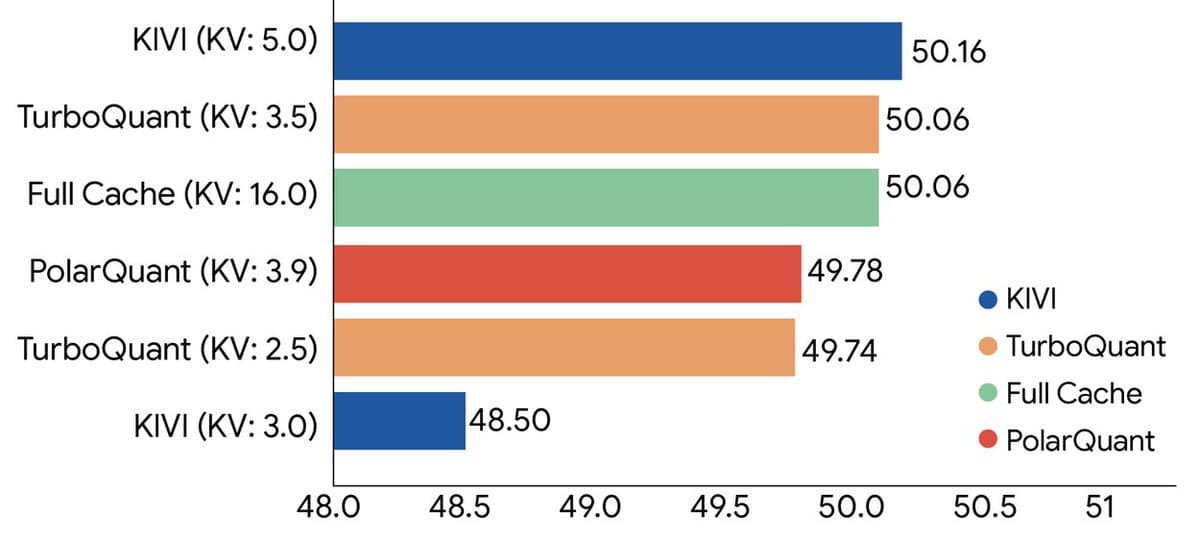
The performance charts matter because they move this beyond a storage-only claim. In the chart thread, the 4-bit variant is shown reaching up to roughly 7x speedup over einsum at million-token sequence lengths, and the same thread shows TurboQuant variants staying close to full-cache quality and outperforming other low-bit vector-search baselines at similar bit budgets.
Where could this change serving economics?
If the reported numbers hold in production stacks, TurboQuant changes the cost model for long-context inference first. Google's launch post ties lower KV-cache footprint directly to higher effective context capacity, and the recap video repeats the headline combination of "6x smaller footprint, 8x faster" on H100-class hardware.
That also makes this relevant to system design, not just model compression. The research post explicitly extends the same ideas to semantic search, where compressed embeddings can preserve Recall@k while reducing storage overhead. For teams balancing long prompts, batch size, and memory pressure, that means the same compression work could affect both serving tiers and retrieval infrastructure.
Early ecosystem signals are already appearing. The vLLM post points to TurboQuant running in vLLM with "4M+ KV-cache tokens on a USB-charger-sized box," which is anecdotal but useful as a sign that implementers are testing the serving path quickly.
What are engineers questioning?
TurboQuant: Redefining AI efficiency with extreme compression
This matters if you work on LLM serving, long-context inference, or vector search: the core claim is that KV caches and embeddings can be compressed far more aggressively, potentially changing memory footprint and attention throughput. The thread also surfaces practical concerns engineers would care about—GPU compatibility, wall-clock performance, prior-art lineage, and the fact that the community is already prototyping implementations in PyTorch and llama.cpp.
The main caveat is that the launch claims are benchmark-heavy and engineers immediately asked about hardware reality. The HN summary says the thread centered on "GPU compatibility, wall-clock performance, prior-art lineage," which are the right objections for anyone deciding whether to change an inference stack.
Those concerns are concrete in the discussion digest. One commenter argued the method is "hardly compatible with modern GPU architectures" and said the paper emphasizes accuracy-versus-space more than end-to-end latency. Another pointed to prior work, saying the "geometric rotation prior to extreme quantization" was introduced earlier in DRIVE. The same discussion also surfaced an independent PyTorch implementation via a working implementation, which suggests the fastest validation path will come from third-party kernels and framework ports rather than the paper alone.