
Pi community ships pi-treebase, Miko voice mode, and OpenCode Go guides
Builders shipped pi-treebase, a Miko voice mode for pi-listens, devrage support, and a Japanese OpenCode Go guide after the first Pi extension burst. The releases arrive as Pi’s provider abstraction gets stress-tested by OpenClaw-scale multi-provider use.
TL;DR
- Pi's first community burst already spans new interfaces, extensions, and workflow tooling: badlogicgames' pi-treebase repost surfaced a more controllable
/treebase, while badlogicgames' pi-listens repost showed a separate voice layer for Pi. - The most consequential underlying detail came from badlogicgames' provider abstraction thread, which says Pi's LLM provider layer is now getting hammered by OpenClaw-scale multi-provider usage and is "working and battle tested."
- Community add-ons are arriving fast enough that even adjacent tools are patching Pi support in: badlogicgames' devrage repost highlighted a new release, and nicopreme's subagents repost pointed users to pi-subagents and pi-intercomm.
- Pi is also turning into OpenCode Go glue. badlogicgames' Zenn repost linked a Japanese guide for running OpenCode Go with pi-coding-agent, while opencode's outage notice showed one reason this layer matters, upstream provider incidents still leak into user experience.
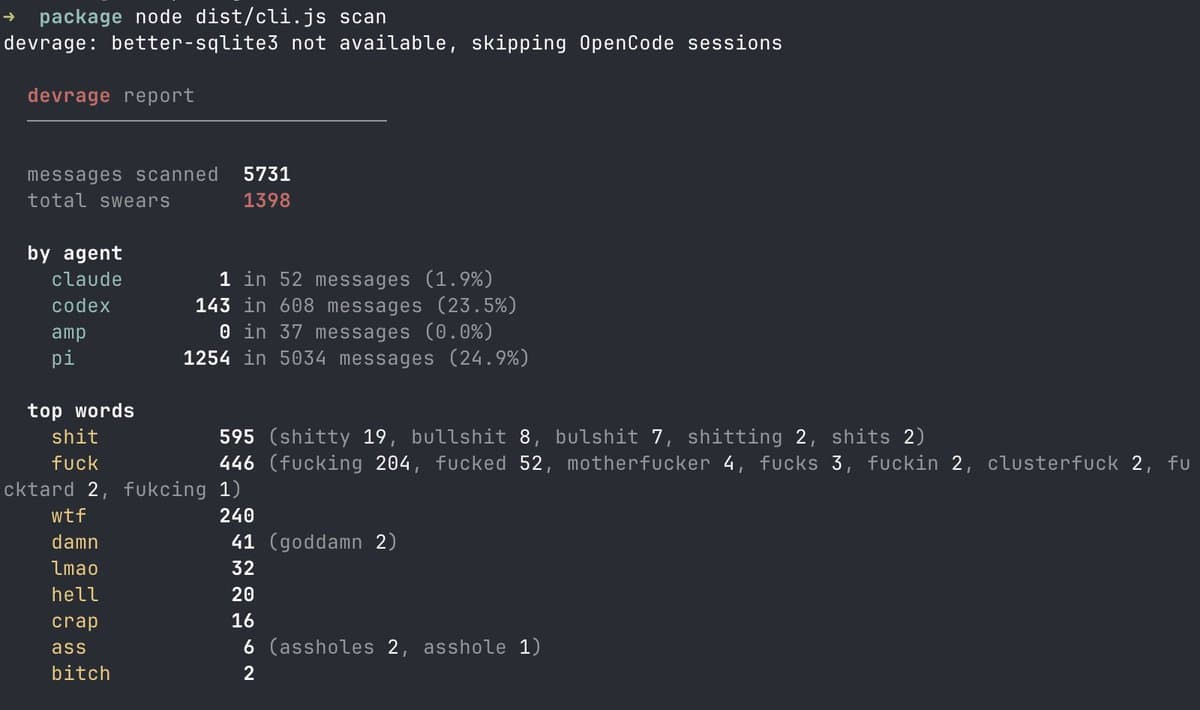
- Builders are shipping instrumentation around the agent, not just inside it: zeeg's devrage screenshot counts transcript swears by model, and badlogicgames' diff-review note describes line-by-line review passes because the agent still misses obvious fixes.
You can inspect Pi's own AI package, browse the OpenCode Go + pi-coding-agent guide, and even dig into side tooling like the devrage gist. The fun bit is how mixed the ecosystem already looks: a tree navigation extension badlogicgames' pi-treebase repost, a terminal voice character nicopreme's Miko repost, subagent extensions nicopreme's subagents repost, and session-management work that badlogicgames' pi-session-manager repost says cuts disk and database I/O.
Provider abstraction
The core Pi story this weekend was not a headline feature drop. It was badlogicgames' thread saying the project's provider abstraction is being stress-tested by the OpenClaw user base, then following up that the layer is "terrible like all abstractions, but working and battle tested" in the follow-up post.
That matters because the claim is specific about what Pi is trying to absorb:
- model-provider quirks at scale, per badlogicgames' thread
- a homegrown abstraction in Pi's AI package
- a deliberate contrast with OpenCode's reliance on the Vercel AI SDK, which badlogicgames says still does not really shield users from those quirks
The same week produced a clean external reminder that abstraction layers do not erase upstream failures. In opencode's outage post, OpenCode Go said DeepSeek-model issues came from a provider outage, which matches DeepSeek's own status page.
pi-treebase
The first extension-shaped release in the evidence set was pi-treebase. badlogicgames' repost quotes the project as "I love /tree, but wanted even more control," which is exactly the kind of narrowly opinionated fork that shows a CLI has crossed into extension territory.
The useful signal here is not just that someone shipped a tree command variant. It is that Pi already has enough command surface and user expectation around /tree for a derivative tool to make sense as its own product. The post points back to pi.dev, which suggests the extension wave is forming around Pi's existing command model rather than around a separate plugin runtime.
Miko voice mode
A second branch of the ecosystem is going after interface, not code generation. badlogicgames' pi-listens repost describes @p8n.ai/pi-listens v0.1.2 as "a voice layer" for Pi, and nicopreme's later repost turns that into a character, "Miko," for terminal voice mode.
That is a small but telling split:
pi-listensadds speech I/O on top of Pi, per the reposted release note- Miko adds persona and presentation, per nicopreme's post
- Pi's community is already treating the terminal agent as something that can be wrapped, themed, and specialized, not just configured
OpenCode Go glue
The ecosystem is also filling in bridge material for people mixing Pi with other coding agents. badlogicgames' repost links a Japanese Zenn guide explicitly recommending OpenCode Go plus pi-coding-agent.
A separate screenshot from dinnaiii's post shows why that pairing is attracting tinkerers. The image points to packages/agent/src/harness/types.ts and an ExecutionEnv interface with file I/O, temp files, binary reads, and command execution, then argues that this existing abstraction is stronger than a simpler session environment plan.
That makes the current Pi burst look less like a random pile of hacks and more like a harness ecosystem growing around a reusable agent core. The same pattern shows up in adjacent tools:
- badlogicgames' devrage repost says
npx devrageadded Pi support - nicopreme's subagents repost calls out pi-subagents and pi-intercomm as powerful extensions
- badlogicgames' pi-session-manager repost points to a v0.6.0 release that reportedly cuts disk and database I/O across the board
Instrumentation and failure loops
The most honest Pi posts in the set are about cleanup after the model does something dumb. zeeg's screenshot shows npx devrage reading transcripts and counting swears by agent, while badlogicgames' gist post says those markers are being used to tag sessions where the LLM messed up.
Badlogicgames also described a much more practical review loop in the diff-review post: pi-diff-review walks modified or new files, leaves line-based review comments, and still missed enough issues that tests could pass while a lifecycle stayed broken.
The linter discussion in badlogicgames' AGENTS.md thread and the follow-up question is the sharpest implementation detail in the whole batch. The options listed are all awkward:
- inject a system reminder after modified files, but the model might ignore it
- auto-run the linter after a modifying turn, but that can force another turn when warnings appear
- rely on a pre-commit hook, but only if the model is actually committing
That is Christmas come early for coding-agent nerds. A weekend extension burst is nice, but the more durable story is a community already building around the real pain points: provider quirks, review passes, session tooling, and the annoying question of when a harness should stop trusting the model and just run the check itself.