
Raindrop launches Triage for Slack digests and trace search
Raindrop launched Triage, a Slack-based agent that finds traces, summarizes recurring failures, runs recurring briefs, and opens experiments from production conversations. Teams using Claude Code, Cursor, or Devin can plug it into agent ops to shorten debugging loops.
TL;DR
- Raindrop shipped Triage, an agent that investigates production agent failures from Slack, the web, and MCP, according to benhylak's launch post and the official launch post.
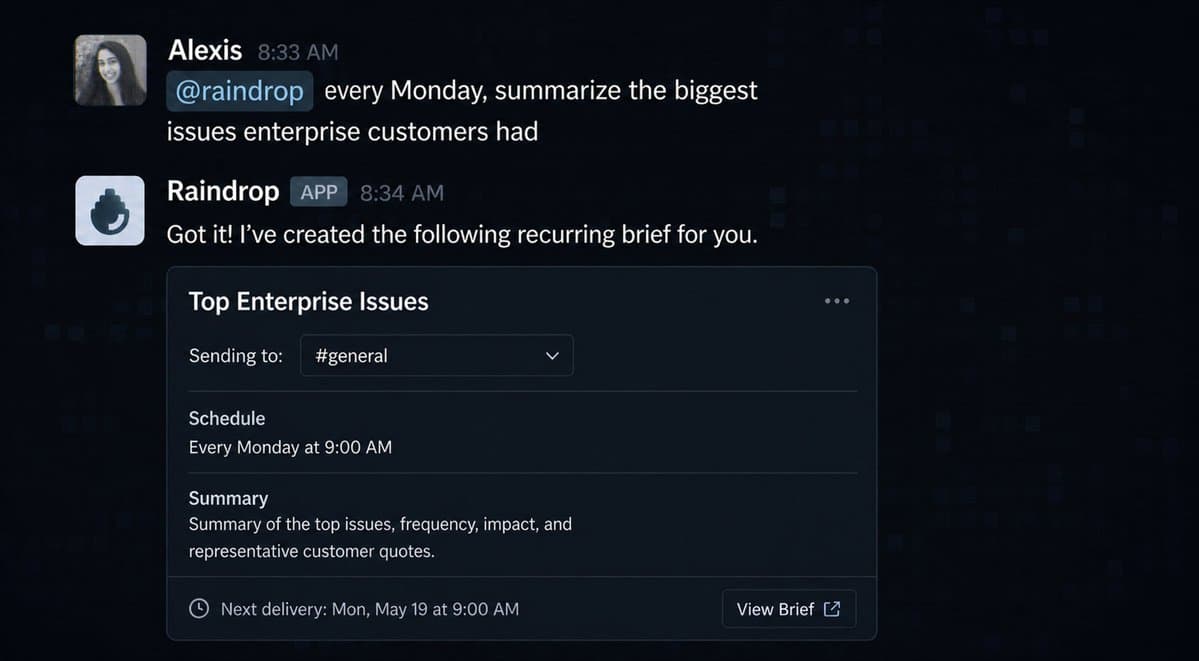
- In Slack, Triage is pitched as a teammate for trace hunting: benhylak's Slack demo shows the core loop, while benhylak's recurring brief example adds scheduled digests like "every day, summarize weird tool call failures."
- Raindrop also exposed Triage itself as an MCP tool, and benhylak's MCP design note points to the blog's argument that a tuned triage harness can outperform handing raw tools to coding agents like Claude Code, Cursor, Codex, and Devin.
- Customer quotes in benhylak's customer quote post and benhylak's Speak quote frame the early use case as pattern-finding plus weekly issue digests, not just one-off incident search.
You can read the launch post, skim Raindrop's earlier Self Diagnostics launch, and browse the broader Raindrop blog to see how Triage sits next to trace search, automated issue detection, and agent debugging. The funny detail is that Raindrop did not just add another MCP server, it wrapped its own triage agent as the MCP surface and argues that the harness itself is the product.
Slack triage
Raindrop's first pitch is simple: paste the problem into Slack, ask a question, and let Triage find the trace. In benhylak's Slack demo, the product is framed as replacing the usual dashboard spelunking loop with a threaded answer inside Slack.
The official post says Triage can answer the kinds of questions teams already ask in incidents:
- "every Monday, summarize the biggest issues enterprise customers had"
- "how's the rollout on flag checkout-v2?"
- "is this still happening?" with a screenshot of a customer complaint
That list comes directly from the launch post, which also says replies stay in-thread and keep context across follow-ups.
Recurring briefs and experiments
The second feature bucket is scheduled and comparative work. benhylak's recurring brief example shows daily summaries for weird tool call failures, while benhylak's experiment example uses the same interface to ask how an Opus 4.7 rollout is going.
Raindrop's blog folds both into the same surface: automated briefs, experiments, and ad hoc investigation all run through the same Slack agent. That matters because the product is not only a search box for past traces, it is also a standing analyst that can keep reporting on the same failure pattern over time.
Customer quotes line up with that framing. In benhylak's customer quote post, an engineer at Framer describes quick ad hoc questions plus broader pattern spotting, while benhylak's Speak quote describes a Monday digest of top issues and new patterns.
Triage agent as an MCP
Raindrop's most interesting design choice is in benhylak's MCP design note: Triage itself is exposed as an MCP tool, not only the underlying tools.
The launch post gives three reasons:
- Task-specific harness: Raindrop says its triage harness is tuned for debugging production data, navigating conversations, and calculating impact, and that it generally beats Claude Code using the same tools on speed and accuracy.
- Personalization: feedback on signals, issue fixes, and Triage usage across web, Slack, and MCP can carry forward into future agent runs.
- Context handoff: a Slack investigation can continue inside Devin or another coding agent without rebuilding the thread context.
Raindrop names Claude Code, Cursor, Codex, and Devin as day-one coding-agent fits in the blog and in benhylak's coding agent post. The example workflow is blunt: ask Devin to check Raindrop for the top enterprise issue, patch the code, run tests, and open a PR.
The self-healing stack
Triage reads like the next layer on top of tooling Raindrop had already been shipping. The Self Diagnostics launch in February let agents proactively report their own failures, including missing context, broken tools, loops, and capability gaps. The blog index also shows Trajectories, a March launch for natural-language trace search and visualization.
Put together, the product line is getting pretty legible:
- Self Diagnostics generates agent-reported failure signals.
- Trajectories gives teams a trace viewer and natural-language search.
- Triage adds a conversational layer for recurring briefs, experiments, and MCP handoff into coding agents.
That last piece is the new bit. Raindrop is no longer only selling observability surfaces. It is packaging investigation itself as an agent that can stay in Slack, then jump into a coding harness when the bug needs a fix.