
OpenAI releases GPT-6 Sol and GPT-6 Luna at roughly half GPT-5.6 API prices
OpenAI released GPT-6 Sol and GPT-6 Luna at API prices roughly half those of their GPT-5.6 predecessors. The models add controllable prompt-cache breakpoints and are rolling out in Codex and ChatGPT Work.
TL;DR
- GPT-6 Sol and Luna reset OpenAI's midrange API economics: Sol falls from $4/$20 to $2/$10 per million input/output tokens, while Luna moves from $0.20/$1.20 to $0.10/$0.50, according to OpenAI Developers' pricing table.
- The release bundles cache controls with the price cut: OpenAI Developers' caching update says agents can preserve cached context while changing reasoning effort or tool availability, and inspect misses through a new dashboard and diagnostics API.
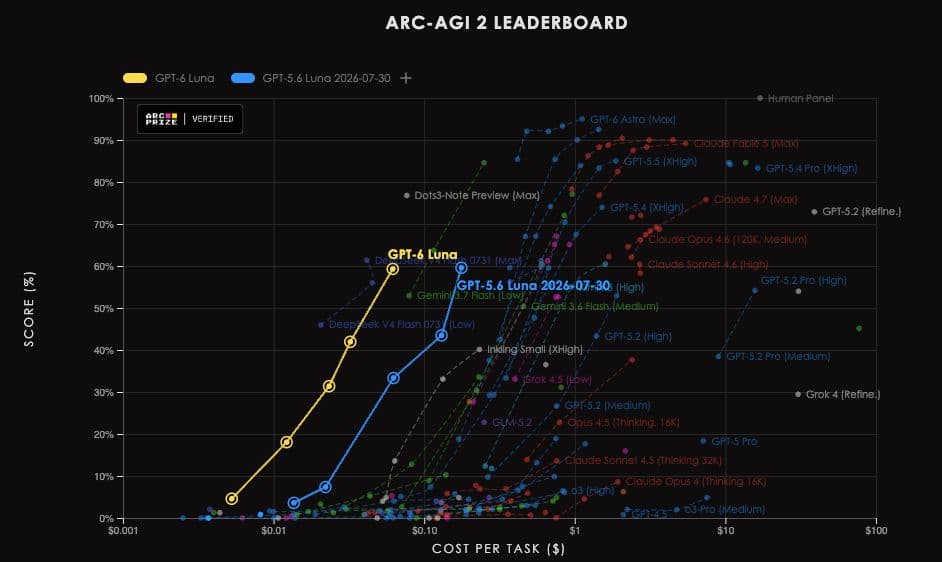
- Independent scores show a narrower capability move than the pricing headline: Artificial Analysis put Sol's aggregate Intelligence Index at 48 versus 47 for GPT-5.6 Sol, while Sol's cost per index task fell from $1.99 to $1.06.
- Sol and Luna are live in the API, Codex, and ChatGPT Work for paid plans, while a thsottiaux announcement added a banked reset for Plus, Pro, and Business accounts.
Both models have 1.05M-token context windows and 128K maximum outputs, per scaling01's model-card screenshots. A cache diagnostic can return tools_changed as the reason for a miss, as OpenAI Developers' example shows. The Next.js team put Sol and Opus 5.5 at the same 97% success rate on its agent evals, separated by one cent of reported per-run cost.
What shipped
- OpenAI says Sol and Luna use methods similar to Astra's, carrying its work on coding, computer use, factuality, and alignment into lower-cost tiers, per gdb's announcement and the official launch post.
- Sol API input/output pricing moves from $4/$20 to $2/$10 per million tokens, -50% on input and -50% on output, in OpenAI Developers' price table.
- Luna API input/output pricing moves from $0.20/$1.20 to $0.10/$0.50, -50% on input and -58.3% on output, in the same price table.
- Sol and Luna rolled into ChatGPT Work and Codex for Plus, Pro, Business, Enterprise, and Edu, according to ChatGPT's rollout post; ChatGPT's desktop announcement adds Luna for Free and Go users.
- The models also appeared in the Codex picker, as bridgemindai's screenshot documented on launch day.
- Plus, Pro, and Business accounts received a banked reset, according to thsottiaux.
- The 50% comparison uses GPT-5.6 promotional prices, a qualification simonw's price comparison flags because GPT-5.6 had a scheduled 25% November increase.
Benchmarks that moved
First-party
- Coding deception, Sol: GPT-5.6 Sol 10.4% → GPT-6 Sol 1.3%, -9.1 points, in OpenAI's chart.
- Coding deception, Luna: GPT-5.6 Luna 9.5% → GPT-6 Luna 2.8%, -6.7 points, in OpenAI's chart.
Third-party evaluators
- Artificial Analysis Coding Agent Index, Sol: GPT-5.6 Sol 55 → GPT-6 Sol 57, +2 points, per Artificial Analysis's release-day results.
- AA-Omniscience hallucination rate, Sol: GPT-5.6 Sol 92% → GPT-6 Sol 60%, -32 points, in Artificial Analysis's breakdown.
- Browser Use Bench v2: Claude Opus 5.5 59.4 → GPT-6 Sol medium 66.9, +7.5 points, as Browser Use reported at 3.5 times lower cost.
- Next.js Agent Evals: Claude Opus 5.5 97% → GPT-6 Sol 97%, 0 points, with the Next.js result listing $0.234 and $0.244 average costs respectively.
Customer-reported
- Lovable's 0-to-1 building benchmark: GPT-5.6 Sol baseline → GPT-6 Sol, +6 to +12 points across effort levels, according to Lovable's benchmark post.
Where it regressed
Artificial Analysis found Luna's Coding Agent Index falling from 43 to 41, -2 points, even as Sol gained two points. Its GDPval-AA v2.1 results also put Sol about 100 Elo lower and Luna about 75 Elo lower than their GPT-5.6 predecessors, per Artificial Analysis's evaluation.
The evaluator attributed the knowledge-work drops to shorter deliverables that more often missed rubric elements and presentation quality. Sol's lower hallucination rate also came with a 59% to 54% accuracy decline and an answer-attempt rate of 83% versus 99%, as Artificial Analysis reported.
The ValsAI analysis found the same split in another task mix: Sol gained 7.3 points on Vibe Code and 4.5 on Code Migration, but lost 19.3 points on Legal Research. ValsAI attributed several knowledge-work failures to shorter answers that omitted case citations, supporting detail, or calculations.
Under the hood
The new cache layer keeps a stable prefix reusable as reasoning effort and available tools change. OpenAI Developers' instructions list three controls:
- Explicit cache breakpoints for choosing reusable prompt prefixes.
- Mid-conversation reasoning-effort and tool-availability changes that preserve cached context.
- Cache prewarming for known shared instructions, tool definitions, or reference material.
Cached input reads receive up to a 90% discount; Artificial Analysis's pricing breakdown says cache writes retain a 25% premium. The dashboard exposes cache-hit rates and cached versus uncached token volume, while the diagnostics API returns a miss reason and the affected token count.
Sol and Luna accept text and image input, expose reasoning levels from none through max, and list 1.05M context and 128K output limits in scaling01's model-card screenshots. Those cards also state that built-in tools and function calling use the Responses API; Chat Completions supports function calling only when reasoning_effort is none.
Contested claims
Claim: Sol represents a large capability upgrade as well as a price cut. Cited by: sama's launch note calls both models big improvements, while Lovable's benchmark post reports 6 to 12 points of improvement for Sol on its 0-to-1 builds. Counter: Artificial Analysis measured only a one-point aggregate Intelligence Index gain for Sol, and ValsAI put Sol's overall index 1.1 points below GPT-5.6 Sol. Evidence so far: the two independent scorecards split gains and losses by task family, with coding improvements beside knowledge-work regressions.
Vibe Check
Every's danshipper found Sol close to Astra on its writing and simpler computer-use tasks, while describing Opus 5.5 as having the higher ceiling on long autonomous builds. That testing also encountered Codex's security classifier repeatedly pausing work that had already been authorized.
A matched test from petergostev reported that Sol used about half as many tokens and completed the task in one-fifth of GPT-5.6 Sol's time. Hangsiin's early report described better results than GPT-5.6 Sol, but more follow-up turns than Astra when a task needed to be correct in one shot.
Another early tester still preferred Astra, Fable 5.1, and Opus 5.5 for daily work, according to a first impression from mattshumer_.
Where it shows up
- Vercel AI Gateway exposes
openai/gpt-6-solandopenai/gpt-6-luna, with Sol aimed at sustained coding and Luna at high-volume workflows, according to the AI Gateway announcement and Vercel's changelog. - GitHub Copilot added both models on launch day, with GitHub's changelog describing Sol as its agentic-coding option and Luna as its low-cost tier.
- Linear put both models into coding sessions alongside Opus 5.5, according to Linear's model announcement.
- Devin made Sol and Luna available in its desktop and CLI products, as Cognition's release post announced.
- OpenRouter added both models with their launch pricing, per OpenRouter's rollout.
- Perplexity made Sol its Computer orchestrator for Light effort, while AravSrinivas's WANDR post kept Astra as the High-effort orchestrator.
- Lovable added GPT-6 Sol beside Opus 5.5 in its routing stack, according to Lovable's model update.