
Grok 4.3 drops to $1.25/$2.50 with 1M context
Provider and benchmark trackers listed Grok 4.3 with 1M context and lower token pricing, and OpenRouter and Venice exposed it through their APIs. The model undercuts Opus 4.7 and GPT-5.5 on price while independent evaluations show stronger legal and finance performance than general coding.
TL;DR
- bridgemindai's pricing screenshot and OpenRouter's model page both list Grok 4.3 at $1.25 per million input tokens and $2.50 per million output tokens, with a 1M token context window.
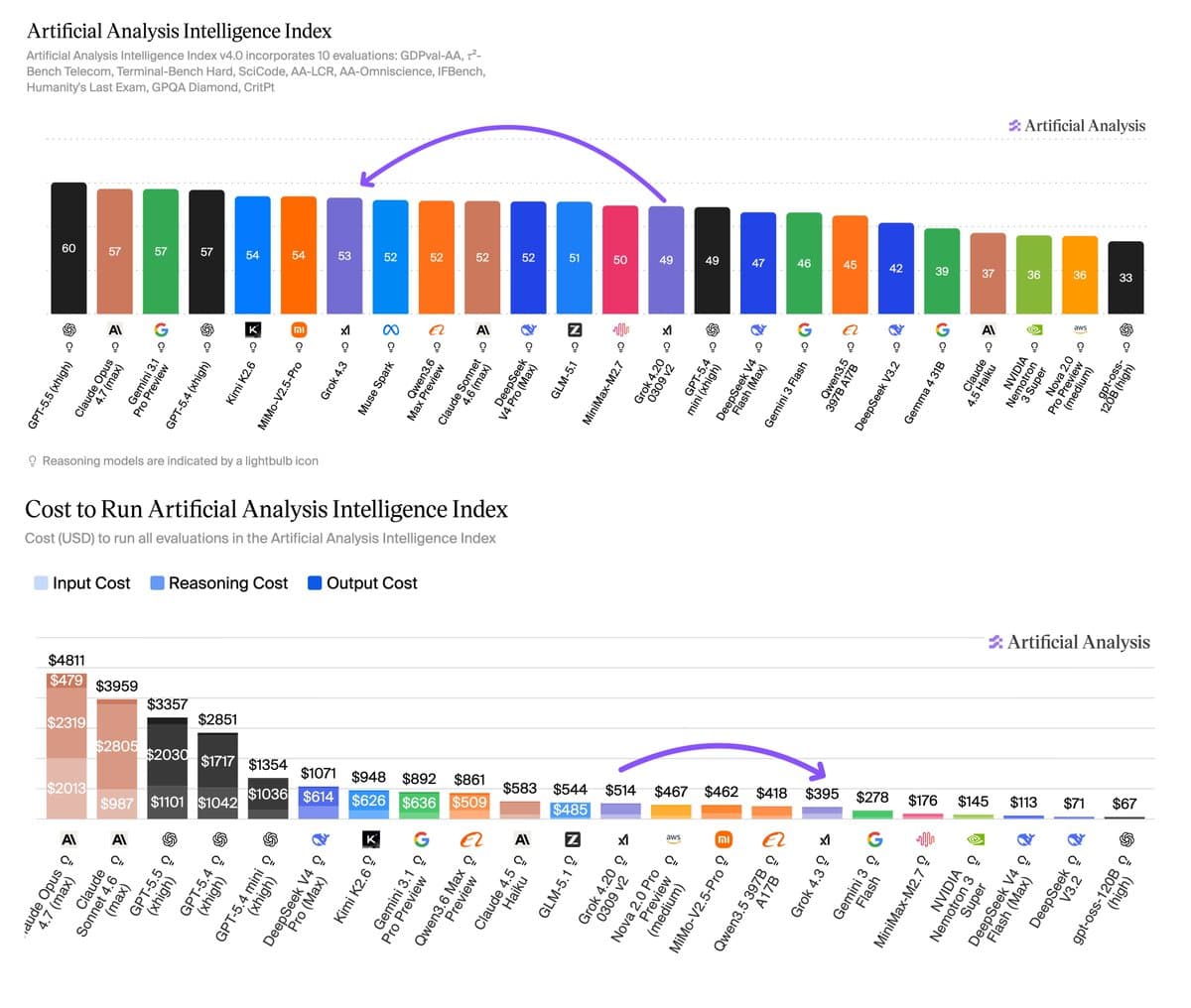
- According to ArtificialAnlys' launch thread, Grok 4.3 reached 53 on the Artificial Analysis Intelligence Index, up 4 points from Grok 4.20 0309 v2, while the cost to run that suite fell by about 20%.
- ValsAI's headline post and ValsAI's benchmark follow-up both show the same shape: #1 on CaseLaw v2 and CorpFin, but weaker results on general coding.
- ValsAI's methodology note says the model has 1M context and output tokens, costs $0.38 per test on Vals' index, and averages 584.24 seconds per test.
- OpenRouter's rollout post and vercel_dev's AI Gateway post show that access through third-party API surfaces landed almost immediately, before xAI published any obvious launch post in the evidence set.
You can inspect the OpenRouter listing, compare Artificial Analysis' model page, read Vercel's AI Gateway changelog, and Vals' model page if you want the raw numbers. The odd bit is the launch shape: benchmark trackers and gateways surfaced Grok 4.3 first, while altryne's post asking for a model card captured how little official xAI packaging was visible at launch time.
Pricing and context
The cheapest useful fact here is also the clearest one. bridgemindai's screenshot matched what OpenRouter's page later showed publicly: 1M context, text and image input, reasoning always on, and base pricing of $1.25 input and $2.50 output per million tokens.
OpenRouter's page adds two details the tweets only hint at: there is no output token limit, and pricing steps up once a request exceeds 200K total tokens, to $2.50 input, $5 output, and $0.40 cache reads per million.
Benchmark shape
The independent eval story is split between broad index gains and narrow domain spikes. According to ArtificialAnlys' launch thread, Grok 4.3 scored 53 on the Artificial Analysis Intelligence Index, versus 49 for Grok 4.20 0309 v2, while input pricing fell 37.5% and output pricing fell 58.3%.
The biggest jump was on agentic work. ArtificialAnlys' thread says GDPval-AA moved from 1179 Elo to 1500, a 321 point increase, while Artificial Analysis' model page also flags the model as notably verbose at 88M tokens across the suite.
Vals shows where the gain is concentrated:
- CaseLaw v2: 79.3%, rank 1 of 47, per ValsAI's CaseLaw and CorpFin breakdown
- CorpFin: 68.5%, rank 1 of 97, per ValsAI's CaseLaw and CorpFin breakdown
- Overall Vals Index rank: 13th, per ValsAI's launch post
Coding gap
Vals' own summary is blunt. ValsAI's coding follow-up says Grok 4.3 gained 15 points on Vibe Code Bench, still ran relatively low on Terminal Bench 2, and scored 11% on ProofBench.
That leaves Grok 4.3 in an unusual slot. ValsAI's strengths-versus-weaknesses post describes a stark gap between strong legal and financial reasoning and weak general coding, which is a much more specific result than the single headline index score suggests.
Rollout surfaces
The rollout hit gateways faster than it hit narrative. OpenRouter's post exposed Grok 4.3 with a public model card and API route on April 30, while Vercel's changelog shipped xai/grok-4.3 on AI Gateway with a stated December 2025 knowledge cutoff and improved tool calling and instruction following.
Other providers moved the same night. AskVenice's launch post put Grok 4.3 live in Venice with function calling, multimodal input, and native X search, and arena's Battle Mode post dropped it into Arena's text, vision, document, and code front end before public scores were available.