
Ideogram 4.0 releases 9.3B open weights with 2K output and non-commercial license
Ideogram released 4.0 as open weights with 2K output, layout control, and strong text rendering, with rollout to ComfyUI, fal, and Hugging Face. Teams can download the design-focused model, but they should check the non-commercial license before using it in production.
TL;DR
- Ideogram shipped Ideogram 4.0 as a 9.3B open-weight text-to-image model, and btibor91's launch summary plus the GitHub repo both describe it as trained from scratch rather than fine-tuned from an existing checkpoint.
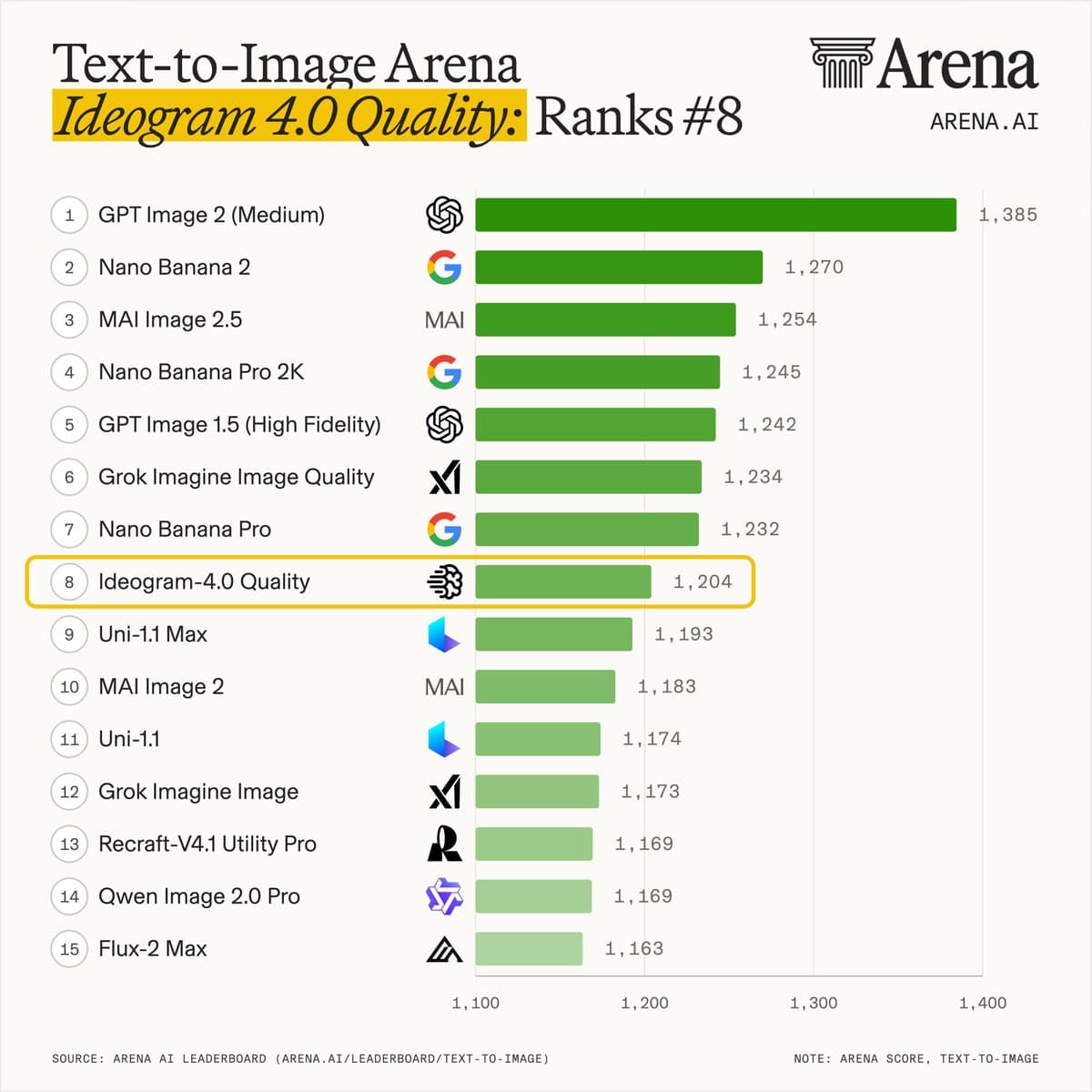
- In Arena's ranking post, Ideogram-4.0-Quality landed eighth in Text-to-Image Arena and became the top open model there, while Arena's category breakdown says the biggest gains showed up in text rendering and commercial design.
- The main workflow change is structured JSON prompting: ComfyUI's support post and the official technical post both point to bounding boxes, typed text elements, and hex palette controls as first-class inputs rather than prompt hacks.
- Access is broad on day one, with ComfyUI, fal, and AskVenice all announcing support within hours, but the weights on Hugging Face are gated and carry an Ideogram 4 Non-Commercial license.
- One caveat surfaced fast: ostrisai's test claimed Ideogram burned a safety filter image into the model behavior, which lines up with the ComfyUI guide stating the safety filter is baked into the weights and cannot be disabled in the UI.
You can read Ideogram's technical post, inspect the repo, and click through the gated Hugging Face card. There is already a day-zero ComfyUI guide, live hosted access on fal, and a separate product page that pushes a different angle: editable outputs, on-prem deployment, and commercial licensing by scale.
License gate
Ideogram is calling 4.0 open weight, and that is true in the download-and-run sense. The weights and inference code are public through GitHub and Hugging Face, but the model card labels both nf4 and fp8 releases as "Ideogram 4 Non-Commercial," with access gated behind license acceptance.
That makes the launch more permissive than a closed API release, but narrower than the phrase open source usually implies. Ideogram's own product page says commercial deployments are available under a separate license tied to deployment scale, while WesRoth's summary notes the same model is also live across Ideogram plans and the API.
JSON prompts
The interesting part is not just that the model is open, it is that Ideogram trained it on the same structured format it wants at inference time. According to the technical post, 4.0 was trained exclusively on structured JSON captions, using per-element styling plus optional bounding boxes and color palettes.
That JSON schema shows up everywhere in the launch materials:
- Bounding boxes use normalized coordinates for layout control, per ComfyUI's setup thread and the ComfyUI guide.
- Color palettes accept up to 16 hex colors per image and up to 5 per element, per btibor91's breakdown.
- Typed text elements separate render text from styling descriptions, which is how Ideogram is framing its typography gains, per btibor91's breakdown.
- Plain-text prompting still works, but the Hugging Face model card says a "magic prompt" LLM rewrites it into the JSON caption the model expects.
The architecture is unusually explicit too. The official post says the 9.3B model is a 34-layer single-stream DiT that uses Qwen3-VL-8B-Instruct as its text encoder and consumes hidden states from 13 intermediate layers.
Arena results
The public bragging rights came from Arena. In Arena's launch post, Ideogram-4.0-Quality ranked eighth overall in Text-to-Image Arena and first among open models; in Arena's follow-up, the largest category gains were text rendering plus product, branding, and commercial design.
The company is clearly aiming at design workflows rather than general image vibes. testingcatalog's summary highlights dense text rendering, native 2K output, transparency, and layout control, while grx_xce's post says the model also topped Design Arena among open releases.
Day-one surfaces
Ideogram did not keep 4.0 trapped inside its own app for even a day. ComfyUI shipped native support immediately, fal made it live on hosted inference, and AskVenice added a private-access endpoint the same afternoon.
The rollout broke into two usage paths:
- Local and workflow-native: ComfyUI's setup thread says users can pull an Ideogram v4 template, download the weights, and run locally.
- Hosted inference: fal's link post points to a public API endpoint, while Replicate's variants post lists Turbo, Balanced, and Quality variants on Replicate.
- Browser demos: Hugging Face's post linked a Hugging Face Space, and multimodalart's post framed the release as Ideogram's flip from closed to open weights.
One practical hardware detail also stood out. btibor91's launch summary says the nf4 build fits on a single 24 GB GPU, a claim that matches the nf4 quantized release on Hugging Face.
Burned-in safety filter
The most technical caveat came from outside the launch copy. The ComfyUI guide says Ideogram 4 includes an internal safety filter baked into the model weights and that ComfyUI cannot disable or tune it.
In ostrisai's test, prompt upsampling appeared to trigger false positives and still produced a distinctive blocked image; in ostrisai's follow-up, ostrisai connected that behavior to an older case where a safety placeholder leaked into downstream model outputs. That gives the launch a very specific wrinkle: the model is downloadable, but one of its guardrails may travel with it.