
Moonshot launches Kimi K3 with 2.8T parameters and 1M context
Moonshot launched Kimi K3 in Kimi products and API with 1M context, native multimodality, KDA/AttnRes, and weights promised by July 27. Benchmarks place it near frontier systems, but testers cite slow serving and usability caveats.
TL;DR
- Kimi K3 shipped as a 2.8T, 1M-context, native multimodal model, and Kimi_Moonshot's launch thread says it is live on Kimi.com, Kimi Work, Kimi Code, and the Kimi API.
- The open-weight release is scheduled, not done: Kimi_Moonshot's launch thread says full weights arrive by July 27, 2026, while Artificial Analysis's breakdown still classifies the launch model as not yet weight-released.
- Independent testing puts K3 near the frontier, not at the top: Artificial Analysis's breakdown gives it a 57 Intelligence Index score, behind Claude Fable 5 and GPT-5.6 Sol but ahead of Claude Opus 4.8.
- The main engineering caveat is harness behavior: Moonshot's limitation screenshot says K3 is sensitive to preserved thinking history, can be excessively proactive, and still has a user-experience gap versus Fable 5 and GPT-5.6 Sol.
- Ecosystem support landed fast: vLLM's note says Moonshot contributed KDA prefix caching for day-zero serving, while Cline's K3 instructions and Hermes Agent's K3 support added model-picker access.
Moonshot's official tech blog buries some of the fun stuff after the headline specs: K3 built a MiniTriton compiler, designed a 4 mm² chip in a 48-hour autonomous run, and reproduced an astrophysics workflow after reading 20+ papers. Simon Willison's pelican writeup found one tiny SVG prompt using 13,241 reasoning tokens, which is a useful smell test for the model's verbosity. The same official blog says Moonshot recommends 64 or more accelerators for efficient deployment, so "open weights" here means frontier-scale availability, not hobbyist local inference.
What shipped
- Model: Kimi K3, a 2.8T-parameter model with 1M context and native multimodal input, according to Kimi_Moonshot's launch thread.
- Surfaces: Kimi.com, Kimi Work, Kimi Code, and Kimi API, per the official tech blog.
- Weights: full model weights are promised by July 27, 2026, according to Kimi_Moonshot's launch thread.
- API price: $3.00 per 1M cache-miss input tokens, $0.30 per 1M cache-hit input tokens, and $15.00 per 1M output tokens, per the official availability section.
- Reasoning mode: max thinking effort is the launch default, with low and high modes coming later, according to the official tech blog.
- Model ID: OpenRouter listed
moonshotai/kimi-k3with text and image input, text output, 1M context, and $3/$15 pricing in scaling01's OpenRouter screenshot. - Unresolved from official sources: Moonshot did not publish the full technical report, active parameter count, or final weight license in the launch post, only the July 27 weight-release date.
Benchmarks that moved
First-party
- DeepSWE: Claude Opus 4.8 59.0 → Kimi K3 67.5, +8.5 points, in Kimi's official benchmark table.
- Terminal Bench 2.1: Claude Opus 4.8 84.6 → Kimi K3 88.3, +3.7 points, in Kimi's official benchmark table.
- FrontierSWE: Claude Opus 4.8 66.7 → Kimi K3 81.2, +14.5 points, in Kimi's official benchmark table.
- Program Bench: Claude Opus 4.8 71.9 → Kimi K3 77.8, +5.9 points, in Kimi's official benchmark table.
- SWE Marathon: Claude Opus 4.8 40.0 → Kimi K3 42.0, +2.0 points, in Kimi's official benchmark table.
- BrowseComp: Claude Opus 4.8 84.3 → Kimi K3 91.2, +6.9 points, in Kimi's official benchmark table.
Third-party evaluators
- Artificial Analysis Intelligence Index: Kimi K2.6 44 → Kimi K3 57, +13 points, according to Artificial Analysis's token-efficiency note.
- GDPval-AA v2: Kimi K2.6 1190 → Kimi K3 1668, +478 Elo, according to Artificial Analysis's full breakdown.
- AA-Briefcase: Kimi K2.6 815 → Kimi K3 1547, +732 Elo, according to Artificial Analysis's full breakdown.
- Frontend Code Arena: Kimi K2.6 1515 → Kimi K3 1679, +164 points, according to Arena's Frontend Code Arena result.
- Frontend Code Arena pairwise win rate: Claude Fable 5 63% → Kimi K3 76%, +13 points, according to Arena's pairwise win-rate update.
Customer-reported
- Next.js Agent Performance: Claude Fable 5 high 92% → Kimi K3 92%, +0 points, while average duration moved from 233.93s to 199.89s, -34.04 seconds, in Guillermo Rauch's Next.js benchmark.
- Atomic Chat retro games: Claude Opus 4.8 $0.54 → Kimi K3 $0.28, -$0.26, while output moved from 21.3K to 18.4K tokens, -2.9K tokens, in Rohan Paul's Atomic Chat test.
Where it regressed
Moonshot's own limitation section is the cleanest caveat: K3 trails Claude Fable 5 and GPT-5.6 Sol in user experience, according to Moonshot's limitation screenshot. The same section says quality can become unstable if the harness does not pass back preserved thinking history.
- Hallucination: Kimi K2.6 39% → Kimi K3 51%, +12 points worse, according to Artificial Analysis's AA-Omniscience update.
- LiveBench: Kimi K3 77.9 overall sits below GPT-5.4 xhigh at 78.0 and Opus 4.8 xhigh at 78.9, according to scaling01's LiveBench screenshot.
- ProgramBench metric: Ofir Press said Moonshot used average implementation percentage rather than ProgramBench's recommended fully implemented program metric, which can turn many 90%-complete failures into a high score.
- Serving: nrehiew_'s OpenRouter note put early throughput at 26 tokens per second, and synthwavedd's capacity post showed bad uptime during launch load.
- Real task miss: thdxr's coding anecdote said Sol fixed a TUI hover-color bug for $0.30, while Kimi reached $1.00 and started reading a database before being interrupted.
Under the hood
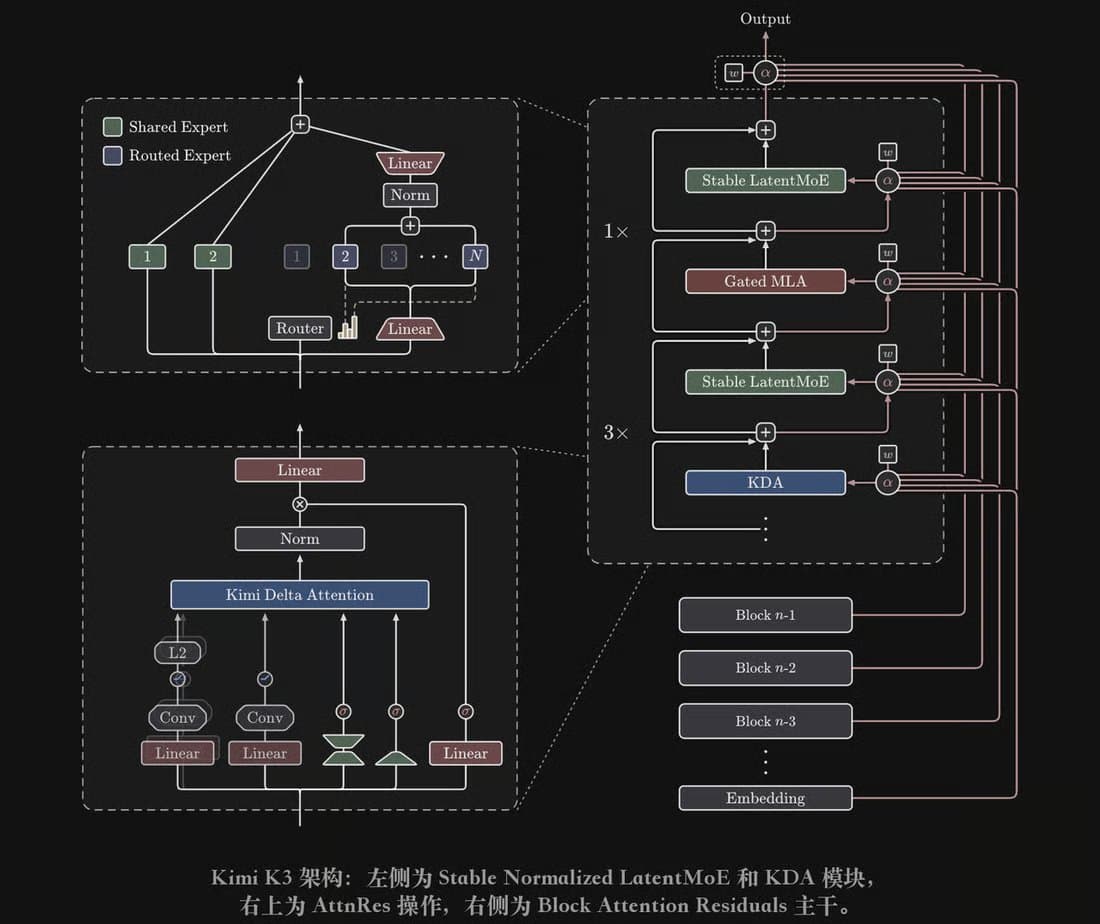
K3's architecture story is not just parameter count. Moonshot combined attention changes, extreme MoE sparsity, and serving work to make a 2.8T model plausible on the API.
- KDA and AttnRes: Kimi_Moonshot's architecture post says Kimi Delta Attention and Attention Residuals improve information flow across sequence length and model depth.
- Sparse MoE: K3 activates 16 of 896 experts under Stable LatentMoE, according to Kimi_Moonshot's architecture post.
- Scaling efficiency: the same post claims roughly 2.5x overall scaling efficiency over K2.
- Training details: the official tech blog names Quantile Balancing, Per-Head Muon, SiTU, Gated MLA, MXFP4 weights, and MXFP8 activations.
- Serving topology: teortaxesTex's deployment excerpt quotes Moonshot recommending supernodes with 64 or more accelerators.
- Prefix caching: vLLM's note says Moonshot contributed a KDA prefix-caching implementation because KDA breaks assumptions behind conventional prefix caching.
- Thinking history: Moonshot's limitation screenshot says K3 was trained with preserved thinking history, making mid-session model switches risky.
Contested claims
Claim: K3 is basically Fable/Sol class. Cited by: scaling01's benchmark count said K3 beat GPT-5.6 Sol on 11 of 14 official benchmarks and Opus 4.8 on all 14. Counter: Moonshot's limitation screenshot says K3 still has a noticeable UX gap versus Fable 5 and GPT-5.6 Sol. Evidence so far: Artificial Analysis's breakdown places K3 at 57, behind Fable 5 and GPT-5.6 Sol.
Claim: K3 proves China is only a few months behind the frontier. Cited by: kimmonismus's DeepSeek 2.0 framing argued K3 beats Opus 4.8 and narrows the US lead. Counter: Ryan Greenblatt's correction says quick tests put the K3 pretrain around halfway between Opus 4 and Opus 4.5, roughly 10 months behind Anthropic on pretraining. Evidence so far: the official launch table shows strong coding and agentic scores, while the full technical report is still unpublished.
Claim: K3's ProgramBench lead is decisive. Cited by: Kimi's official benchmark table lists K3 at 77.8, ahead of Fable 5 and GPT-5.6 Sol. Counter: Ofir Press said the metric Moonshot used can be misleading because it rewards partial implementations rather than fully working programs. Evidence so far: Moonshot's score is real for the published metric, but the benchmark maintainer disputes the metric choice.
Vibe Check
Hands-on reports converged on a model that is unusually strong at visual coding and long reviews, but often slow, verbose, and weirdly proactive.
- nrehiew_'s first impressions found strong multi-hop understanding, unusually detailed self-checks, good design, weaker taste than Claude, and slow platform behavior.
- nrehiew_'s SVG follow-up called the zero-shot output close to Opus for style, diagrams, and content, with verbosity and speed as the main negatives.
- doodlestein's FrankenGraphDB follow-up said Fable's meta-review found K3's plan review substantially correct, with the two most severe findings understated.
- doodlestein's clarification said K3 was not as good as Fable or Sol, but different enough in architecture, data, training, and attention mechanism to catch issues those models missed.
- Ethan Mollick's murder-mystery test said K3 still failed at satisfying murder mystery writing, where clues were too obvious or too obscure.
- Theo's 3D testing reply said K3 was far ahead of Fable and GPT-5.6 in limited Three.js modeling tests.
Where it shows up
- Kimi products: Kimi_Moonshot's launch thread lists Kimi.com, Kimi Work, Kimi Code, and the Kimi API as day-one surfaces.
- vLLM: vLLM's note says vLLM will support Kimi K3 on the day-zero release with KDA prefix caching.
- Cline: Cline's K3 instructions lists the model ID
moonshotai/kimi-k3and supports CLI, VS Code, and JetBrains use. - Hermes Agent: Teknium's Hermes Agent post says Kimi is available through Nous Portal, Kimi Direct, and OpenRouter.
- OpenCode Go: OpenCode's launch note made K3 available immediately, with higher limit consumption until a discount is negotiated.
- AI/ML API: TestingCatalog's AI/ML API post says K3 is live behind the same OpenAI-compatible endpoint as 1000+ other models.
- Arena: Arena's launch post added K3 to Agent Arena, Text, Vision, Document, and Frontend Code Arena.
- Conductor: Charlie Holtz's Conductor note shows K3 running through OpenCode plus an OpenRouter API key.
What the release signals
- LocalLLaMA users are split on whether huge open weights still count as local: one LocalLLaMA thread says massive open-weight drops feel like API marketing for normal rigs, while another LocalLLaMA thread discusses 1TB DDR3 servers and Q2 quantization plans for K3.
- The Chinese lab ecosystem is commercial, not just benchmark theater: Deedy Das's revenue map put five pure-play Chinese AI labs at a combined $2.6B revenue run rate, with Moonshot listed at $200M and a rumored $30B valuation.
- Policy questions moved from hypothetical to release-process concrete: Ethan Mollick's vetting question asked how open-weight pre-clearance works when models approach Mythos/Sol-class capabilities, since weights cannot be recalled after release.