
Thinking Machines releases Inkling: 975B open-weight multimodal MoE
Thinking Machines released Inkling with Apache 2.0 weights, 975B parameters, 41B active parameters, text/image/audio support, and up to 1M context. vLLM, SGLang, Modal, Databricks, and Vercel added day-zero support.
TL;DR
- Thinking Machines shipped Inkling as an Apache 2.0 open-weight MoE: 975B total parameters, 41B active, text/image/audio input, and up to 1M context, according to thinkymachines' launch thread.
- The launch is aimed at customization, not benchmark maximalism: soumithchintala's note called Inkling a first general model available on Tinker, Hugging Face, and partners.
- The architecture has several nonstandard choices for a 1T-class model: relative position bias instead of RoPE, short convolutions, a 5:1 sliding-window/global attention mix, and 2 shared MoE experts, as ben_burtenshaw's architecture read summarized.
- Day-zero deployment landed broadly: vllm_project reported BF16 and NVFP4 support, while modal said its DFlash speculator produced 67% higher throughput.
- Early evaluation split fast: the AA benchmark thread put Inkling at the top of U.S. open-weight models, while emollick's first test found it rough on a constraint-following poem task.
The official launch post includes a self-finetuning demo where Inkling writes and evaluates its own Tinker job. The model card says BF16 needs at least 2TB aggregate VRAM, while NVFP4 cuts that to at least 600GB. The vLLM integration post claims up to 380 tok/s/user on 4 GB200s with MTP, and Unsloth's local guide gets a 1-bit GGUF down to 270 to 285GB.
What shipped
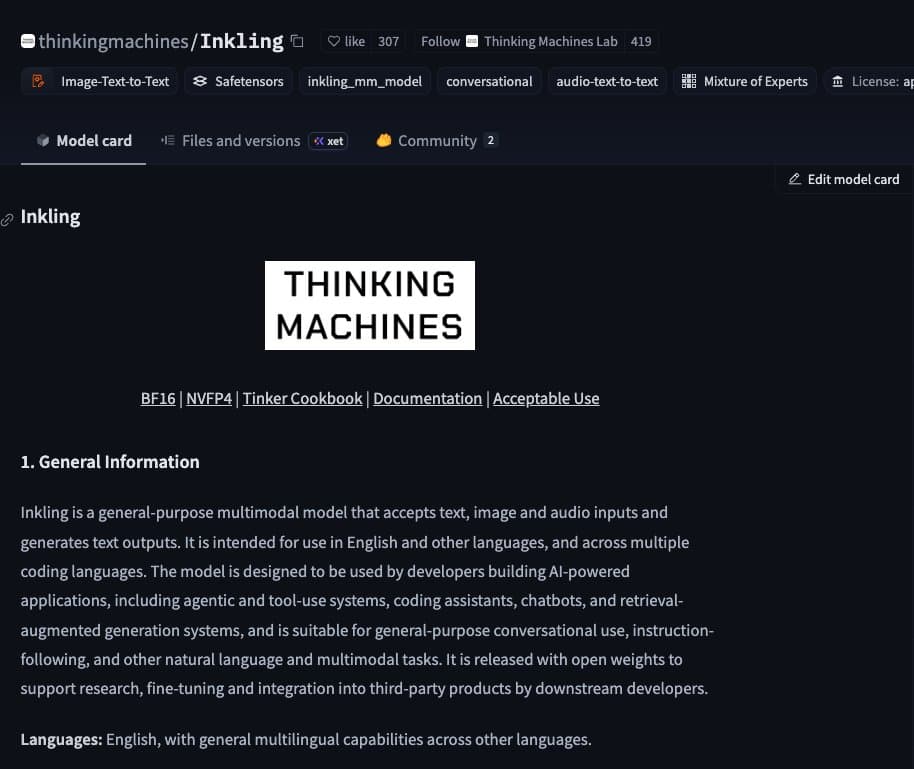
Inkling is Thinking Machines Lab's first production language model release, and the weights are downloadable through Hugging Face. The model card lists Apache 2.0 licensing, BF16, MXFP8, and NVFP4 numerics, plus third-party API distribution.
The core spec:
- 975B total parameters, 41B active.
- Sparse MoE, 6 of 256 routed experts per token, plus 2 shared experts.
- 66-layer decoder-only transformer.
- Text, image, and audio inputs, text output.
- Up to 1M context in the open weights.
- 64K and 256K context options on Tinker, per the official launch post.
- Pretrained on 45T tokens across text, images, audio, and video.
- Inkling-Small previewed with 12B active parameters.
The sharpest product read is simple: Thinking Machines released a large open base model and attached it to Tinker as the customization funnel.
Architecture
Inkling looks conservative at the skeleton level and weird in the details. The model card describes a decoder-only multimodal autoregressive transformer, while the launch post's architecture section adds the long-context choices.
The interesting pieces:
- MoE: 256 routed experts, 6 active per token, plus 2 shared experts.
- Router: sigmoid-based, auxiliary-loss-free load balancing, with selected routed experts and shared experts normalized jointly.
- Attention: local and global layers interleaved at a 5:1 ratio.
- Position: learned relative positional bias instead of RoPE.
- Short convs: applied after key/value projections, and on attention and MLP residual branch outputs.
- Multimodal inputs: images use 40x40 patch encoding through a four-layer hMLP, audio uses dMel spectrogram inputs, and both are processed jointly with text tokens.
rasbt's architecture note called out the same surprise trio: small conv layers, embedding RMSNorm before block RMSNorm, and relative position bias. stochasticchasm's RoPE note focused on the relative-position choice, calling it unusual for a full-scale run.
Benchmarks and first tests
Artificial Analysis put Inkling at 41 on its Intelligence Index, 3 points above Nemotron 3 Ultra at 38, making it the leading U.S. open-weight model in that index. The same Artificial Analysis writeup reported 1238 Elo on GDPval-AA v2, above Kimi K2.6 at 1190 and DeepSeek V4 Flash max at 1189.
The token-efficiency result is more interesting than the rank. The benchmark thread says Inkling averaged 25K output tokens per Intelligence Index task, versus 43K for GLM-5.2 max, 38K for Kimi K2.6, and 37K for DeepSeek V4 Pro max.
The official table still shows plenty of gaps:
- GLM 5.2 beats Inkling on Terminal Bench 2.1, 82.7% to 63.8%, in the Thinking Machines benchmark table.
- Claude Fable 5 is far ahead on SWE-bench Verified, 95.0% to Inkling's 77.6%, in the same table.
- Gemini 3.1 Pro high is ahead on MMMU Pro, 82.0% to Inkling's 73.5%.
- Inkling's strongest official audio score is VoiceBench at 91.4%, close to Gemini 3.1 Pro high at 94.3%.
Hands-on reports were less clean. emollick's test showed Inkling failing a six-line alliterative rhyming poem task, and one scaling01 follow-up called it usable while framing the benchmarks as below the Chinese open-weight frontier.
Controllable thinking effort
Inkling exposes thinking effort as a continuous control rather than a small named menu. thinkymachines' thread said the setting lets users choose a point on the cost/performance curve, reaching the same score with fewer tokens.
The official launch post says Thinking Machines swept effort from 0.2 to 0.99 on Terminal Bench 2.1, HLE, and IFBench. It claims Inkling matched Nemotron 3 Ultra on Terminal Bench 2.1 at roughly one third of the tokens.
The implementation detail surfaced in community analysis: nrehiew_ tied the compressed late-RL chain-of-thought style to adjusting per-token cost during training. saranormous called the effort sweep a better way to present capability than flat benchmark percentages.
Serving stack
The day-zero serving story was unusually broad for a new open-weight model. thinkymachines' ecosystem note listed Together, Fireworks, Databricks, Unsloth, Modal, Baseten, Lightseek, Inferact on vLLM, and RadixArk on SGLang.
Concrete numbers and hooks:
- vLLM supports BF16 and NVFP4 checkpoints, with up to 380 tok/s/user using MTP and 140 tok/s/user without MTP on 4 GB200 GPUs.
- lmsysorg said SGLang implements ShortConv, relative attention, shared expert sink MoE, prefill full CUDA graph, and MXFP8 KV cache.
- modal said Inkling on Modal uses a custom DFlash speculator for 67% higher throughput and interactivity.
- vercel_dev put the model on AI Gateway under
thinkingmachines/inkling. - baseten added day-zero hosted access, with continuing optimization work credited to Inferact.
Local deployment is technically real and physically ridiculous. UnslothAI said its dynamic 1-bit quant runs around 280GB, and Unsloth's documentation lists 270 to 285GB disk for dynamic 1-bit, 317GB for 2-bit, and 1.9TB for BF16.
Tinker and post-training
johnschulman2 said pretraining began last winter, and a small team started building coding, reasoning, and agentic training in mid-January. That timeline makes Inkling feel less like a one-off checkpoint drop and more like the first artifact from a post-training factory.
The Tinker angle has three parts:
- The official launch post says Inkling is available for fine-tuning on Tinker and in a new Inkling Playground.
- The same post shows Inkling writing, running, and evaluating its own fine-tuning job.
- ben_burtenshaw's OpenEnv example connects Tinker, Inkling, and ECHO, where environment-token prediction trains an implicit world model without a separate verifier or extra rollouts.
The first customer quotes were about efficiency and tool use. tinkerapi's thread quoted Mantic saying Inkling beat Kimi K2.6 on its forecasting evals with half the output tokens, while Trajectory Labs described concise reasoning, strong tool calling, and long-horizon agentic behavior.
Distillation caveat
A viral claim framed Inkling as the only open-weight model trained without distilling from OpenAI or Anthropic. The official post-training paragraph narrows that claim: teortaxesTex's screenshot shows Thinking Machines saying it bootstrapped an initial SFT pass with synthetic data from open-weight models including Kimi K2.5, while most compute went to large-scale RL on synthetic and human-created environments.
jxmnop's correction later conceded that Inkling did use distillation, described as a small amount. the Community Note screenshot added another boundary condition: Meta's Llama 3.1 was also trained from scratch, challenging the broadest version of the purity claim.
The cleaner version: no cited OpenAI or Anthropic teacher appears in the disclosed SFT bootstrap, and Kimi K2.5 does.
Inkling-Small
Inkling-Small did not ship as open weights on day one. JustinLin610 asked whether the small model was open sourced, and cHHillee replied that the team needed to finish final testing.
The preview is still worth tracking as a separate model. stochasticchasm's note pointed out how evenly the small model traded blows with the larger one in the release table, and nrehiew_'s table read argued the comparison hints at which tasks need larger capacity, naming Terminal Bench and SimpleQA as examples.