
LingBot 2.0 releases open weights for robot-action and world models
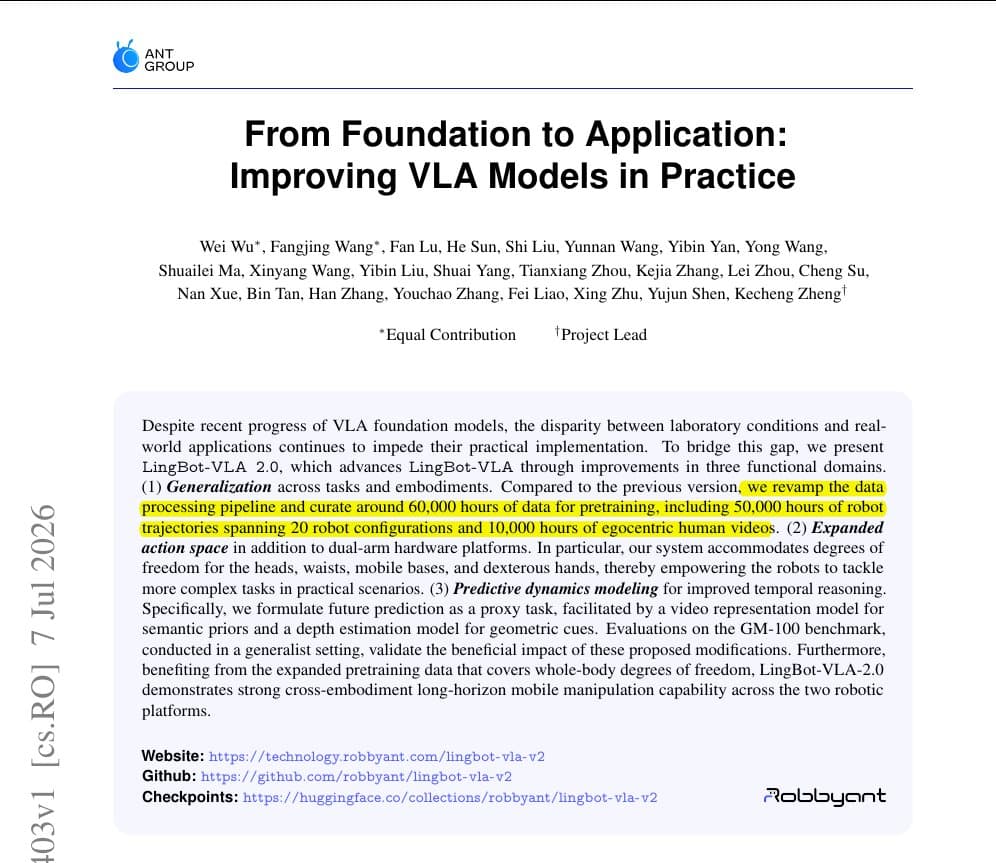
LingBot 2.0 released code and weights for a real-time world model and robot-action models. The VLA maps 20 robot body configurations into a 55D action format and filters 90,000 raw robot hours to 50,000 training hours.
TL;DR
- Robbyant shipped a broad open release: World 2.0 has code, weights, and partner hosting through Reactor, while VLA 2.0 has GitHub, Hugging Face, and paper links in the World resource post and the VLA resource post.
- LingBot-World 2.0 reports a 60-minute, 20-scenario interactive rollout at 720p and 60fps with no perceptible decay, according to rohanpaul_ai's World overview.
- LingBot-VA 2.0 moves video-action modeling toward native control pretraining, with omarsar0's thread citing 93.6 average on RoboTwin 2.0 and a 927 ms to 142 ms per-chunk inference drop.
- LingBot-VLA 2.0 is the cross-body robot policy: the action-format note says it maps robot bodies into one 55D action vector, and the data-filtering note says 90,000 raw robot hours become 50,000 cleaner hours.
- LingBot-Video adds the simulator-side base model: the LingBot-Video overview says the 30B MoE model activates 3B parameters per generation and adds 70,000+ hours of embodied footage.
The live links are unusually complete for a robotics drop: World has code, weights, and a Reactor-hosted demo; VLA has GitHub, Hugging Face, and a paper; Video has Hugging Face, GitHub, and a paper. The strangest part is the game-like world harness: hotkeys for combat, archery, spell-casting, shooting, weather, user-registered events, and multiplayer show up in the interaction note.
What shipped
Robbyant, described in launch posts as Ant Group's embodied-AI company, released four adjacent pieces:
- LingBot-World 2.0 / LingBot-World-Infinity: an interactive world model that starts from one frame and accepts live camera movement or text instructions, according to rohanpaul_ai's World overview.
- LingBot-VA 2.0: a video-action foundation model pretrained for robot control from scratch, according to omarsar0's architecture post.
- LingBot-VLA 2.0: a whole-body robot policy trained across 20 robot configurations, according to rohanpaul_ai's VLA overview.
- LingBot-Video: a MoE Diffusion Transformer video foundation model for embodied AI, with resources collected in the Video resource post.
World model
World 2.0 takes one starting frame plus live camera movements or text instructions, then keeps generating the scene as the user moves. It reports a single 60-minute rollout across 20 scenarios with no perceptible decay, plus real-time output at 720p and 60fps, according to rohanpaul_ai's overview.
The model release includes a 14B main model and a 1.3B variant for a single consumer GPU, according to omarsar0's release note.
The training recipe in the World overview and the attention-mask note has four useful parts:
- A slower causal diffusion model learns high-quality world prediction.
- Consistency distillation compresses the model into a few-step student.
- Distribution Matching Distillation trains the student on its own long rollouts, so it learns from imperfect generated histories.
- A mixed bidirectional and autoregressive attention mask preserves cause-before-effect while regularizing long context.
Agentic harness
The world model ships inside an agent scaffold. A VLM acts as the “Brain,” the video generator acts as the “Cerebellum,” and two agents keep the generated world moving, according to the World overview.
- Pilot agent: plans and executes character behavior.
- Director agent: seeds fresh content and events.
- Mode A: direct semantic interaction without masks.
- Mode B: SAM-tracked object interaction.
- World intervention: day/night changes, weather, and entity spawning.
Navigation is only one control surface. The interaction note lists WASD and IJKL controls, combat, archery, spell-casting, shooting, weather changes, user-registered events, and multiple players inside the same generated world, while itsPaulAi's post frames the release as image-to-interactive-world with open weights and harness.
Video-action control
LingBot-VA 2.0 pretrains the video-action stack natively for embodiment, rather than adapting a content video generator with an action head, according to omarsar0's architecture post.
The control stack in omarsar0's thread is easier to read as components:
- World states and latent actions share one semantic latent space.
- A visual-action tokenizer aligns to a frozen vision foundation model.
- Latent actions are learned self-supervised from unlabeled video, so web video contributes control signal.
- Causal training starts from scratch because control runs forward in time.
- The video stream uses sparse MoE: 128 experts, top-8 routing, one shared expert, about 13B total parameters, and about 1.9B active per token.
- The action stream stays dense.
- Systems optimization cuts per-chunk inference from 927 ms to 142 ms and raises asynchronous execution from 35 Hz to 225 Hz.
- Foresight Reasoning drafts the next action chunk while the current one executes, then re-grounds on the latest real observation.
The headline robot number is 93.6 average on RoboTwin 2.0, ahead of π0.5 and the prior VA model, with adaptation from 10 to 15 demonstrations, according to the same thread.
Whole-body VLA
VLA 2.0 is the cross-body policy. It maps each robot into one 55-dimensional vector covering arm joints, end-effector pose, grippers, dexterous hands, waist, head, and base motion, with padded values for missing body parts, according to the action-format note.
The data pipeline starts with about 90,000 raw robot hours and keeps 50,000 after filtering jerky motion, static signals, joint-video mismatch, damaged camera footage, blur, dropped frames, and long static periods, according to the filtering note. Human videos are filtered for hand-object interaction, then camera motion and hand pose are reconstructed as action data in the VLA overview.
The VLA stack adds two modeling tricks:
- Sparse MoE inside the action expert: the MoE note says the 1.6B-parameter model keeps about 0.6B active per step while beating a dense 0.6B model on training loss and validation action error.
- Learned current/future queries: the depth and video-feature note says LingBot-Depth teaches geometry while DINO-Video teaches time-aware visual features.
On Agilex GM-100, VLA 2.0 reaches 66.2% progress and 34.4% success versus π0.5 at 59.1% and 32.2%, according to the VLA overview. Refrigerator sorting reaches 77.1% progress and 60.0% success, and stove cleaning reaches 84.3% progress and 66.7% success in the long-horizon task note.
Embodied video pretraining
LingBot-Video is the base video model in the release cluster. The overview says the flagship 30B model activates 3B parameters per generation at 1M-token sequences, and the efficiency note says it is 3.18x faster than a dense 30B model at that length.
Its data and reward stack is tuned for action, not only image quality:
- The pretraining mix adds 70,000+ hours of embodied footage covering robot manipulation, navigation, and egocentric video, according to the data note.
- Samples are tagged across quality, camera, motion, semantic, and structural signals for filtering and rebalancing, according to the profiling note.
- Rewards score text-video fit, motion level, motion coherence, human-motion consistency, and physical plausibility, according to the reward note.
- Physical plausibility is pushed toward causality, object permanence, and non-penetration in the same reward note.
LingBot-Video reports 0.620 average on RBench, according to the RBench note.
Uneven scores and memory
The source material names the weak spots.
- VLA 2.0 loses badly to π0.5 on Agilex block sorting, while relative joint targets raise average success from 33.7% to 55.0%, a 21.3-point shift, according to the failure-case note.
- World 2.0 has visual persistence but not true long-term identity: the memory note says a region that leaves the context window may be generated again rather than remembered exactly.
- LingBot-Video's RBench result is not a sweep: the RBench note says Wan 2.6 still leads the Spatial and arm columns.
Action-to-Video
One robotics piece sits at the boundary between video generation and policy evaluation: Action-to-Video. Given an initial world state and a robot action sequence, LingBot-Video rolls out likely future frames, according to rohanpaul_ai's Action-to-Video note.
That makes the video model simulator-like machinery for data generation, policy evaluation, and action planning in the same note.