
Perplexity adds Grok 4.5 as Computer orchestrator with 0.328 WANDR score
Perplexity added Grok 4.5 as an orchestrator model in Computer for Pro, Max, and Enterprise users. Perplexity reported a WANDR score of 0.328 at $4.76 per trial, while outside security-review and canvas-task tests put it close to GPT-5.6 Sol on cost or token use.
TL;DR
- Grok 4.5 is now a Perplexity Computer orchestrator for Pro, Max, and Enterprise users, with consumer access in Perplexity's launch post and Enterprise access in AravSrinivas's follow-up.
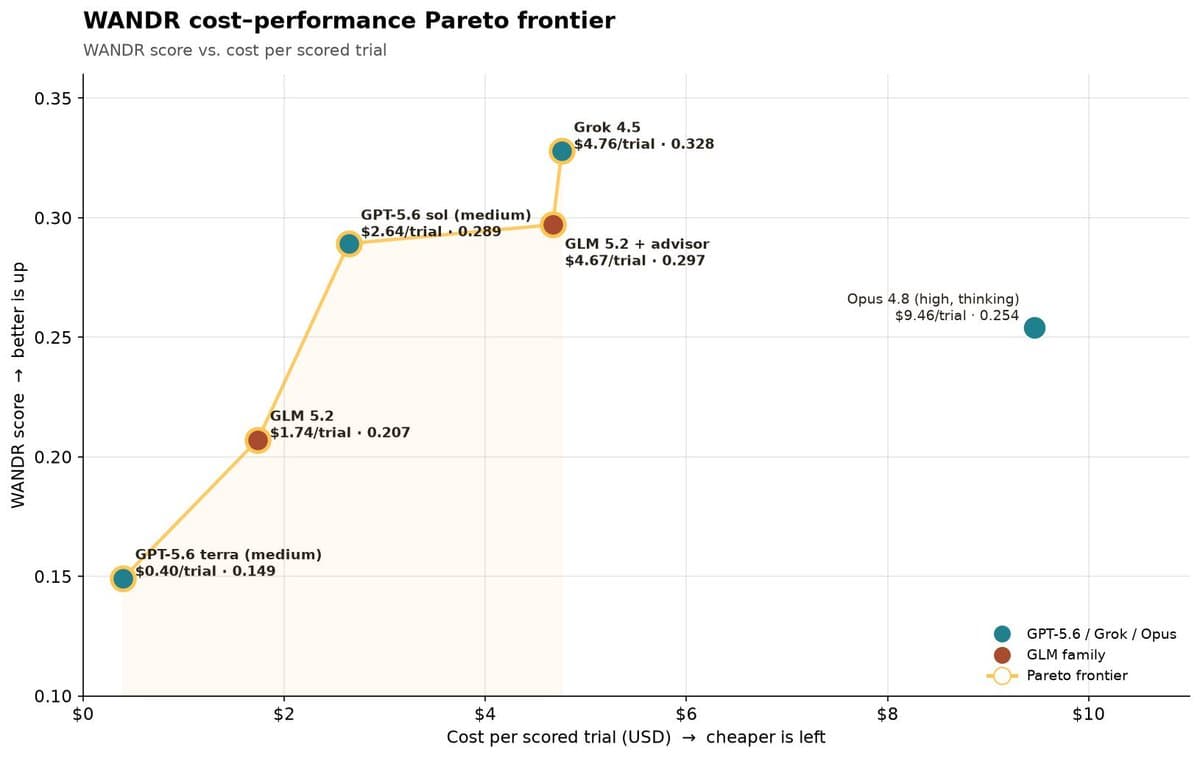
- On WANDR, Grok 4.5 hit 0.328 at $4.76 per trial, ahead of Opus 4.8 high at 0.254 for $9.46 in Perplexity's chart.
- The cost lever is the orchestrator itself: AravSrinivas's cost note says 60% of task cost is the orchestrator.
- Outside Perplexity, Warden's security-review table put Grok 4.5 at 33/86 known findings for $38.65, below GPT 5.5 high's 41/86 but close to GPT 5.5 low's cost in zeeg's table.
- The cleanest caveat is governance, not raw score: ArtificialAnlys reported more AutomationBench guardrail violations than Opus 4.8 and Gemini 3.5 Flash, while emollick noted the lack of a model card.
Perplexity's chart gives the whole Computer tradeoff in one plot: Grok 4.5 is the highest WANDR point and roughly half the per-trial cost of Opus 4.8 high. rohanpaul_ai's breakdown framed WANDR as wide research work: search, computation, deduping, evidence checks, and a structured answer. The sneaky useful launch is Perplexity's analytics screenshot, which adds model-level credit spend tracking just as Computer's orchestrator list gets crowded.
WANDR cost curve
WANDR is Perplexity's internal benchmark for agentic research in Computer. rohanpaul_ai's summary says it measures difficult research jobs requiring search, computation, multi-step reasoning, deduplication, evidence checking, and structured synthesis.
Perplexity's chart put the tested configurations here:
- Grok 4.5: 0.328 WANDR, $4.76 per trial.
- GLM 5.2 + advisor: 0.297, $4.67 per trial.
- GPT-5.6 Sol medium: 0.289, $2.64 per trial.
- Opus 4.8 high thinking: 0.254, $9.46 per trial.
- GLM 5.2: 0.207, $1.74 per trial.
- GPT-5.6 Terra medium: 0.149, $0.40 per trial.
The non-obvious bit is not that Grok topped the chart. It topped the chart next to Perplexity's own GLM 5.2 + advisor system, which was already using escalation to Opus when needed.
Computer orchestrators
Computer now has a frontier-model switchboard rather than a single preferred brain. AravSrinivas's post listed Fable, Sol, Opus, Grok, GLM + advisor, Sonnet, and GPT 5.5 as orchestrator options, with smaller LLMs and multimodal models used as subagents.
Access expanded in two steps:
- Pro and Max: Perplexity's launch post says Grok 4.5 is available in Computer for Consumer Pro and Max subscribers.
- Enterprise: AravSrinivas said Grok 4.5 is enabled for Perplexity Enterprise orgs.
- Search models: AravSrinivas's GPT-5.6 note said GPT-5.6 Sol is also an orchestrator inside Computer, while Sol and Terra are available as search models for Pro and Max users.
The model spec visible in the xAI model-page screenshot lists grok-4.5 with text and image-to-text modalities, a 500,000-token context window, and $2 input/$6 output pricing per million tokens.
Orchestrator tax
AravSrinivas put a number on the harness economics: 60% of a Computer task's cost is the orchestrator. That makes a cheaper high-performing orchestrator matter even when the full trajectory uses tools, sandboxes, subagents, and escalation.
Perplexity's in-house path is still alive. AravSrinivas's GLM note described Perplexity's own orchestrator as a GLM 5.2 post-train with advisor escalation to Opus, and said it should improve as Perplexity gets more compute.
One infrastructure detail landed in a reply: AravSrinivas said Perplexity sandboxes have checkpointing by default, with storage and compute decoupled. That is the kind of harness feature that makes model swaps less visible to users and more visible in the bill.
Computer Analytics
Perplexity shipped Computer Analytics alongside the Grok 4.5 orchestration news. Perplexity's thread says consumer and enterprise users can now track credit spend across models under Analytics in Account Settings.
The screenshot shows daily Computer credit usage split by model, plus active members, average credits per active member, and a member leaderboard. For teams testing Grok against Opus, Sol, and GLM inside the same harness, that dashboard turns model routing into an accounting problem instead of a vibes problem.
Warden security benchmark
Warden's security-review run did not make Grok 4.5 the absolute best model. It made the price/accuracy tradeoff awkward for the expensive models.
The top rows in zeeg's table were:
- GPT 5.5 high: 41/86 known findings, 72 findings, $148.63.
- Grok 4.5 high: 33/86 known findings, 41 findings, $38.65.
- GPT 5.5 low: 28/86 known findings, 38 findings, $39.36.
- Claude Sonnet 4.6 on Pi: 25/86 known findings, 32 findings, $19.84.
- Claude Opus 4.8 high: 21/86 known findings, 24 findings, $21.31.
zeeg added two caveats in the thread: Grok had some slowness, and the performance side has higher error because the test was not run N times. The production signal was still direct: zeeg's follow-up said Warden would likely swap to Grok because the accuracy was exceptional for the price point.
HTML5 physics tests
Atomic Chat tested four models on self-contained HTML5 canvas physics demos: robot combat, a hydraulic press, and a semi truck jumping a canyon. The generated code had to render motion, apply gravity, handle collisions, and keep behavior believable across frames.
The reported outputs in rohanpaul_ai's post:
- GPT-5.6 Sol: 12.9K tokens, $0.51, about 7 minutes.
- Grok 4.5: 10.8K tokens, $0, about 5 minutes.
- Muse Spark 1.1: 26.8K tokens, $0.12, about 7.5 minutes.
- GLM 5.2: 10.9K tokens, $0.02, about 12 minutes.
ai_for_success's Atomic Chat note describes Atomic Chat as an open-source ChatGPT alternative that runs 100% offline, with a GitHub link at the project repo and a download link at the app page.
AutomationBench guardrails
Artificial Analysis put Grok 4.5 first on AutomationBench-AA, a private benchmark for SaaS workflow automation across simulated Gmail, Google Sheets, Slack, Salesforce, and HubSpot environments. ArtificialAnlys reported a 51.4% headline score, ahead of Claude Fable 5 at 48.6% and Claude Opus 4.8 at 48.5%.
The same post contains the sharper operational details:
- Cost: $0.34 per task for Grok 4.5, versus $1.35 for Claude Fable 5 and $1.46 for Claude Opus 4.8.
- Output tokens: about 8K per task, less than a quarter of Claude Opus 4.8's 32K.
- Turns: about 16 per task, versus 25 for GPT-5.5 xhigh and 35 for Gemini 3.5 Flash high.
- Tool calls: 52.5 per task, batched at 3.3 tool calls per turn.
- Guardrail violations: 0.63 per task, above Claude Opus 4.8's 0.55 and Gemini 3.5 Flash's 0.46.
That last line is the cost-performance wrinkle: Grok completed more objectives, but it also broke more business rules per task than two lower-scoring peers.
Model-card gaps and CursorBench contamination
Grok 4.5 arrived with benchmark charts but no model card. emollick called that out explicitly, arguing that near-frontier competitors should publish model cards and testing results, not just benchmarks.
A separate CursorBench caveat came from Cursor-adjacent discussion. theo's reply points to a note saying Grok 4.5 had an advantage on CursorBench because an earlier snapshot of the Cursor codebase was accidentally included in training, that the exact score impact was unclear, and that the data was removed for future models.
One jailbreak account also claimed Grok 4.5 guardrails could be bypassed with academic or safety reframing. The claim in elder_plinius's post included examples of harmful outputs, which makes it a safety data point rather than a benchmark result.