
GPT-5.6 Sol ranks near top of DeepSWE and coding evals at lower reported cost
New benchmark posts put GPT-5.6 Sol at or near the top of DeepSWE and several coding/context evals. Cost reports placed Luna on the efficiency frontier, while Amp said replacing Opus with GPT-5.6 cut its average model costs ~50%.
TL;DR
- GPT-5.6 shipped as a three-model family, Sol, Terra, and Luna, across ChatGPT, Codex, and the API, according to OpenAI's rollout thread.
- Sol’s strongest public story is agentic coding price-performance: it topped DeepSWE at 73% while Fable 5 hit 70%, with average task cost at $8.39 vs $21.63 in the DeepSWE chart.
- The new API plumbing matters as much as the model score: Programmatic Tool Calling lets GPT-5.6 write JavaScript to coordinate tools, and multi-agent spawning is in beta, per OpenAI Devs' API thread.
- The launch had real rough edges: OpenAI said it made high-compute settings too easy to burn, reorganized the desktop app too aggressively, and introduced regressions in some multi-agent workflows in the launch follow-up.
- Ecosystem rollout was immediate, with Cursor, VS Code, Devin, OpenRouter, Lovable, Factory, Warp, and Microsoft 365 Copilot all surfacing GPT-5.6 in the first wave, including Cursor's launch post and sama's Microsoft 365 note.
OpenAI's launch page framed GPT-5.6 as an efficiency release, but the weird bits are in the developer plumbing. OpenAI Devs described JavaScript-based tool orchestration in hosted V8 runtimes, plus beta multi-agent requests that spawn concurrent subagents inside one Responses API call. Simon Willison's writeup pulled out the quiet spec-sheet details: all three models list a February 16, 2026 knowledge cutoff, 1M context, and 128K max output.
What shipped
- Models: GPT-5.6 Sol, Terra, and Luna, rolling out across ChatGPT, Codex, and the API, per OpenAI's rollout thread.
- ChatGPT access: Plus, Pro, Business, and Enterprise users get Sol through medium and higher effort settings, while Pro and Enterprise also get GPT-5.6 Pro for complex tasks, according to OpenAI's availability note.
- API pricing: Sol is $5 input and $30 output per 1M tokens, Terra is $2.50 and $15, and Luna is $1 and $6, as shown in the pricing note.
- Cache pricing: GPT-5.6 adds cache writes at 1.25x uncached input, while cache reads keep the 90% cached-input discount, according to the cache-pricing excerpt.
- Ultra mode: OpenAI described Ultra as a high-performance setting that coordinates multiple agents in parallel and trades higher token use for stronger results, in the Ultra announcement.
- Product surface: ChatGPT Work, a new desktop app, and hosted Sites were the three non-model launches Sam Altman listed in sama's launch post.
- Desktop merge: Codex joined the ChatGPT desktop app on macOS and Windows, with inline diff editing, PR review, multi-repo projects, and faster Computer Use in the Codex release note.
Benchmarks that moved
First-party
- Agents' Last Exam: Claude Fable 5 40.5% → GPT-5.6 Sol 53.6%, +13.1 points, per OpenAI's benchmark post.
- Terminal-Bench 2.1: Claude Mythos 5 88.0% → GPT-5.6 Sol Ultra 91.9%, +3.9 points, per the Terminal-Bench chart.
- DeepSWE v1.1: GPT-5.5 67.0% → GPT-5.6 Sol 72.7%, +5.7 points, per the official coding table.
- SEC-Bench Pro: GPT-5.5 45.8% → GPT-5.6 Sol Ultra 74.3%, +28.5 points, per the cybersecurity table.
Third-party evaluators
- Artificial Analysis Coding Agent Index: Claude Fable 5 77.2 → GPT-5.6 Sol 80.0, +2.8 points, per OpenAI's AA citation and Artificial Analysis' eval.
- DeepSWE: Claude Fable 5 70% → GPT-5.6 Sol 73%, +3 points, with Sol at $8.39 per task vs Fable at $21.63 in the DeepSWE chart.
- Context Arena AUC@128k: GPT-5.5 xhigh 91.7% → GPT-5.6 Sol max 97.1%, +5.4 points, according to the Context Arena thread.
- Context Arena 512k pointwise: previous best 57.6% → GPT-5.6 Sol max 61.3%, +3.7 points, according to the Context Arena follow-up.
- Code Arena Frontend: GPT-5.5 xhigh 1502 → GPT-5.6 Sol xhigh 1636, +134 Elo, according to Arena's frontend post.
- AA-Briefcase Presentation Elo: GPT-5.5 xhigh 1122 → GPT-5.6 Sol max 1656, +534 Elo, according to Artificial Analysis' Briefcase post.
- CritPt physics: GPT-5.5 xhigh 27.1% → GPT-5.6 Sol max 32.3%, +5.2 points, according to Artificial Analysis' CritPt post.
Customer-reported
- Box Financial Services eval: GPT-5.5 71% → GPT-5.6 Sol 76%, +5 points, according to Aaron Levie's Box eval.
- Box Healthcare eval: GPT-5.5 46% → GPT-5.6 Sol 58%, +12 points, according to the same Box eval.
- Box Public Sector eval: GPT-5.5 63% → GPT-5.6 Sol 74%, +11 points, according to the same Box eval.
- Lovable production workflows: prior model baseline → GPT-5.6, 25% fewer steps, 35% to 48% fewer tool calls, and 15% fewer stuck runs, according to Lovable's rollout note.
Where it regressed
SWE-Bench Pro is the cleanest benchmark caveat in OpenAI's own table: Claude Mythos 5 scored 80.3% while GPT-5.6 Sol scored 64.6%, a -15.7 point gap for Sol on that eval, per the official coding table.
Other misses clustered around taste, knowledge accuracy, document parsing, and launch UX:
- AA-Briefcase overall: Claude Fable 5 1583 Elo → GPT-5.6 Sol 1495 Elo, -88 Elo, according to Artificial Analysis' Briefcase chart.
- AA-Briefcase rubric score: Claude Fable 5 56% → GPT-5.6 Sol 42%, -14 points, according to Artificial Analysis' writeup.
- AA-Briefcase Analytical Quality Elo: Claude Fable 5 1764 → GPT-5.6 Sol 1592, -172 Elo, according to Artificial Analysis' writeup.
- SimpleBench: Claude Fable 5 81.9% → GPT-5.6 Sol Pro 71.7%, -10.2 points, according to the SimpleBench table.
- ParseBench average: GPT-5.5 64.4 → GPT-5.6 Sol 62.1, -2.3 points, according to Jerry Liu's ParseBench post.
- Code Arena Frontend top score: Claude Fable 5 1649 → GPT-5.6 Sol xhigh 1636, -13 Elo, according to Arena's leaderboard.
OpenAI also had to patch product defaults. The launch follow-up said the team made the highest-compute settings too easy to use without enough usage-limit clarity, moved familiar chats and projects too abruptly, made Codex users worry the product was going away, and introduced regressions for some existing multi-agent workflows.
Under the hood
The API launch added two pieces of harness machinery that explain why the benchmark story is not just “a smarter model.”
- Programmatic Tool Calling: GPT-5.6 can write and run JavaScript to coordinate tool workflows, process results, and decide next steps inside isolated hosted V8 runtimes, according to OpenAI Devs' API thread.
- Multi-agent beta: The Responses API can spawn concurrent subagents within one request, divide work across approaches, and synthesize one result, according to the same API thread.
- Ultra: OpenAI framed Ultra as max reasoning plus automatic task delegation, while reach_vb's reasoning explainer said Max is one model working longer and Ultra is multiple subagents working in parallel.
- Effort levels: Light, Medium, High, xhigh, Max, and Ultra do not map directly from GPT-5.5 to GPT-5.6, according to the reasoning explainer.
- Prompt caching: GPT-5.6 adds explicit cache breakpoints, a 30-minute minimum cache life, 1.25x cache-write billing, and 90% cache-read discounts, according to the pricing excerpt.
- Context: Simon Willison's writeup reported 1M context and 128K max output for all three models, while one Codex context screenshot put usable GPT-5.6 context in Codex around 353K after reserving space for compaction.
- Cerebras: Early posts hyped 750 tokens per second, but Cedric Chee's note said Cerebras was not in the launch docs, and thsottiaux's reply said the widely shared 750 TPS clip was normal fast mode rather than the Cerebras variant.
Vibe Check
Hands-on reports mostly described Sol as a cheaper workhorse with better follow-through than GPT-5.5 and less “big model smell” than Fable.
- MatthewBerman said he used GPT-5.6 Sol internally for two months and about 25B tokens, found it better at long sustained work, and estimated daily use felt 2x to 3x faster than Fable in his review.
- Petergostev reported a 47-hour /goal rebuild that cut an app from 105,704 LOC to 31,711 LOC, 70.00% lower, and reduced deterministic test time from 96.72s to 8.50s, 91.21% faster, in his rebuild report.
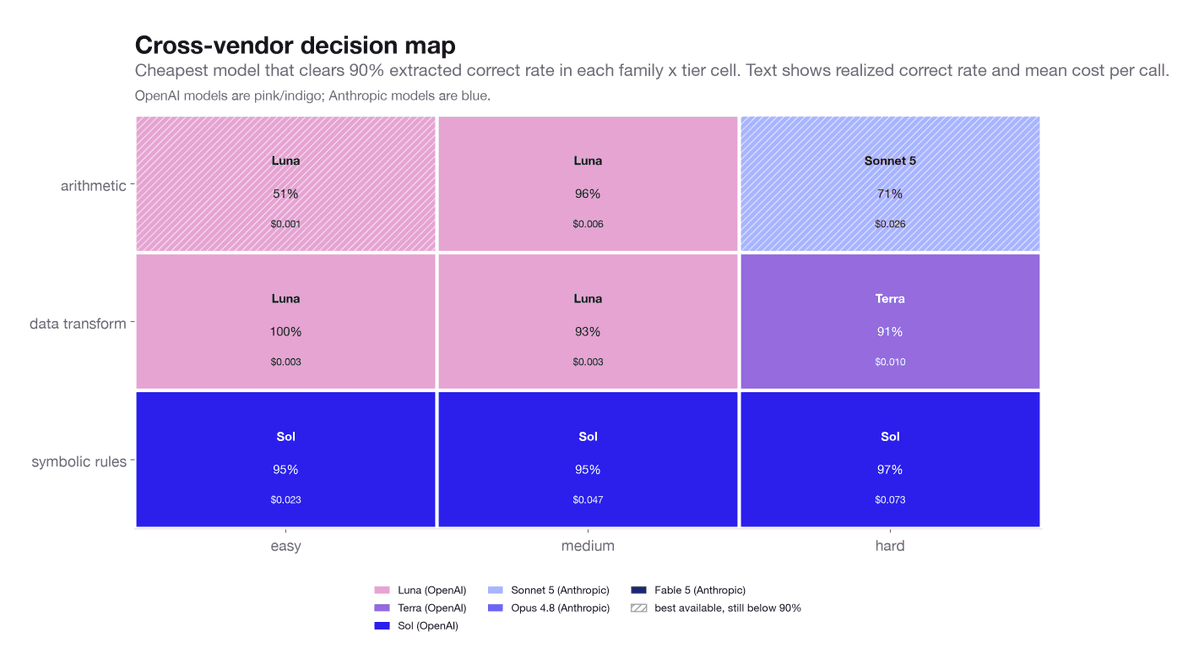
- Teknium's five-PR Hermes Agent review gave Sol an 8.8 weighted score vs Terra's 8.1, while Terra cost $0.092 per item vs Sol's $0.332, according to the Hermes Agent comparison.
- Hangsiin saw Sol use subagents without being asked, respond to steering faster than 5.5, and consume quota faster in practice despite the “Local Messages” allowance, according to the Codex app notes.
- Theo found Codex subagents wasteful when Ultra caused spawned agents to inherit Ultra, then said workflows in Claude Code used fewer tokens for similar output quality in the Ultra complaint and the workflow follow-up.
- Nick Dobos pointed at a lower-level computer-use trick: Sol generates small throwaway scripts that queue clicks and keystrokes, rather than driving every GUI step live, according to his computer-use note.
Where it shows up
GPT-5.6 landed across the coding-agent stack within hours, which made the rollout feel less like a model card and more like a platform migration.
- Cursor added Sol, Terra, and Luna, and reported Sol at 67.2% on CursorBench in Cursor's launch post.
- VS Code announced GPT-5.6 Sol, Terra, and Luna rolling out in the VS Code post.
- Devin added GPT-5.6 across Devin Cloud, Desktop, and CLI, with Sol reaching top performance at nearly half the cost of the next best model on FrontierCode 1.1 Extended, according to Cognition's post.
- OpenRouter listed Sol as the flagship, Terra as the balanced everyday driver, and Luna as the fast low-cost tier in OpenRouter's launch thread.
- Microsoft 365 Copilot made GPT-5.6 the preferred model, according to sama's Microsoft 365 note.
- Lovable said GPT-5.6 was available and reduced long workflow steps and tool calls in Lovable's rollout note.
- Factory added the family to Droid, describing Sol as the broad engineering generalist, Terra as the edit-test-iterate model, and Luna as strongest for codebase research and document synthesis across Factory's launch post, its Sol note, its Terra note, and its Luna note.
- Warp added Terra, Luna, and Sol in Warp's post.
- Cline exposed
openai/gpt-5.6-solas a model ID in Cline's launch note. - Capy added Sol, Terra, and Luna with Codex subscription support in Capy's post.