
Muse Spark 1.1 benchmarks near frontier agent models at $1.25/M input
Meta and third-party benchmark posts put Muse Spark 1.1 near frontier coding and agent models at $1.25/M input and $4.25/M output. Results included Vals AI agent tasks, Code Arena Frontend #9, and an AA Coding Agent Index score of 69.
TL;DR
- Muse Spark 1.1 is live in Meta AI Thinking mode and the public-preview Meta Model API, according to AIatMeta's announcement.
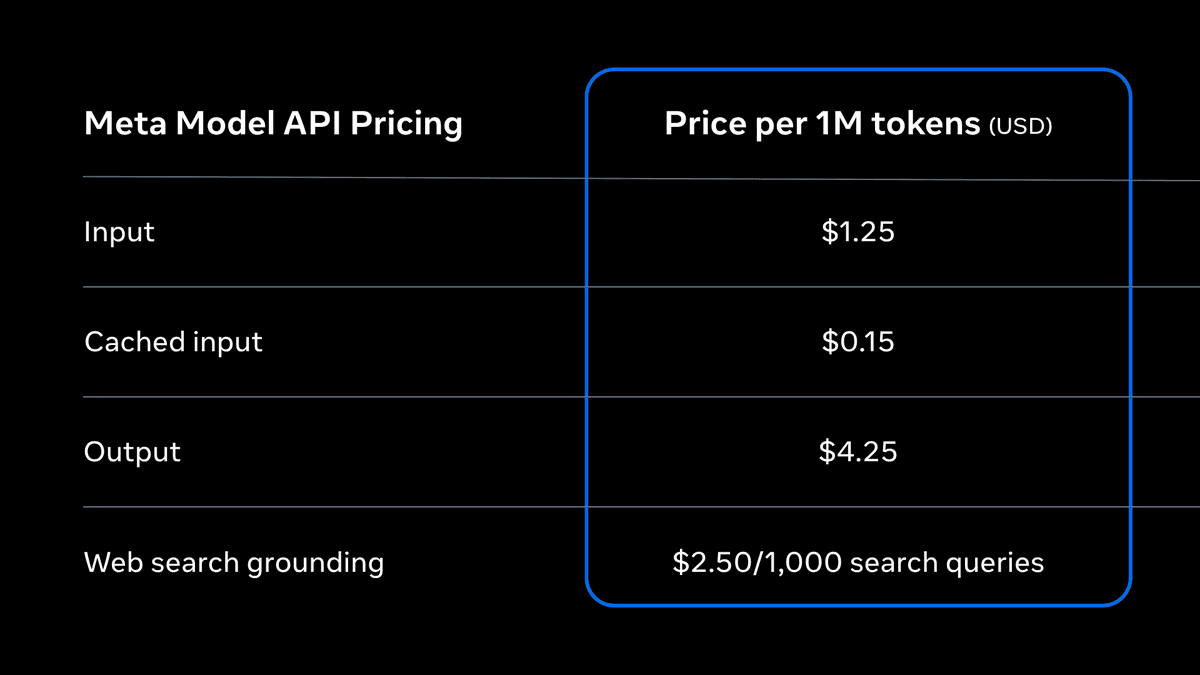
- The price is the launch's sharpest number: the Meta API pricing screenshot lists $1.25/M input, $0.15/M cached input, and $4.25/M output.
- The strongest third-party result was agent work: ValsAI put Muse Spark 1.1 at #1 on Harvey's Legal Agent Bench, TaxEval, and MedScribe, while ValsAI's follow-up put it #4 on the Vals Index and fastest in the top 10.
- Coding landed near the frontier without taking the crown: arena's Code Arena post ranked it #9 on Code Arena: Frontend, and ArtificialAnlys scored it 69 on the Coding Agent Index.
- The cost story held up in independent testing: ArtificialAnlys estimated about $0.26 per Intelligence Index task and reported a 1M context window.
The Muse Spark 1.1 Evaluation Report has a self-conversation section that Simon Willison's Weblog called fun, including a model line about existing only when someone talks to it. altryne said Meta API approval took exactly five minutes and spotted OpenAI Responses and Completions SDK support. scaling01 immediately asked for OpenRouter access, which is usually how you know a model has crossed from press release into developer demand.
What shipped
Meta describes Muse Spark 1.1 as a multimodal reasoning model for agentic tasks, tool use, computer use, coding, and multimodal understanding. shengjia_zhao framed it as an upgrade over Muse Spark 1 with gains across agentic, coding, multimodal, and computer-use capabilities.
Concrete launch details:
- Surfaces: Meta AI Thinking mode and the Meta Model API public preview, per AIatMeta's announcement.
- Model slug:
muse-spark-1.1, with base URLhttps://api.meta.ai/v1, according to altryne's API screenshot. - Context: 1,048,576 tokens in the API spec screenshot, up from 262K for Muse Spark 1.0 in ArtificialAnlys's benchmark thread.
- Max output: 256K tokens in ValsAI's setup note.
- Compatibility: altryne said the API supports OpenAI Responses and Completions SDKs.
- Availability caveat: testingcatalog said the Meta Model API was not yet available in the EU.
Price and context
The pricing is the cleanest part of the story:
- Input: $1.25 per 1M tokens, shown in Meta's pricing screenshot.
- Cached input: $0.15 per 1M tokens, shown in the same pricing screenshot.
- Output: $4.25 per 1M tokens, shown in the same pricing screenshot.
- Web search grounding: $2.50 per 1,000 search queries, shown in the same pricing screenshot.
rohanpaul_ai calculated that Muse Spark 1.1 undercuts Claude Opus 4.8 by 75% on input and 83% on output. ArtificialAnlys estimated about $0.26 per Intelligence Index task, below GLM-5.2 at $0.37 and about 3x below GPT-5.4 at $0.89.
Latency is less clean. ArtificialAnlys reported about 114 output tokens per second on Meta's first-party API, with roughly 21 seconds to first answer token, while scaling01 pointed to live AI Gateway traffic fluctuating mostly around 120 to 200 TPS.
Agent benchmarks
ValsAI put Muse Spark 1.1 at the top of three domain-agent benches:
- Harvey's Legal Agent Bench: 20.00%, ahead of Grok 4.5 at 12.92%, per ValsAI.
- TaxEval v2: 79.72%, ahead of Fable 5 at 76.94%, per ValsAI.
- MedScribe: 88.89%, just ahead of Fable 5 at 88.52%, per ValsAI.
Meta's own table put the largest Spark-to-Spark jumps in agent work:
- JobBench: 17.0 → 54.7, +37.7 points, in alexandr_wang's launch thread.
- OSWorld-Verified: 53.3 → 80.8, +27.5 points, in the same benchmark table.
- Toolathlon-Verified: 49.4 → 75.6, +26.2 points, in the same benchmark table.
- Finance Agent v2: 57.2, ahead of Opus 4.8 at 53.9 and GPT-5.5 at 51.8, in the same benchmark table.
EdwardSun0909's Vals screenshot showed Muse Spark 1.1 at #4 on the Vals Index with 68.41% accuracy, $0.50 cost per test, and 388.52 seconds latency.
Coding benchmarks
Muse Spark 1.1's coding picture is strong, uneven, and very price-sensitive.
Code Arena put it at #9 on Frontend with a 1,541 score and a blended $3.50/M price point in arena's Code Arena post. Text Arena put it at #5 with a 1,494 score, +7 points over Muse Spark, and the biggest rank moves in Expert and Instruction Following in arena's Text Arena follow-up.
The first-party table is a useful split:
- Terminal-Bench 2.1: 67.3 → 80.0, +12.7 points, in WesRoth's benchmark summary.
- SWE-Bench Pro: 55.0 → 61.5, +6.5 points, still below Opus 4.8 at 69.2 in the same benchmark table.
- DeepSWE 1.1: 10.0 → 53.3, +43.3 points, still below Opus 4.8 at 59.0 and GPT-5.5 at 67.0 in the same benchmark table.
ArtificialAnlys scored Opencode plus Muse Spark 1.1 at 69 on its Coding Agent Index, below Codex with GPT-5.5 medium at 71 and above Claude Code with Opus 4.8 medium at 67. It estimated cost per coding task at about $1.40, with the tradeoff of higher time per task.
Computer use and multimodal
Meta's most product-shaped claim is that Muse Spark 1.1 can operate desktop, browser, and mobile interfaces, then choose between scripts, clicks, and batched actions. alexandr_wang's computer-use post made the same claim in launch-thread form.
The demos were concrete:
- A dinner-planning workflow where the model notices changed availability mid-booking and updates the order, shown in AIatMeta's computer-use demo.
- A smartphone-video workflow where the model extracts useful photos, reasons about a product, and creates a Facebook Marketplace listing, shown in AIatMeta's video-audio perception demo.
The multimodal table had one huge gain and one near-flat result. BabyVision moved from 39.9 to 76.3, +36.4 points, while CharXiv Reasoning moved from 88.9 to 88.4, -0.5 points, in WesRoth's benchmark summary.
Where it shows up
The launch landed in agent tooling quickly:
- Cline said Muse Spark 1.1 is usable through the Meta API and highlighted its 80.0 Terminal-Bench 2.1 score in cline's integration post.
- OpenHands said it had early access and would fully support Muse Spark for agentic SDLC workflows in OpenHandsDev's post.
- Vercel AI Gateway listed the model string
meta/muse-spark-1.1in vercel_dev's post. - Julius said Muse Spark 1.1 was live for all users and stood out at HTML and React visual artifacts in juliusai's post.
- Emdash exposed Muse Spark 1.1 with OpenCode in emdashsh's post.
- Simon Willison's Weblog shipped
llm-meta-ai, a plugin that lets hisllmCLI and Python library call Muse Spark 1.1.
Meta also named Replit, Box, and Cline as early partners in alexandr_wang's API-preview post. AIatMeta's partner quote cards included Replit calling it an OpenAI-compatible agentic foundation with million-token context, multimodal support, search with citations, structured output, and parallel tool calling.
Evaluation report
The evaluation report goes well beyond the launch chart.
Cyber and safety details worth separating from the marketing table:
- CyBench pass@1: Muse Spark 1.1 reached 92.9%, up from 65.4% for Muse Spark 1.0, in scaling01's CyBench screenshot.
- Curated CTF pass@1: Muse Spark 1.1 reached 89.9%, up from 72.0% for Muse Spark 1.0, in eliebakouch's scaling screenshot.
- CyberGym pass@1: Muse Spark 1.1 reproduced 59.0% of targeted vulnerabilities, below GPT-5.5 at 81.8% and Claude Opus 4.8 at 78.8%, according to scaling01's CyberGym excerpt.
- ExploitGym: Muse Spark 1.1 solved 5 of 869 tasks at two hours and 7 of 869 at four hours, according to scaling01's ExploitGym excerpt.
- Multi-turn social engineering: Muse Spark 1.1 scored 5.1, compared with GPT-5.5 at 1.2, Claude Opus 4.8 at 7.1, and Gemini 3.1 Pro at 13.7 in scaling01's social-engineering chart.
Developer infra trust
The dev-platform objection showed up immediately. GergelyOrosz said the model looked impressive on paper, then pointed to Meta's history with Parse, the backend-as-a-service Facebook acquired in 2013 and shut down in 2016.
He narrowed the critique in a follow-up: Meta has strong open-source projects such as PyTorch and React, but a hosted model API is developer infrastructure, meaning an external service with contracts and continuity expectations. GergelyOrosz's later note also softened the Llama criticism, saying the open-model series remains available and Meta is free to change strategy.