
OpenRouter benchmarks 1,730 visual-reasoning questions on low-detail image costs
OpenRouter tested 1,730 visual-reasoning questions across five models and found low-detail images often reduced accuracy while increasing reasoning-token spend. Caps on reasoning effort had the biggest billing impact.
TL;DR
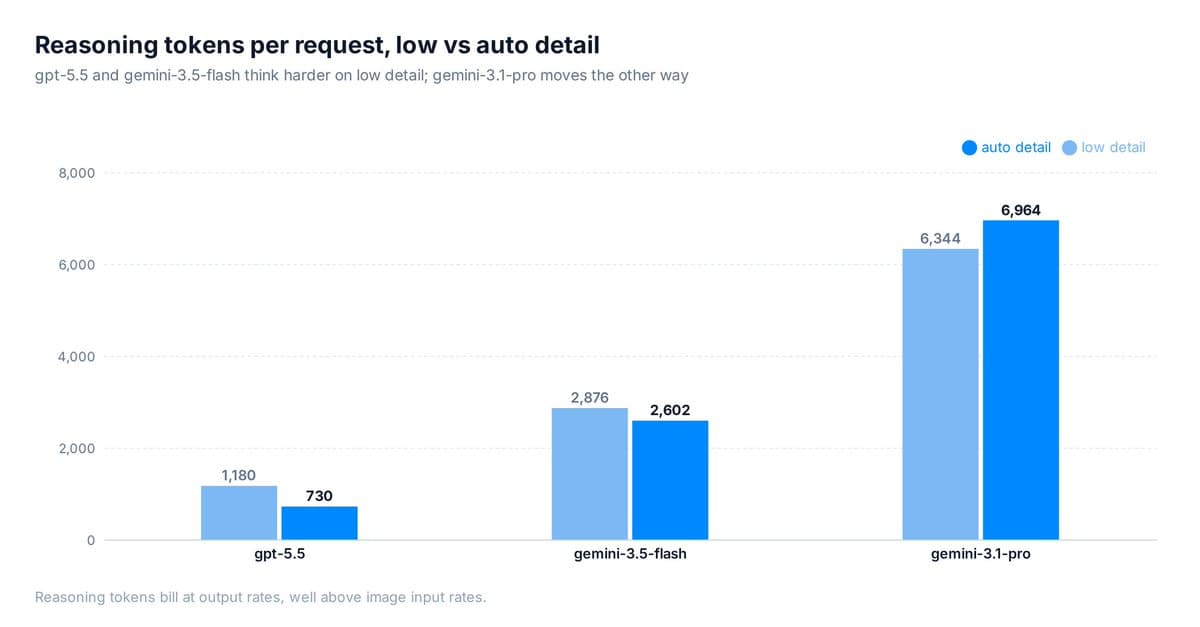
- Low detail can raise total cost on reasoning models: OpenRouter's benchmark thread says the model burns extra reasoning tokens when it has to reason over blurrier images.
- The accuracy hit depended heavily on provider semantics: OpenRouter's provider comparison says OpenAI low downscales to 512×512 and lost 10 to 17 points, while Gemini low kept roughly 273 tokens per image part and lost under 3.
- Reasoning effort dominated the bill: OpenRouter's cost breakdown says capping effort cut cost 50 to 75 percent while accuracy moved only 1 to 2 points.
- OpenRouter's own split was model-type dependent: its TL;DR says reasoning-model runs kept detail on auto or high and moved cost control to reasoning effort.
- The public replies still wanted scoring mechanics: scaling01 asked why OpenAI's score was 7x higher, while haider1 asked how the ranking worked.
OpenRouter's full benchmark includes per-model tables and methodology. The odd mechanic is that a smaller image can make a reasoning model spend more tokens trying to recover fine print, according to OpenRouter's follow-up. The provider split was not symmetric: OpenRouter's comparison says OpenAI's low setting downsampled images to 512×512, while Gemini low kept roughly 273 tokens per image part.
Low detail backfire
In OpenRouter's benchmark thread, the company said it tested 1,730 visual-reasoning questions across five models against the common cost trick of setting image detail to low.
OpenRouter's follow-up named the failure mode: the low-detail post says unreadable fine print can make the model think harder, ending with lower accuracy and higher cost.
For inference accounting, the surprise was that the image flag changed reasoning-token behavior.
Provider detail modes
Low detail did not mean the same thing across providers.
- OpenAI: OpenRouter's provider comparison says low downscales everything to 512×512, and those runs lost 10 to 17 points.
- Gemini: The same comparison says low keeps roughly 273 tokens per image part, both Gemini runs lost under 3 points, and gemini-3.1-pro's low run was cheaper.
Reasoning effort
OpenRouter separated two knobs in the cost breakdown:
- Image detail: the cost breakdown put accuracy movement at 2 to 17 points while cost barely moved.
- Reasoning effort: the same post put cost cuts at 50 to 75 percent, with accuracy moving 1 to 2 points within noise.
This was the cleanest result in the thread: detail changed answer quality, effort changed the invoice.
Model split
OpenRouter converted the result into a model-type split:
- Reasoning models: OpenRouter's TL;DR says detail stayed on auto or high, while cost control moved to reasoning effort.
- Non-reasoning models: the same TL;DR says low detail genuinely saved money and latency when the application could absorb the accuracy hit.
Tables and methodology
OpenRouter's TL;DR points to the full benchmark for per-model tables and methodology.
For the cost comparison, OpenRouter's cost post linked a chart isolating detail versus reasoning effort.
The evidence pool also includes aparnadhinak's link-only post, a separate URL-only share with no visible context in the normalized tweet text.