
Goodfire releases Block-Sparse Featurizers for DINOv3, SDXL, and InceptionV1
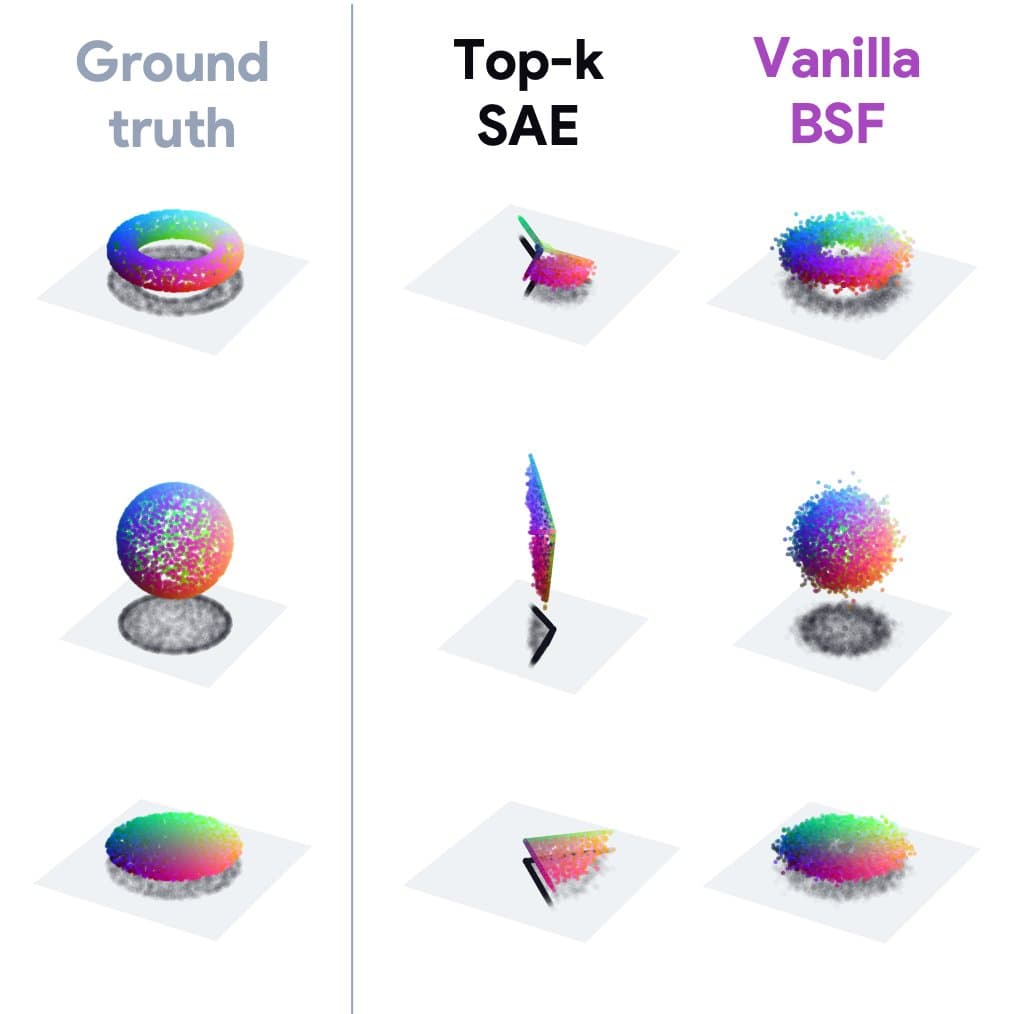
Goodfire introduced Block-Sparse Featurizers, which model activation concepts as multidimensional blocks instead of single SAE directions. The examples cover DINOv3, SDXL, and InceptionV1 activations.
TL;DR
- GoodfireAI shipped Block-Sparse Featurizers as an interpretability method that searches for multidimensional activation blocks instead of single SAE directions, according to GoodfireAI's launch thread and GoodfireAI's subspace explanation.
- The first reported runs target DINOv3 and SDXL activations; GoodfireAI's model-results post says BSFs explain those activations more faithfully and efficiently than SAEs.
- The strongest examples are geometry you can traverse: GoodfireAI's arch feature maps position inside an arch, while GoodfireAI's pretzel manifold walks through generated pretzel variants.
- InceptionV1 curve detectors collapsed into one continuous orientation feature, and GoodfireAI's curve-detector post says the block also exposed higher-order Fourier harmonics.
- GoodfireAI says most concepts it inspected in vision models were multidimensional, typically 2-4 dimensions, in GoodfireAI's dimensionality post.
The paper, code, and full post sit behind a compact thread. The oddest examples are concrete: an arch feature whose coordinates move from bottom to spandrel to crown, an SDXL pretzel manifold that changes generated pretzel type, and an ICML booth post that put neural-geometry stickers next to the paper launch.
Block-Sparse Featurizers
In GoodfireAI's SAE critique, the foil is the assumption that a model's “thoughts” can be recovered as one-dimensional directions. BSFs replace that search target with subspaces that tend to activate together, from GoodfireAI's subspace explanation.
GoodfireAI makes the methodological point in its closing post: a featurizer is a hypothesis about the structure of model representations. The opinionated part is the geometry, because the tool is built to find small regions rather than single axes.
DINOv3 and SDXL activations
GoodfireAI trained BSFs on off-the-shelf DINOv3 and SDXL vision models. The reported comparison in GoodfireAI's model-results post has three claims:
- Activation explanation: more faithful than SAEs.
- Efficiency: better than SAEs.
- Feature quality: coherent, interpretable, and multidimensional.
The thread gives the comparative result, not a table of headline scores.
Arches and pretzels
The arch example in GoodfireAI's arch post maps internal coordinates to semantic parts of the object: bottom, spandrel, crown. The SDXL example in GoodfireAI's pretzel post turns one block into a surface for generating different pretzel types.
deedydas called the SDXL result a “low-compute volume dial” for editing generation output in deedydas's reaction. That framing is the practical hook: a concept block can be moved through, not just switched on.
Curve detectors
GoodfireAI revisited InceptionV1 curve detectors, an interpretability classic. In GoodfireAI's InceptionV1 post, neurons and SAE features are fragments of one continuous orientation feature, and the BSF block also contains higher-order Fourier harmonics that GoodfireAI says had not been described before.
The same object appears at three resolutions: neurons, SAE features, and a BSF block.
2-4 dimensional concepts
GoodfireAI used BSFs to ask how many vision-model concepts are multidimensional. Its answer in GoodfireAI's dimensionality post was most concepts, usually 2-4 dimensions.
A 2-4D concept is still small enough for local traversal and visualization, while no longer fitting a one-axis feature catalog.
Paper, code, and ICML demos
GoodfireAI's final thread item points to paper, code, and the full post via the release bundle. A separate ICML post placed the work at booth B102 and advertised neural-geometry stickers.
In GoodfireAI's ICML booth post, the sticker photo labels several Llama 3 8B representation manifolds: days of the week, temperature, color, age, and geography. GoodfireAI also answered one future-facing reply with a terse “stay tuned”.