
X-Humanoid introduces TG-VLA with claimed 100% mobile-manipulation success
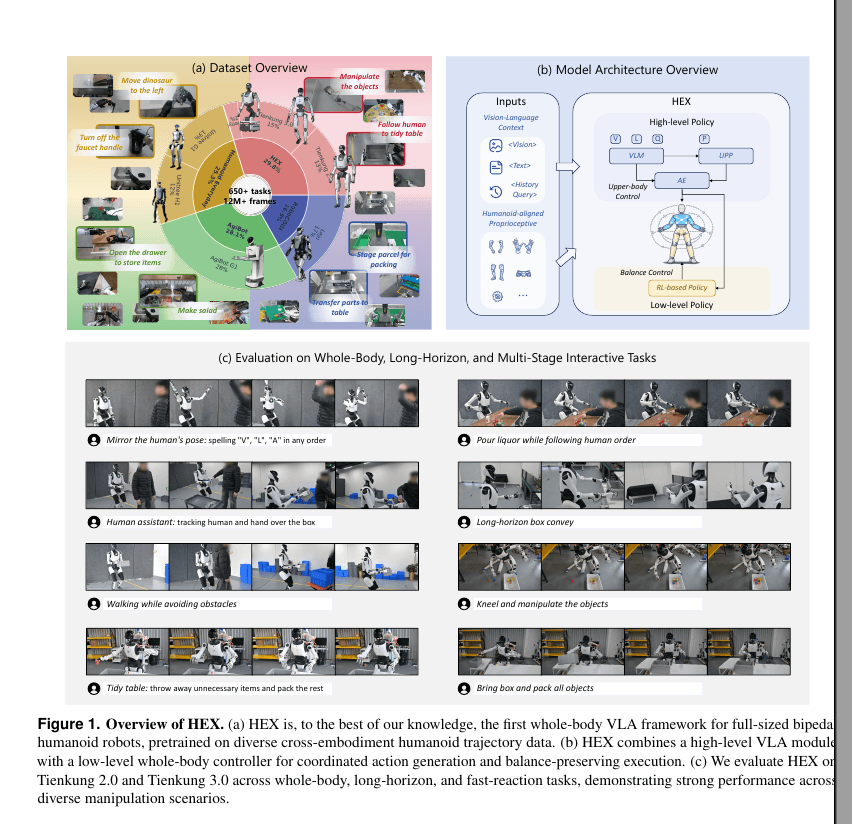
X-Humanoid unveiled TG-VLA as a full-size whole-body VLA framework for humanoids, built around HEX, HAF-VLA, and DSRL-DCT. The company claims DSRL-DCT reached 100% success in mobile-manipulation tasks by freezing the VLA and learning a smaller noise-selection policy.
TL;DR
- According to rohanpaul_ai's launch thread, X-Humanoid calls TG-VLA the world’s first full-size, whole-body Vision-Language-Action framework for humanoid robots.
- The TG-VLA overview breaks the framework into three pieces: HEX for cross-embodiment learning, HAF-VLA for structured whole-body action, and DSRL-DCT for reinforcement learning on high-DoF robots.
- The DSRL-DCT note says X-Humanoid claims 100% success in mobile-manipulation tasks by freezing the pretrained VLA, learning a smaller noise-selection policy, and compressing the action space with Discrete Cosine Transform.
- The HEX follow-up describes visual retrospection, where the robot can reuse earlier visual context instead of treating every moment as a fresh frame.
The thread links out to the paper and project page. The HEX follow-up names visual retrospection for scene memory, the HAF-VLA note describes denoising inside one shared action space, and the DSRL-DCT note says the RL layer compresses a large robot action space with Discrete Cosine Transform.
Whole-body VLA
X-Humanoid’s frame is whole-body coordination: task understanding, scene memory, prediction, full-body movement, and online adjustment during execution, according to the launch thread.
The concrete bet is that humanoids need a single coordinated action chain, not just better grasping. The hard case is a task where torso, legs, arms, hands, balance, vision, memory, and timing all interact.
TG-VLA’s stated chain:
- Understand the task.
- Remember the scene.
- Predict what may happen next.
- Coordinate the whole body.
- Adjust while acting.
HEX
HEX is the cross-embodiment piece. The launch overview names it as the component for learning across different humanoid robot bodies, while the follow-up adds visual retrospection: the robot can look back at earlier visual context instead of treating each frame as a fresh scene.
That makes HEX the memory-ish layer in the stack. Longer manipulation tasks need context from before the current camera frame, especially when the body has moved and the scene has changed.
HAF-VLA
According to the HAF-VLA note, the system avoids generating every whole-body movement at once. It breaks motion into structured action steps, then cleans the final motion through denoising.
The mechanics are compact:
- Break whole-body action into simpler steps.
- Run step-by-step denoising.
- Keep the output inside one shared action space.
That shared-space detail is the interesting part. It suggests the model is not stitching separate arm, base, and torso controllers after the fact.
DSRL-DCT
rohanpaul_ai's DSRL-DCT note attributes the 100% mobile-manipulation success claim to X-Humanoid’s reinforcement-learning layer.
The reported recipe has three parts:
- Freeze the pretrained Vision-Language-Action model.
- Learn a smaller noise-selection policy.
- Compress the robot’s large action space into a smaller latent space using Discrete Cosine Transform.
That is the engineering move worth remembering: the RL update targets a smaller control problem instead of retraining the full VLA against a high-degree-of-freedom robot.
Paper and project page
The linked paper is titled “HEX: Humanoid-Aligned Experts for Cross-Embodiment Whole-Body Manipulation,” according to the paper-link post. TG-VLA is the framework label in the launch thread; HEX is the named contribution in the paper title.
The same post also points to a project page, which is the most direct artifact in the evidence pool for readers who want the underlying demos and paper materials.