
LongCat-2.0 opens MIT weights for 1.6T MoE with 1M context
Meituan released LongCat-2.0 weights and inference code under MIT, with Hugging Face, GitHub, ModelScope, GPU, and NPU paths. Analysts noted the ~48B-active MoE keeps attention shape while reducing zero-communication experts from 256 to 128.
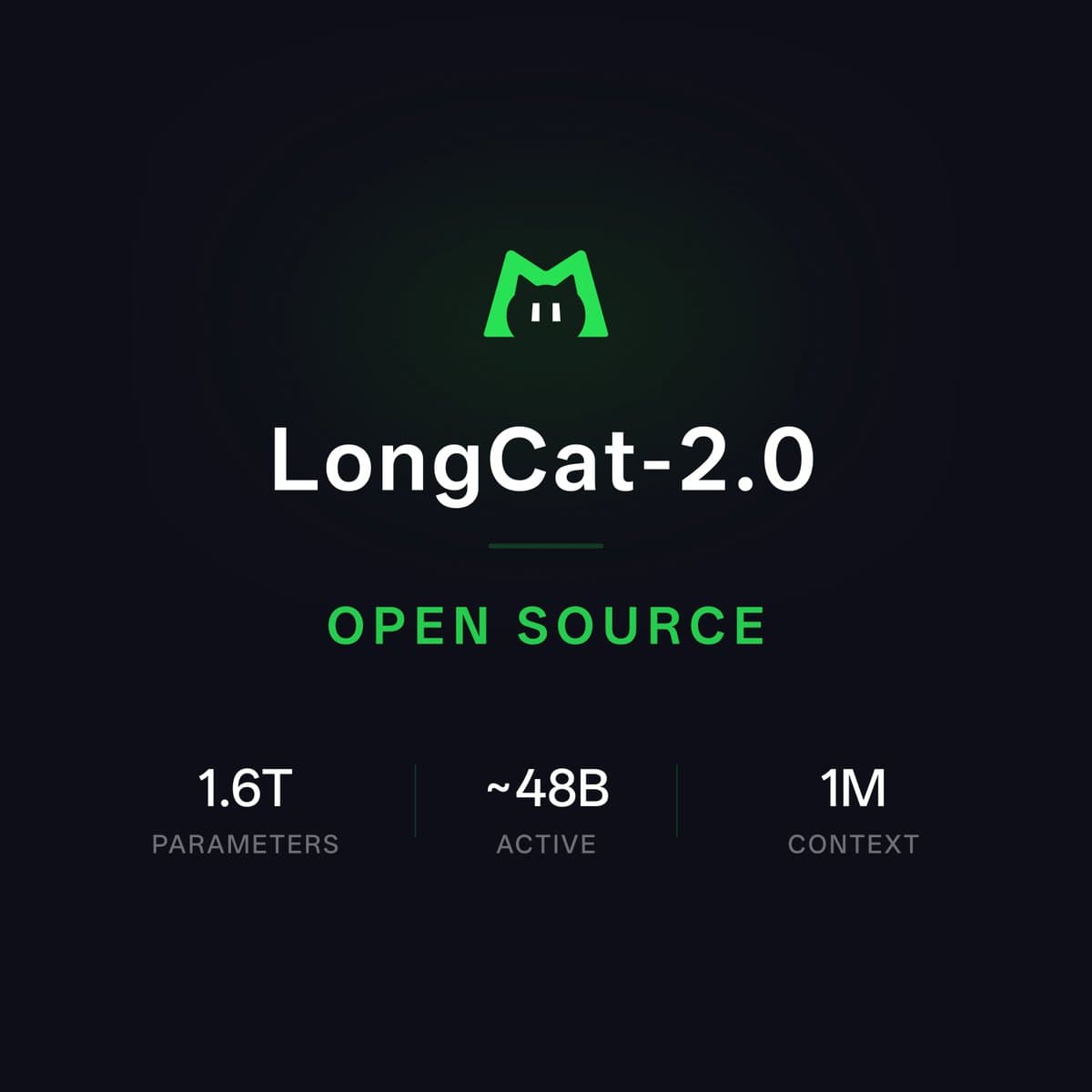
TL;DR
- Meituan_LongCat's release post says LongCat-2.0 is now MIT licensed, with model weights and inference code published for GPU and NPU deployments.
- The same post gives the public shape: 1.6T total parameters, ~48B active parameters, and a 1M token context window.
- eliebakouch's architecture note flags the weird delta from the prior iteration: same attention shape, zero-communication experts cut from 256 to 128, and 135B embedding parameters with n-gram.
- The Hugging Face model-card screenshot says the training and deployment ran entirely on AI ASIC superpods, over more than 35T pretraining tokens, with no rollbacks or irrecoverable loss spikes.
Christmas came early for open-weight MoE infra nerds. The release bundle points to the tech blog, Hugging Face, GitHub, ModelScope, GPU inference code, and NPU inference code. The most useful footnotes are buried in the architecture chatter: eliebakouch's correction narrows the expert-count change to zero-communication experts, and his DeepSeekMoE reply points at prior ablations where expert segmentation mattered even with fixed active parameters.
MIT weights and inference code
Meituan says the LongCat-2.0 weights and inference code are now open under MIT with “no restrictions.” The release is broad enough to matter as an infra artifact, not just a model-card announcement.
What shipped:
- Weights: Hugging Face and ModelScope.
- Code: GitHub.
- Inference paths: GPU code and NPU code.
- Claimed agent integrations: Claude Code, OpenClaw, and Hermes Agent.
- Claimed deployment coverage: GPU and NPU platforms, verified on large-scale domestic clusters.
LongCat model shape
The clean spec line from Meituan_LongCat's announcement is 1.6T total parameters, ~48B activated per token, and 1M token context.
The public materials also carry a parameter-count wrinkle:
- The model-card introduction describes “1.6 trillion total parameters” and ~48B active per token.
- The Hugging Face sidebar shows a 1.8T model size.
- multimodalart's launch note also calls LongCat-2.0 a 1.8T behemoth.
The safest read is to quote the official architecture line for the model shape and treat the 1.8T label as a packaging or model-card size label until Meituan spells out the accounting.
Zero-communication experts
The architecture detail that got practitioners talking was not the total parameter count. It was the choice to keep the same attention shape while reducing zero-communication experts from 256 to 128.
The thread breaks into four concrete claims:
- eliebakouch's correction says the reduced count refers to zero-communication experts, not all experts.
- The updated post says LongCat-2.0 keeps the same attention shape as the previous iteration.
- The same note says the model has 135B embedding parameters with n-gram.
- eliebakouch's follow-up frames sparsity as a way to increase total parameters at the same active count, assuming the infra can handle it.
The explanation stayed speculative. teortaxesTex's reply floated a tradeoff with n-grams or weak zero-communication expert behavior, while eliebakouch's reply guessed larger scale may make the zero-expert mechanism more unstable.
ASIC superpods
The model-card screenshot says LongCat-2.0's full training run and large-scale deployment were built entirely on AI ASIC superpods. It also claims pretraining over more than 35T tokens, measured in millions of accelerator-days, with no rollbacks or irrecoverable loss spikes.
teortaxesTex's post framed the release as the largest known pretraining run on non-Western chips. multimodalart's post similarly described it as a 1T-plus parameter model trained entirely on Chinese ASICs.
Benchmark chart
multimodalart's post attached a six-panel benchmark chart rather than a prose eval summary. The chart compares LongCat-2.0 against Gemini 3.1 Pro, GPT-5.5, and several Opus 4.x variants across:
- Terminal-Bench 2.1.
- SWE-bench Pro.
- SWE-bench Multilingual.
- FORTE.
- RWSearch.
- BrowseComp.
API platform and Discord
The file release also has a hosted surface. Meituan_LongCat's follow-up points to the LongCat API Platform and a Discord for support, feedback, and community discussion.