
Zyphra prices GLM-5.3-Flash FP4 inference 25% below FP8
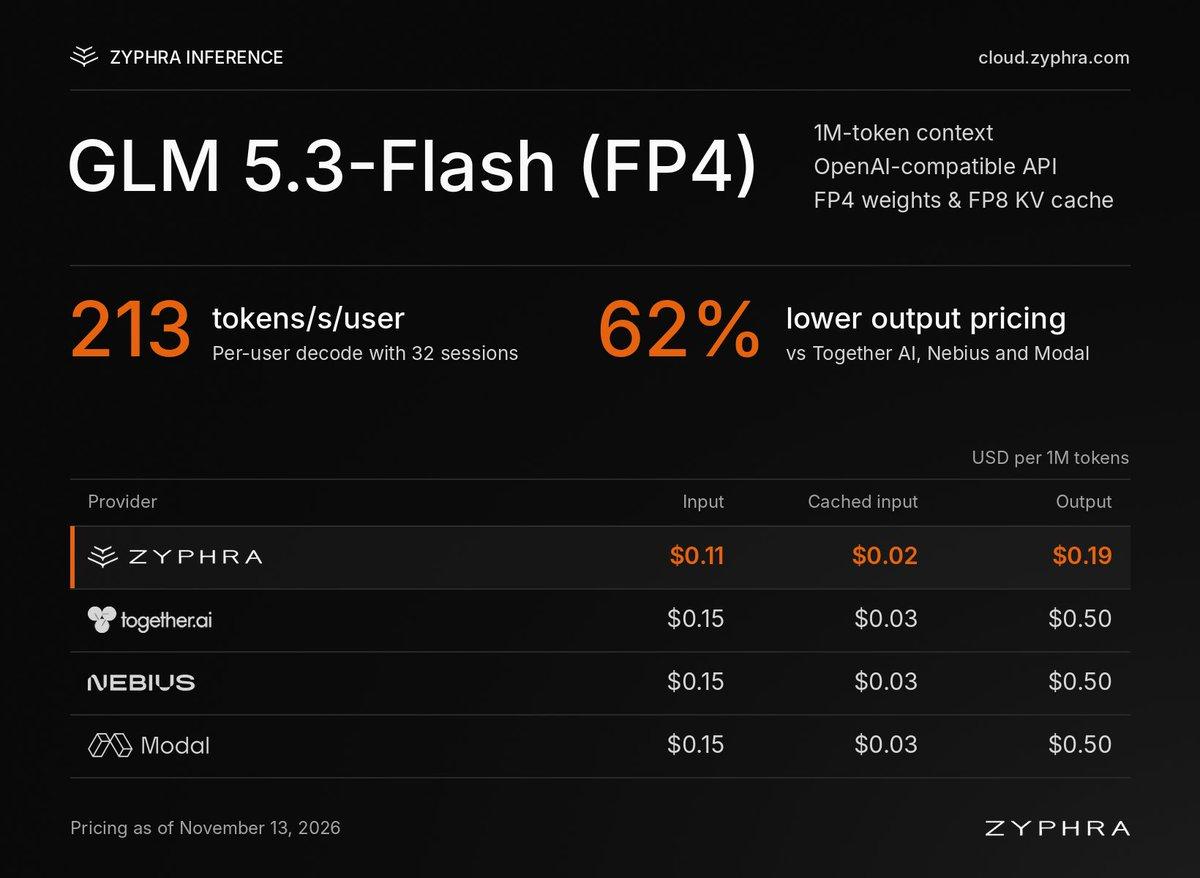
Zyphra prices FP4 inference on MI300X GPUs 25% below its FP8 offering. AgentX tests report 9.5× faster p90 generation than stock SGLang, with about 95% of input tokens served from cache.
TL;DR
- GLM-5.3-Flash FP4 is live on MI300X at 25% below Zyphra's FP8 prices, according to the launch announcement.
- At 96 concurrent sessions, p90 generation rose from 4.7 to 44.6 tokens/s per user in ZyphraAI's AgentX results.
- P90 time to first token fell from 299.32 seconds to 6.24 seconds in the same comparison.
- About 95% of AgentX input tokens hit the prefix cache, and cached input supplies most revenue, Zyphra says in its pricing post.
The clever bit is in the custom kernel: weights change precision immediately before the multiply. AgentX's replay corpus also removes the original prompts, source code, tool arguments, and tool results while preserving the workload's structure.
FP4 endpoint and prices
Zyphra's FP4 model page dates availability to November 13. The discount applies equally to all three billing categories.
| Per million tokens | FP8, from the earlier announcement | FP4, from the pricing post |
|---|---:|---:|
| Input | $0.15 | $0.1125 |
| Cached input | $0.03 | $0.0225 |
| Output | $0.25 | $0.1875 |
The documented OpenAI-compatible API uses:
- Base URL:
https://api.zyphracloud.com/api/v1 - FP4 model:
zai-org/GLM-5.3-Flash-FP4 - FP8 model:
zai-org/GLM-5.3-Flash, documented on the standard endpoint page.
MXFP4 weights and FP8 multiplication
Zyphra implemented a custom mixture-of-experts kernel on MI300X with two weight representations:
- In memory: expert weights are stored in MXFP4.
- In registers: those weights are converted to FP8 immediately before multiplication.
The checkpoint description lists 320 billion total parameters, 18 billion active per token, and a 1-million-token context window.
AgentX latency at 96 sessions
Zyphra compared ZOE with stock SGLang v0.5.22 on one eight-MI300X node, according to its benchmark description. The workload replays multi-turn coding-agent sessions.
| Metric at 96 concurrent sessions | Stock SGLang | ZOE | Reported improvement |
|---|---:|---:|---:|
| P90 generation speed per user | 4.7 tokens/s | 44.6 tokens/s | 9.5× faster |
| P90 time to first token | 299.32 s | 6.24 s | 48× lower |
The published comparison changes the serving stack from stock SGLang to ZOE. It does not isolate the performance contribution of FP4 quantization from the rest of ZOE.
AgentX replay and answer quality
The AgentX methodology specifies several details behind these workload replays:
- Synthetic inputs: deterministic coding and tool-use tokens preserve input lengths and shared-prefix structure.
- Client concurrency: the configured count measures live agent clients. Subagent fan-out can produce more in-flight HTTP requests than clients.
- Closed-loop execution: clients submit their next eligible request after dependencies finish, so faster systems can progress through a different request mix during the same measurement window.
- Warmup: prefix primers and ten additional requests per replay lane precede the one-hour profiling window.
- Speculative decoding: measured acceptance lengths from SPEED-Bench replace acceptance behavior induced by synthetic payloads.
AgentX explicitly excludes answer-quality evaluation. Zyphra separately describes the FP4 checkpoint as staying close to FP8 on agentic coding benchmarks; the serving-speed results measure a different property.
Cached input and GPU margins
Cached input costs one-fifth as much as uncached input, yet Zyphra says it supplies most revenue in this cache-heavy workload. The company also claims roughly 60% margin on both endpoints.
At full utilization and 96 sessions per node, Zyphra estimates hourly revenue at $5.00 per MI300X with ZOE, versus $1.06 with stock SGLang. It compares that with listed MI300X rental rates of $1.85 to $2.99 per GPU-hour.
Subtracting only those quoted rents from $5.00 leaves $2.01 to $3.15 per GPU-hour, or 40.2% to 63% of revenue, before other costs.
96-session cap
Zyphra says 128 sessions per node would generate more revenue, but p90 time to first token rises from 6.24 seconds to 12.96 seconds. The company therefore runs 96 sessions per node.