
Nace AI releases Drex models that output calibrated probabilities
Nace AI released Drex, an open-weight multimodal decision-model family that outputs calibrated probabilities. Its training report describes verified decision training, while reports put the 27B Max response time at 183 ms.
TL;DR
- Drex's four open-weight models return probabilities over caller-supplied answers without generating text, as omarsar0 explains.
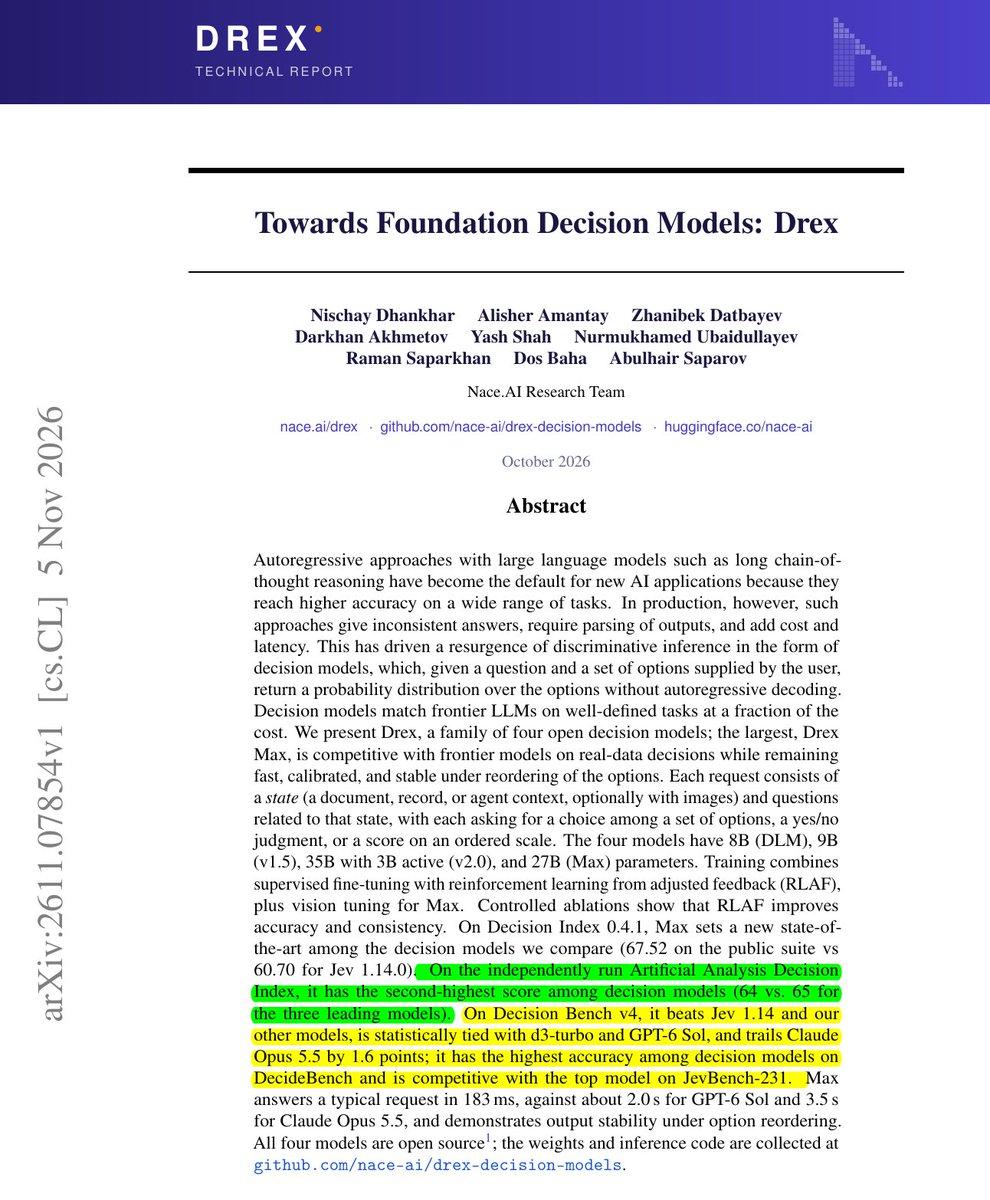
- The 27B Max statistically ties GPT-6 Sol on Decision Bench v4 and answers in a reported median 183 ms, according to rohanpaul_ai's account.
- Training combines verified answers with a larger model's confidence judgments, a process testingcatalog describes in its coverage of Nace's technical report.
Cheap decisions have a caching catch: Max re-encodes the document for every question. On Nace's image-only evaluation, feeding it raw images instead of text descriptions raised accuracy from 63% to 98%.
Fixed-option API
Nace's release timeline dates Max's weights to October 14 and the technical report to November 5. The new report documents how the family was trained and evaluated.
Each request supplies a state, such as a document, record, or agent context, plus named questions. The System One interface supports three question types:
choice: User-defined answers, with a probability for each option and the most likely choice. Max supports up to 255 options.noul: A yes/no judgment, returned as the probability of “yes.”score: An ordered rating scale, returned as probabilities over the levels plus their expected value.
The answer set can change between requests. The model's output remains confined to the supplied options.
Decision benchmarks
The public Decision Index measures chance-corrected skill. Nace's chart separates the public suite from the full score that includes private tests:
Other results in Nace's evaluation cover different workloads:
- Decision Bench v4: Max with raw image input statistically ties d3-turbo and GPT-6 Sol, finishing 1.6 percentage points behind Claude Opus 5.5.
- Artificial Analysis Decision Index: Max scores 64, versus 65 for each of the three leading decision models.
- Latency: Max's reported median is 183 ms per request, versus about 2 seconds for GPT-6 Sol and 3.5 seconds for Opus 5.5.
- Cost: Nace's comparison puts Max at $0.06 per 1,000 decisions, versus $10.17 for Opus 5.5.
Closed-book reasoning remains a substantial gap. On sampled Humanity's Last Exam questions without chain-of-thought or tools, Max answers 21% correctly versus Opus's 56%, rohanpaul_ai reports.
RLAF training
Drex v1.5's training mixture contains exactly 1,150,460 textual decision records across eleven domains. Max extends that data base, according to the technical report.
Max's recipe has three stages:
- Supervised fine-tuning: Train on decision records, with consistency losses penalizing changes caused by reordered answer options or shuffled state fields and sentences.
- Reinforcement learning from adjusted feedback: Combine verified correct answers with a reasoning judge's option probabilities. A KL penalty keeps the output distribution close to the supervised checkpoint.
- Vision fine-tuning: Train the image encoder and its projection into the language model.
In Max's controlled ablation, RLAF adds 2.0 Decision Index points. Consistency losses reduce option-order flips from 6.3% to 4.2%, as omarsar0's summary details.
Calibrated confidence
Nace evaluated calibration on roughly 230,000 labeled decisions per model. In its research post, the company reports 97% accuracy on Max decisions where confidence reaches at least 93%.
The API's choice confidence field has a specific definition. For K options and maximum option probability p, the report defines it as (p - 1/K) / (1 - 1/K), correcting for chance. With four options, a top probability of 0.70 therefore produces a confidence value of 0.60.
State caching
Max's model card describes a hybrid 64-layer backbone:
- 48 Gated DeltaNet linear-attention layers retain left-to-right processing.
- 16 full-attention layers, every fourth layer, use non-causal attention across the sequence.
- A 255-way linear readout maps the final hidden state to option probabilities.
Bidirectional full attention makes the state's representation depend on the question. Max processes the state separately for each question; DLM, v1.5, and v2.0 encode it once and share the cached state across questions.
The bundled loader applies the non-causal attention settings. A plain causal chat run does not reproduce the reported scores.
Local runtimes and licenses
The downloadable family spans four configurations:
| Model | Parameters | Weight license |
| --- | --- | --- |
| Drex DLM | 8B | CC BY-NC 4.0 |
| Drex v1.5 | 9B | Nace.AI Open RAIL-M |
| Drex v2.0 | 35B, about 3B active | Nace.AI Open RAIL-M |
| Drex Max | 27B dense | Nace.AI Open RAIL-M, modified |
Max's Python implementation supports images on NVIDIA GPUs. Its llama.cpp and Ollama forks, Kapitsa, and MLX run the text backbone; the GGUF and affine Q4 paths exclude images.
The model card lists roughly 49 GB for bf16 weights or 26 GB with the backbone loaded in 8-bit. The default request limit is 16,384 tokens, configurable up to 262,144.
Hosted testing is available through Nace Console. Testingcatalog also tried a duplicate-payment invoice example:
The report's licensing footnote distinguishes the weight licenses from the repository's Apache-2.0 code license. DLM's CC BY-NC 4.0 terms restrict it to non-commercial use.