
Mistral releases Large 4 open weights
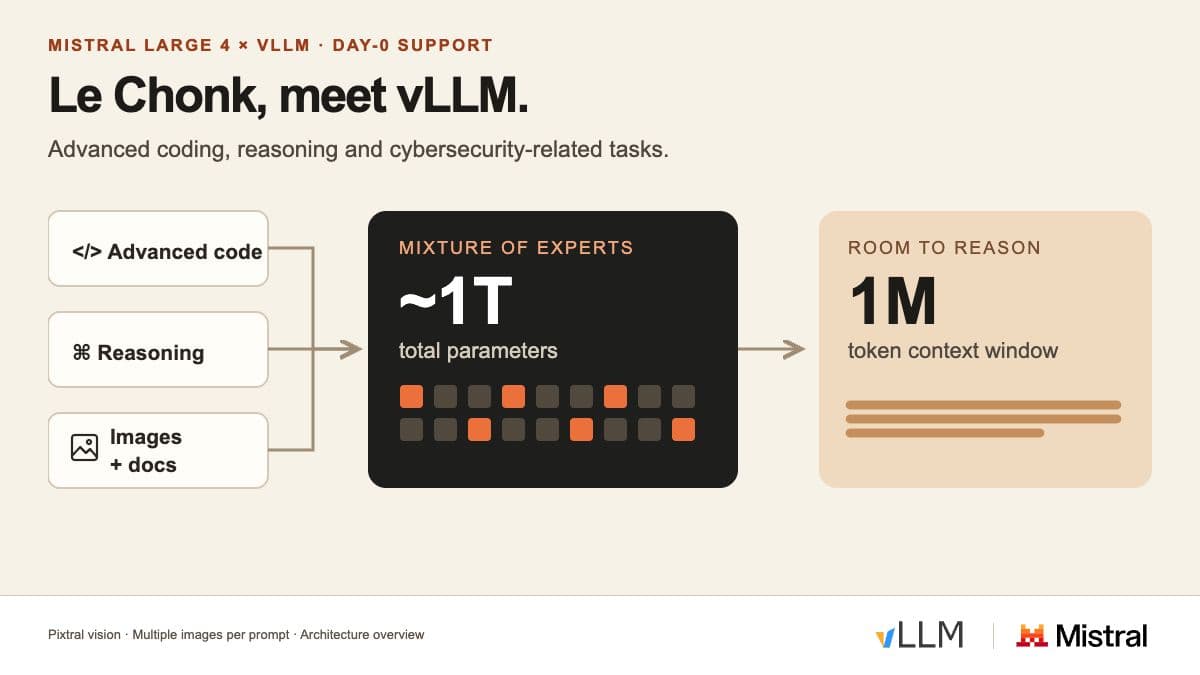
Mistral released Large 4 weights with launch-day serving and LoRA training support. vLLM reports roughly twice baseline output throughput with its built-in drafter in specified tests.
TL;DR
- Mistral released updated Large 4 weights after three more weeks of reinforcement learning, with FP8 and NVFP4 serving support in vLLM’s launch announcement.
- Coding results depend on the harness: Mistral claims an open-weight lead, while Artificial Analysis’s evaluation puts Large 4 second on its Coding Agent Index, using roughly half its leading rival’s tokens.
- Efficiency improved substantially: output tokens per Intelligence Index task fell from 135K to 82K, and measured cost fell from $5.54 to $2.06, according to Artificial Analysis.
- Launch-day tooling includes serving and adapter training: vLLM’s tests report roughly twice baseline output throughput with DSpark, and the TRL recipe trains LoRA adapters on one eight-GPU node.
- The weights carry a commercial restriction: Model-as-a-Service businesses need a separate license, as the release coverage explains.
Sending reasoning_effort="none" still selects high reasoning in Hugging Face’s Transformers implementation. The license reaches businesses whose affiliates operate Model-as-a-Service offerings, with explicit exclusions for embedded products and internal use. Inside the checkpoint, DSpark’s parallel drafter combines three transformer layers with a recurrent head that links its proposed tokens.
What shipped
- Updated checkpoint: October 29’s weights incorporate three additional weeks of RL after the public preview, according to Mistral’s announcement.
- Weight formats:
Mistral-Large-4-1T-A52Bin FP8 and a separate NVFP4 checkpoint for Blackwell GPUs, supported by vLLM. - Hosted access: The updated model is available through the API and Hugging Face, according to the release update.
- API pricing: Input/output prices fell from $1.36/$4.18 to $0.70/$2.10 per million tokens, approximately 50% lower; cached input is $0.07, per the pricing comparison.
- Reasoning controls: Low, medium and high effort, defaulting to high, as vLLM’s integration announcement specifies.
Benchmarks that moved
First-party
- Terminal-Bench 4.0: preview 28% → released model 41%, +13 points, with 30% fewer output tokens, per the reported release comparison.
- BrowseComp: SFT checkpoint 75% → RL-trained model 84.5%, +9.5 points, according to Mistral. This comparison starts from SFT, rather than the public preview.
- B3 Agent Security attack resistance: preview 93.3% → released model 97.1%, +3.8 points, in Mistral’s testing.
Third-party evaluators
- Artificial Analysis Intelligence Index v5: preview 25 → release 26, +1 point, in Artificial Analysis’s assessment.
- Artificial Analysis Cyber Index: preview 50 → release 51, +1 point, in its cyber comparison.
- Coding Agent Index: GLM-5.3 in Opencode 49 → Large 4 in Mistral Vibe 48, −1 point; total tokens per task fall from 15.9M to 8.5M, 46.5% fewer, in the cross-harness results.
- AA-Omniscience hallucination rate: preview 41% → release 28%, −13 points, according to Artificial Analysis.
- Vibe Code Bench perfect apps: 12/50 → 20/50, or 24% → 40%, +16 points, in ValsAI’s results.
- Legal Research Bench: 31.73% → 35.58%, +3.85 points, in ValsAI’s comparison.
- Vals Legal Index: 65.61% → 67.68%, +2.07 points, in the same evaluation.
- Finance Agent v2.1: 61.38% → 61.72%, +0.34 points, according to ValsAI.
- Surge Code human preference against GLM-5.3 and Kimi K3: 50% parity → 64% preference for Large 4, 14 points above parity, as relayed in the human-preference report.
Customer-reported
- No numerical before/after customer results appear in Mistral’s launch post; Booz Allen reports matching frontier-model vulnerability-detection recall without publishing figures.
Where it regressed
Three of the six benchmarks in ValsAI’s comparison declined:
- EMB v1.1: 68.97% → 68.67%, −0.30 points, in ValsAI’s chart.
- Vals Finance Index: 56.90% → 56.18%, −0.72 points, in the finance results.
- HLAB-Vals-1.1: 17.50% → 15.83%, −1.67 points, according to ValsAI.
Broader evaluations leave substantial gaps. Artificial Analysis’s leading open-weight models score 32 versus Large 4’s 26, a 6-point deficit; AA-Omniscience accuracy is 42% for Muse Spark Open versus 26% for Large 4, a 16-point deficit, in the independent assessment.
License restrictions
Large 3 shipped under Apache 2.0; Large 4 uses the modified-MIT Mistral Ecosystem Open-Weight license, as the license comparison notes. Mistral defines the commercial condition in the published license:
- A licensee whose business or affiliate operates Model-as-a-Service needs a separate commercial license before commercial use of the model or derivatives, subject to the exclusions.
- Model-as-a-Service means third-party inference or post-training access with meaningful control over inputs, parameters or training data.
- Exclusions cover capabilities embedded solely within specific product features or harnesses, merely relaying requests to externally hosted models, internal use, and access through Mistral’s official products.
Cyber guardrails
Mistral says monitoring preview traffic revealed potential assistance for real attacks and that it is modifying guardrails. That admission appears alongside the improved security benchmark results in the launch announcement.
Under the hood
Sparse attention and expert routing
The model card describes training from scratch on 3,800 NVIDIA Grace Blackwell GPUs in Mistral’s European datacenters. Its roughly 1.05T parameters include 49B active core parameters per token, or 52B when embeddings and output layers are counted.
The architecture separates expert selection from context-position selection:
- Decoder: 72 layers, hidden size 6,144 and 64 attention heads.
- Experts: Layer 0 is dense. Each subsequent layer selects four of 128 routed experts, plus one always-active shared expert.
- Attention: MLA with latent KV rank 512; a DSA indexer selects up to 2,048 keys per query.
- Position handling: Three RoPE layers followed by one NoPE layer. LeRoPE adds learned frequency multipliers to YaRN; SSMax supplies length-dependent query scaling.
- Indexer reuse: 44 layers own an indexer; 28 reuse earlier top-k selections.
- KV sharing: Nine NoPE layers, numbered 39 through 71 at four-layer intervals, read layer 35’s latent cache.
Those implementation details come from vLLM’s technical breakdown. Weight inspection by eliebakouch also found that RoPE layers reuse indexer results separately from NoPE layers.
Vision
A 1.6B-parameter Pixtral encoder supplies image inputs: 30 layers, hidden size 2,048, 14×14 patches and a spatial merge factor of two, according to Hugging Face’s architecture guide. The serving integration accepts multiple images per prompt, as vLLM confirms.
DSpark speculative decoding
The built-in drafter reads hidden states from target layers 1, 18, 36, 54 and 71. Its three sliding-window MLA layers propose a token block in parallel, while a rank-512 recurrent head conditions each proposal on the preceding drafted tokens, according to vLLM.
Every proposal is verified by the target model. vLLM reports approximately 2.9 accepted tokens per step and uses standard rejection sampling for lossless sampled decoding.
The headline throughput gains in vLLM’s launch measurements used TP8, 200 real prompts, greedy decoding and at most 512 output tokens:
- FP8 baseline 1.00× → DSpark 1.92–2.16×, 92–116% higher output throughput.
- NVFP4 baseline 1.00× → DSpark 2.00–2.23×, 100–123% higher output throughput.
The corresponding short-output latency table tests concurrency 1, 8 and 32. vLLM separately publishes long-context runs on eight GB300 GPUs; those use different prompt lengths and output budgets.
Its launch configuration enables the checkpoint’s drafter with:
Long-context serving
The model supports a 1M-token context, but serving capacity depends on the cache layout. vLLM’s implementation measurements quantify several separate mechanisms:
- Cross-layer sharing: 53,040 hypothetical cache bytes per token → 47,136 actual bytes, 11.1% lower. The sparse indexer itself accounts for 5,808 bytes of the total.
- Decode context parallelism: On TP8, DCP8 shards the otherwise replicated latent cache. NVFP4 cache capacity rises from 3.60M → 28.76M tokens, approximately 8×.
- Latency tradeoff: On the same eight-GB300 setup without speculation, DCP8 decodes 16–28% slower per token than plain TP8 across the reported workloads.
- Prefill/decode separation: NIXL transfers KV state between dedicated prefill and decode workers; DSpark operates on both sides.
- Host-memory offload: HiSparse supports sparse KV offload with the model’s cross-layer sharing.
Reasoning and token budgets
Mistral describes low effort as the replacement for the preview’s “None” mode. In Transformers, the literal reasoning_effort="none" still maps to high effort, and reasoning cannot be disabled, according to Hugging Face.
Independent measurements show reductions beyond the API price cut:
- Intelligence Index output tokens: 135K → 82K per task, 39% fewer, per Artificial Analysis.
- Intelligence Index cost: $5.54 → $2.06 per task, 63% lower, in its pricing assessment.
- Legal Research steps: 47 → 30, 17 fewer steps; Vibe Code steps: 183 → 132, 51 fewer, according to ValsAI.
- Vibe Code output tokens fall 21%, while the Legal and Finance Index output-token reduction is 45%, as ValsAI’s clarification and its main comparison distinguish.
Contested claims
Claim: Large 4 is the best open-weight coding model. Cited by: the release announcement, backed by Mistral’s published FrontierCode and Terminal-Bench comparisons.
Counter: Artificial Analysis’s Intelligence Index runs produce different rankings. Large 4 scores 15% on FrontierCode versus DeepSeek’s 29%, a 14-point deficit, according to Artificial Analysis. Its separate Coding Agent Index places Large 4 one point behind GLM-5.3.
Evidence so far: The independent comparison by alfw.ai attributes the discrepancy to harness and evaluation context:
- FrontierCode 2.0: Mistral’s published 19.7% versus Artificial Analysis’s 15%, a 4.7-point cross-setup gap.
- Terminal-Bench 4.0: Mistral’s published 41% versus Artificial Analysis’s 25%, a 16-point cross-setup gap.
The 41% Terminal-Bench result belongs to the coding-agent comparison; the 25% result comes from the Intelligence Index evaluation. These are separate evaluations of the released model.
Where it shows up
Inference integrations
- Transformers and llama.cpp: Both have launch-day support, with GGUF checkpoints available, according to the Hugging Face integration announcement.
- vLLM: The launch blog supplies the
vllm/vllm-openai:mistral-large-4Docker image and a serving recipe. - AMD: vLLM supports MI350-series GPUs through ROCm, including image inputs, DSpark and MXFP4 experts, in its technical release.
- Kilo Desktop: Large 4 is available in the coding app, according to Kilo’s announcement.
- Ollama Cloud: Large 4 appears in Ollama’s hosted-model update, separately from its local-model list.
Quantized and managed deployment
Unsloth reports a 223GB one-bit quant versus 1.1TB FP8, approximately 80% smaller, retaining 91% of top-1 accuracy across its tests. Its accompanying charts plot KL divergence across domains, and the quants work in Unsloth Desktop, according to the quantization announcement.
Hugging Face reports about 90 prefill tokens/s and 15 generated tokens/s for Q2_K on one M3 Ultra with 512GB unified memory. Its separate eight-H200 managed endpoint recipe exposes 131K context and up to 16 concurrent requests, rather than the full advertised 1M context, in the deployment guide.
Supervised adapter training
TRL’s launch-day recipe trains LoRA adapters over frozen FP8 weights on one node:
- Eight B300 GPUs, with approximately 142GiB used per GPU.
- 32.7K tokens per step in roughly eight seconds.
- Expert parallelism combined with FSDP.
Those measurements come from the TRL training report. The published example uses rank-16 LoRA, packed 4,096-token sequences and assistant-only loss to train multilingual reasoning behavior.
Reinforcement learning
SkyRL’s separate recipe uses eight GB200 nodes, vLLM rollouts and FSDP2 or Megatron training, according to the RL training report:
- AIME 2024 avg@8 rises from approximately 64% → 75% after 75 steps, about +11 points.
- Rank-32 LoRA runs over NVFP4 with quantization-aware training and FP8 KV-cache simulation.
- Routing replay (R3) and token-level truncated importance sampling address rollout/trainer differences.
- FSDP2 maintains a mean absolute trainer–vLLM log-probability gap of approximately 0.02–0.026; Megatron reaches similar accuracy with a comparable gap.