
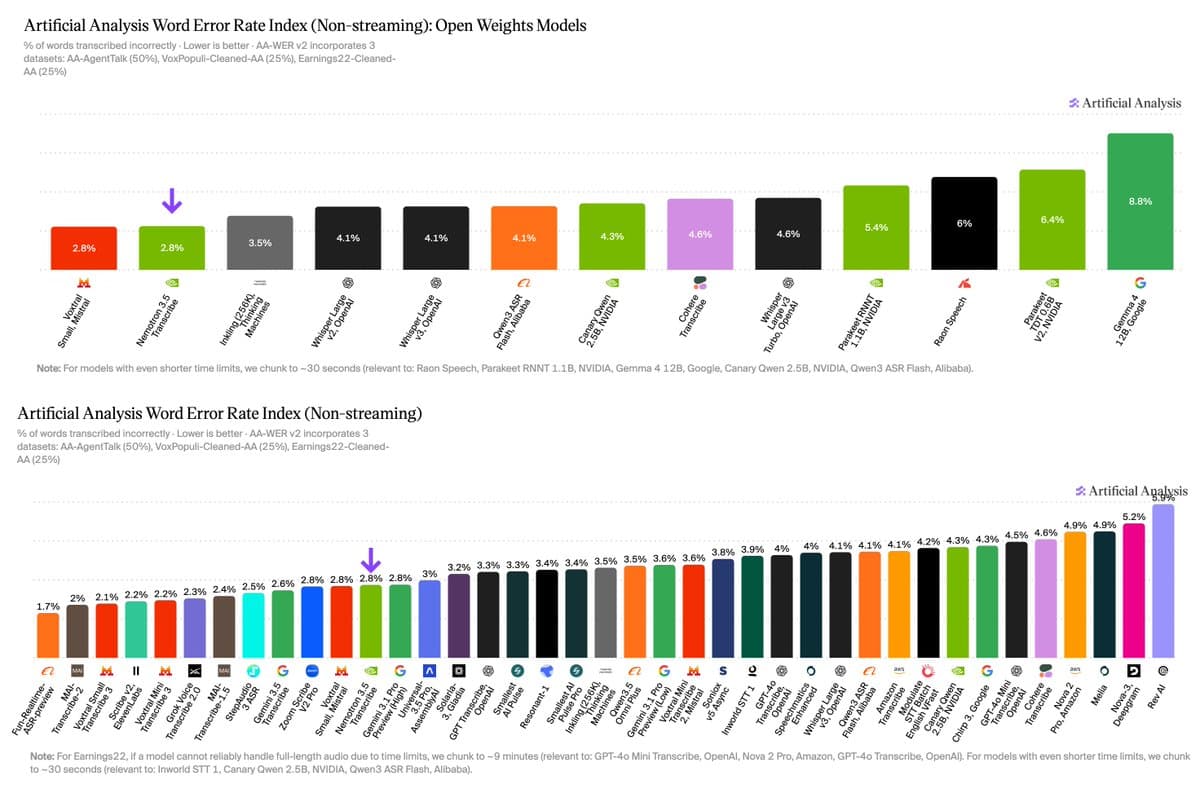
Nemotron 3.5 Transcribe ties the open-weight lead at 2.8% word error rate
NVIDIA's Nemotron 3.5 Transcribe ties the open-weight lead on Artificial Analysis's speech recognition index. Day-zero serving uses a NeMo Speech plugin for vLLM, while native integration remains under review.
TL;DR
- Nemotron 3.5 Transcribe ties Voxtral Small for the open-weight lead at 2.8% AA-WER in Artificial Analysis's evaluation.
- The model handles recordings up to an hour in 40 languages, with speaker labels and audio Q&A, according to the vLLM announcement.
- Day-zero serving uses a NeMo Speech plugin; native vLLM integration remains under review, per the integration update.
NVIDIA's model card lists 34B total parameters, including the audio encoder, under the 30B-A4B model name. Its fastest serving figures carry a hefty footnote: the optimized NIM serving path behind them has not shipped in open source.
AA-WER results
Artificial Analysis evaluated Nemotron as a non-streaming speech recognizer:
- Overall AA-WER: 2.8%, tied with Mistral's Voxtral Small among open-weight models.
- Previous NVIDIA leader: Canary Qwen 2.5B scored 4.3%, a 1.5-percentage-point gap, according to the evaluator's follow-up.
- AA-AgentTalk: 1.8% WER versus Voxtral Small's 2.3%, per the dataset comparison.
AA-WER weighting
The AA-WER v2 methodology combines three datasets:
- 50% AA-AgentTalk: held-out speech directed at voice agents.
- 25% VoxPopuli-Cleaned-AA: parliamentary proceedings.
- 25% Earnings22-Cleaned-AA: corporate earnings calls.
Within each dataset, WER is duration-weighted before those three weights are applied. AgentTalk comprises 469 recordings totaling about 250 minutes; participants read scripted prompts across 17 accent groups using their own devices.
Audio encoders and active parameters
Artificial Analysis compares Nemotron's rounded 4B active parameters with Voxtral Small's 24B, a sixfold difference, in its parameter comparison.
NVIDIA's architecture description identifies three main components:
- A Transformer ASR encoder.
- A Sortformer speaker encoder.
- A Nemotron 3.5 Lightning hybrid Mamba-2–Transformer mixture-of-experts language backbone.
The language backbone activates approximately 3.5B parameters; the joint audio encoder adds approximately 800M. That yields the 4.3B active count reported in vLLM's architecture note.
The model card's BF16 quick-start runs on one H100 80 GB GPU.
Promptable transcripts
The model card specifies a 65,536-token context and recordings up to one hour. Names and technical terms supplied in a prompt can guide recognition, as Baseten's launch post describes.
Task coverage varies, according to the feature walkthrough:
- Transcription: 40 languages.
- Translation: English to or from 31 languages.
- Speaker attribution: up to eight speakers, supported in 13 languages.
- Audio Q&A: trained in English.
Speaker attribution
VoiceArena's English full-session benchmark includes overlapping speech and two to eight speakers, according to NVIDIA's launch post. It uses cpWER, which counts word errors after matching speaker labels.
NeMo Speech and vLLM
Day-zero serving uses vLLM 0.32.0 with the NeMo Speech plugin. The BF16 quick-start uses the latest NeMo Speech main branch and sets VLLM_PLUGINS=nemo_speechlm.
Native vLLM integration was still under review at launch, according to the integration update. The proposed addition covers:
- Transcription and chat endpoints.
- FP8 and NVFP4 loading.
- MTP and DFlash2 speculative decoding support.
Hosted cost and NIM throughput
Hosted endpoints are available from Baseten and DeepInfra, according to NVIDIA's announcement. Artificial Analysis benchmarked DeepInfra's endpoint in its serving comparison:
- Speed Factor: 75x, processing one minute of audio in under one second.
- Price: $2 per 1,000 audio minutes, equivalent to $0.12 per audio hour.
Speed Factor measures batch processing speed relative to audio duration, as defined in AA's methodology.
NVIDIA separately reports up to 2,238 audio seconds processed per second on one RTX PRO 6000 Blackwell Server Edition GPU, using NVFP4 and DFlash2, in its NIM benchmark.
Those serving optimizations are not yet in the open-source release. NVIDIA describes the release-day NeMo Speech integration as intended for model development and expects it to be roughly twice as slow.