
QuixiAI releases MIT-licensed QuixiGate Rust gateway
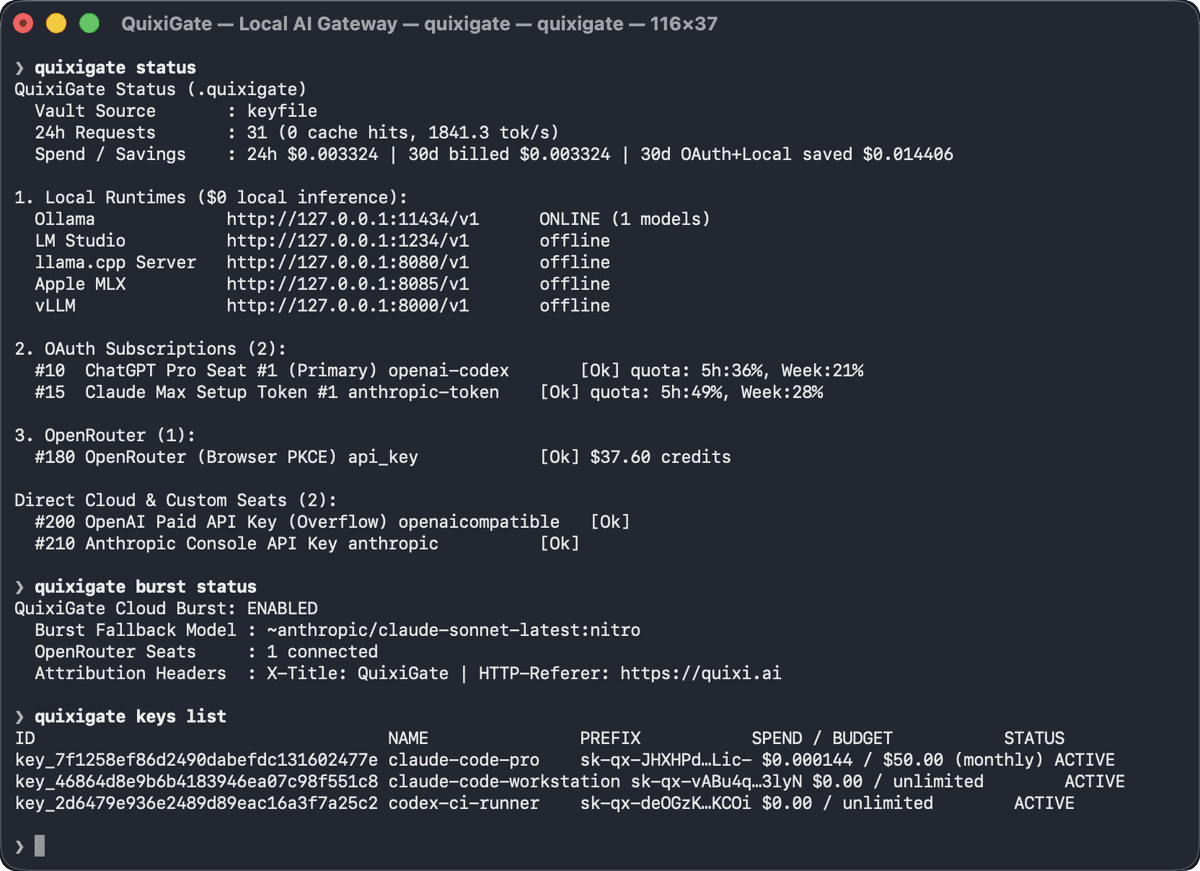
QuixiGate ships as a cross-platform Rust binary for routing requests to cloud and local models. It supports OAuth subscriptions, telemetry integrations and configurable fallback when usage limits are reached.
TL;DR
- QuixiGate ships as a single MIT-licensed Rust binary for macOS, Linux and Windows, according to QuixiAI's release thread.
- Subscription seats can fall back to cloud or local models after usage limits, as QuixiAI describes.
- The reported 29.3× stateless JSON throughput advantage over LiteLLM comes from a mock-upstream test in the launch benchmark.
The README budgets spend in billionths of a dollar and exposes model, spend and audit tools through a hosted /mcp endpoint. Its CLI launcher starts coding agents without editing their dotfiles.
Rust binary and SQLite
QuixiGate's implementation uses tokio, hyper and axum, with embedded SQLite in WAL mode and an AES-256-GCM credential vault. The refreshingly self-contained deployment requires neither PostgreSQL nor Redis.
The repository reports a 20.1 MB macOS arm64 binary. Both an embedded management UI and headless operation are available.
Built-in governance ships under MIT:
- Virtual keys and OIDC/JWKS authentication.
- User and team controls, model restrictions and budgets.
- Audit logs and key rotation.
QuixiAI compares roughly 50K lines with LiteLLM's 1.2 million. The README defines QuixiGate's figure as production Rust SLOC across nine crates, excluding the optional UI; its LiteLLM total includes Python, TypeScript and a broader integration surface.
OAuth seats and local fallback
Provider adapters come from the Rust lazy-hq/aisdk project. The routing configuration combines:
- Local discovery: Ollama, LM Studio and llama.cpp servers.
- Subscriptions: OAuth logins for OpenAI and Grok, according to the announcement.
- Seat pooling: sticky
fill_firstrouting for cache affinity. - Overflow: configurable cloud or local fallback after usage limits, with optional OpenRouter burst on HTTP 429 or saturation.
Model loading remains runtime-specific. QuixiAI said Ollama loads an unloaded model when requested, while leaving the equivalent behavior in LM Studio and llama.cpp unanswered.
Mock-upstream benchmarks
QuixiAI calls QuixiGate the fastest, lightest gateway it knows of. Its published comparison tests QuixiGate v0.2.1 against LiteLLM v1.109.1 on an Apple M5 Max with 18 CPU cores and 128 GB RAM.
The benchmark harness separates the load generator, gateway and mock OpenAI upstream into OS processes, communicating over loopback HTTP/1.1. Even the “live GPU streams” workload uses simulated prefill and decode timing, so its token rates measure transport of simulated model output.
The comparison also stops before a relevant version change. LiteLLM moved routing into Rust in v1.110.0 on November 11, including retries, fallbacks, name resolution and deployment selection.
LiteLLM said users would initially see little change from that refactor. QuixiGate's table contains no measurement of the newer version.
Traces and retention
QuixiGate emits OpenInference-format OpenTelemetry data over OTLP HTTP/protobuf or gRPC, with Arize Phoenix named in the launch announcement. Its observability design sends vendor-neutral telemetry to an external collector for distribution to other sinks.
QuixiAI pitches accumulated traces as a dataset that could eventually be used for training or sold.
Payload logging is configurable through a per-key log_payloads override or the request header x-quixigate-no-log: true, according to the retention controls.
Installers and migration gaps
Release archives are available for macOS, Linux and Windows. The supplied shell and PowerShell installers verify SHA-256 checksums and can fall back to cargo install.
Separately, QuixiAI reported an unrelated social-engineering attempt involving an AdventureVale compiled AppleScript installer.
QuixiGate's 997-route LiteLLM compatibility claim counts explicitly rejected endpoints as accounted for. Its excluded scope covers:
- Bundled RAG and vector stores.
- OCR and video pipelines.
- SCIM synchronization and fine-tuning orchestration.
Requests to excluded routes receive 400 Bad Request with type unsupported_litellm_endpoint, x-should-retry: false, and migration guidance.