
Meta launches Muse Image with reasoning, search, code, and self-refinement
Meta launched Muse Image in its apps and previewed Muse Video from the same media-generation family. Meta says Muse Image can reason, search, write code, self-refine, and use test-time compute before generating images.
TL;DR
- Meta shipped Muse Image as the first image model from Meta Superintelligence Labs, live in Meta AI and rolling into Instagram Stories and WhatsApp in limited countries, according to Meta's launch post.
- The technical hook is an agentic image loop: Tim Brooks said Muse Image plans, writes code, uses search tools, and refines outputs in chain-of-thought before generation.
- Self-refinement was not hand-coded, Meta's self-refinement note says it emerged during RL and can choose local edits, full regeneration, or tool use.
- Arena placed Muse Image at #2 across text-to-image, single-image editing, and multi-image editing, while Muse Video entered text-to-video at #3, per Arena's image leaderboard and Arena's video leaderboard.
- Access is still app-shaped: altryne said there does not seem to be a public API, while one availability reply noted that Meta had not named the limited launch countries.
The research blog has the spicy bits: code execution for QR codes and plots, search-grounded generation, and test-time compute curves. Alexandr Wang's under-the-hood note adds that self-refinement emerged during RL rather than being designed in, and Meta's Content Seal note says generated images carry a hidden watermark that survives cropping, compression, and resizing.
What shipped
Meta announced two media models from MSL:
- Muse Image: Meta's most advanced image generation model, available in the Meta AI app and web, Instagram Stories, and WhatsApp in limited countries, according to Meta's launch post.
- Muse Video: an early preview built on the same pretraining base as Muse Image, with native audio support and availability coming later to creators and Meta AI, according to Meta's launch post.
- Muse Spark integration: Muse Image pairs with Muse Spark to reason through prompts, search the web, and plan before generating, Alexandr Wang said.
- Social surfaces: users can upload photos, mention friends, pull from trends, share to story, feed, or group chat, and use 30-plus new AI effects in Instagram Stories, according to Wang's product note.
Agentic generation loop
The launch framing is unusually explicit for an image model: Meta says Muse Image uses tools before it renders.
The loop breaks into five mechanics:
- Planning: Wang's launch thread says Muse Image pairs with Muse Spark to reason through a prompt before generation.
- Search: Meta's search note says Muse learned to use the web for factual and real-time information plus visual references.
- Code execution: Meta's coding note says Muse writes and executes code for precise details such as plots and QR codes.
- Reference composition: Meta's multi-reference note says Muse can compose people, objects, clothing, styles, and environments from many input images.
- Self-refinement: Meta's self-refinement note says the model can choose local edits, full regeneration, or tool use while optimizing image quality.
Christmas come early for people who wanted image generation to look more like an agent harness than a prompt box.
Test-time compute
Meta says reinforcement learning produced predictable log-linear Elo scaling as total text and visual test-time tokens increase. In Rohan Paul's graph read, tool-aided reasoning reached roughly 1020 Elo around 2x compute, while Best-of-N approached roughly 1015 around 8x.
The claim is a clean one: spending inference budget on deliberation and tool execution scales better than spending it on more samples and selection.
Self-refinement
Wang said self-refinement lets Muse improve its own output inside chain-of-thought, and that the behavior emerged during RL rather than by design in his under-the-hood note. Meta described the actions in its self-refinement note: local edits, full regeneration, or tool use.
The ablation shown above reported:
- Text-to-image: 57.1% with self-refinement vs. 42.9% without.
- Single-image edit: 56.3% with self-refinement vs. 43.7% without.
- Multi-image edit: 56.6% with self-refinement vs. 43.4% without.
Multi-reference prompts
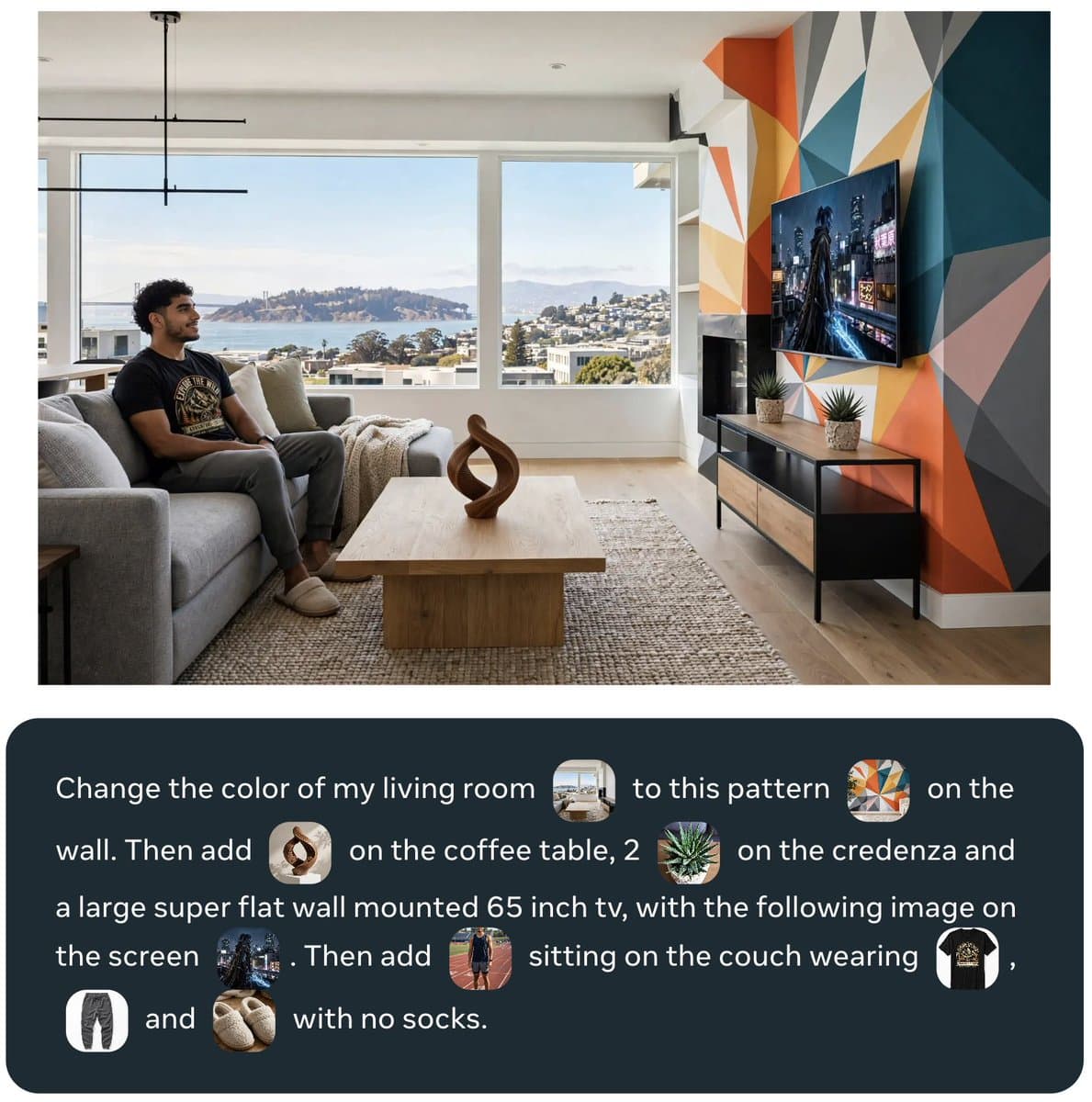
Muse's prompt format is the interface detail worth stealing: users can interleave text and many reference images inline, then refer to them as parts of one composition.
Nick Dobos's face-in-photo example showed the obvious consumer version: putting a user's face into a generated scene. Rohan Paul's prompt screenshot showed the more compositional version: a person, a bike, a tuxedo, three friends, and a style reference combined into one watercolor scene.
Arena rankings
Arena's July 5 leaderboard put Muse Image second across all three image tracks:
- Text-to-image: GPT Image 2 at 1385, Muse Image at 1280, Reve 2.0 at 1271, Nano Banana 2 at 1270, from Arena's image leaderboard.
- Single-image edit: GPT Image 2 at 1466, Muse Image at 1405, MAI Image 2.5 at 1399, from Arena's image leaderboard.
- Multi-image edit: GPT Image 2 at 1454, Muse Image at 1399, Nano Banana 2 at 1376, with Arena's follow-up calling out a 23-point gap over the next model.
- Text-to-video: Muse Video scored 1459 at #3, behind Gemini Omni Flash and Seedance 2.0, and ahead of HappyHorse 1.0 by 30 points, according to Arena's video leaderboard.
Muse Video
Muse Video shares Muse Image's pretraining base and adds native audio support, according to Meta's launch post. Meta said it is investing in gaps around audio-video synchronization and physically accurate fast motion in its video preview.
That caveat is useful because the demo reel is all polish. The model is competitive on prompt adherence, visual fidelity, and temporal consistency, but Meta named the remaining weak spots itself.
Product surfaces and access gaps
Distribution is inside Meta's own apps first. Meta's launch post names the Meta AI app and web, Instagram Stories, and WhatsApp; Wes Roth's summary adds that Facebook, Messenger, and Advantage+ creative are next surfaces.
The launch left two holes visible to developers:
- Countries: one reply to Wang noted that the blog said limited countries without naming the first launch markets.
- API: altryne said there does not seem to be a public API, although Arena appears to have had private eval access.
First tests
Early hands-on posts were stronger than the first launch images. teortaxesTex said one demo's scene logic was odd but that QR replication indicated a powerful underlying model.
A factuality probe in giffmana's post asked Muse Image to research Mark Chen and make a highlights card; the first shot was described as more factual, though the style was not the author's favorite. In koltregaskes's test, Muse handled a long photorealistic portrait prompt well, while the GPT comparison missed the hand on a book and the Gemini comparison also largely nailed the prompt.
Content Seal
Meta says every generated image in the Meta AI app and meta.ai carries a hidden Content Seal provenance signal that survives cropping, compression, and resizing. Meta's Content Seal note also previews a public identification tool for checking whether an image was created by Meta AI or meta.ai.
One caveat came from altryne's launch reaction: Meta did not use Google's SynthID standard, and the identification tool did not work for them in a first test.