
ClaudeDevs reports Sonnet 5 + Fable 5 advisor hits ~92% SWE-bench Pro score at ~63% price
ClaudeDevs reports Sonnet 5 with a Fable 5 advisor reached ~92% of Fable 5's SWE-bench Pro score at ~63% of the price. Other builders route implementation to Sonnet, Codex, GPT-5.5, or GLM workers.
TL;DR
- The useful pattern is expensive-planner, cheap-worker routing, with ClaudeDevs' advisor post saying Sonnet 5 plus a rare Fable 5 advisor call gets ~92% of Fable 5's SWE-bench Pro score at ~63% of the price.
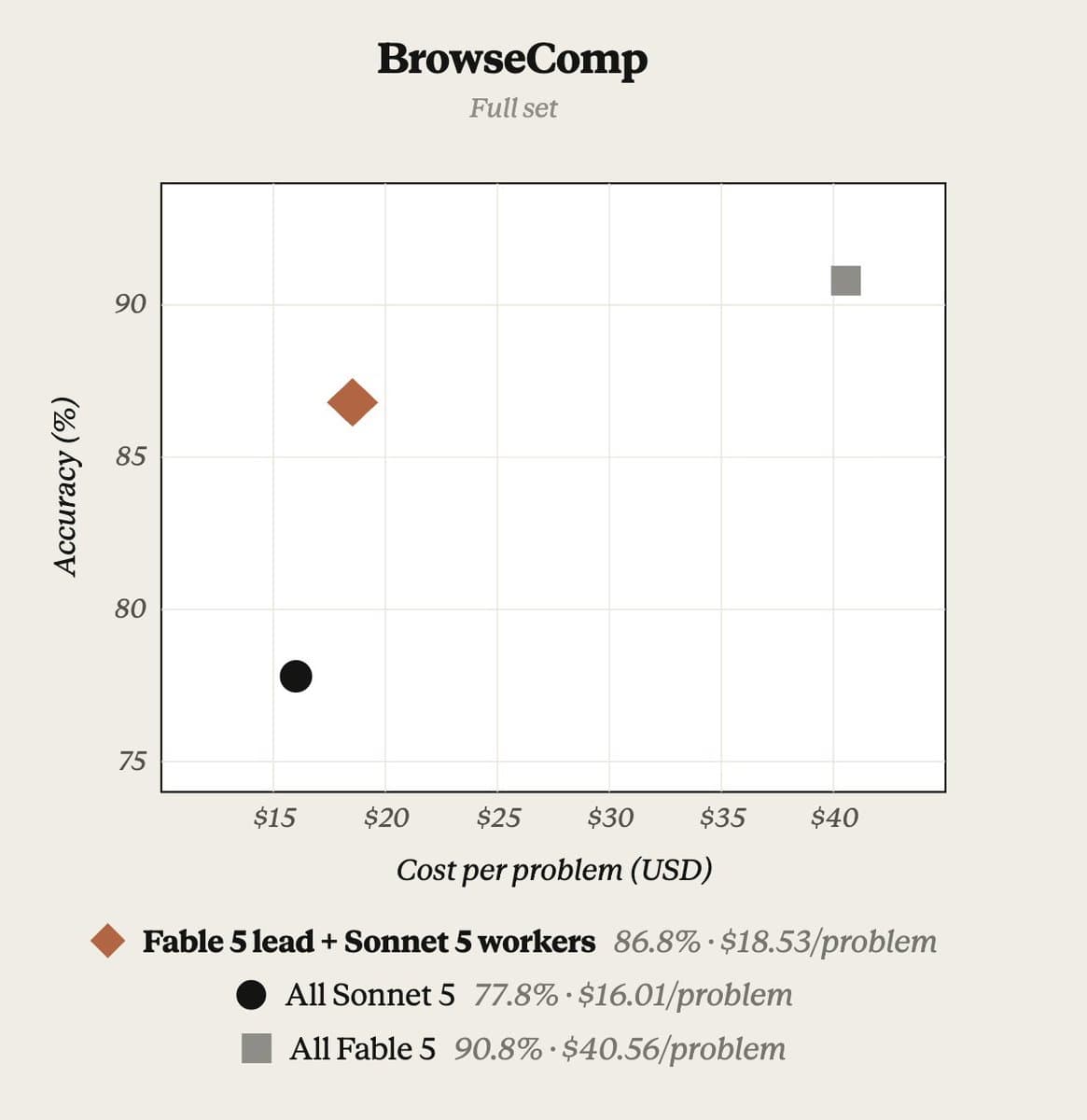
- The companion research setup pushed the cost curve harder, where ClaudeDevs' BrowseComp post reports a Fable 5 orchestrator with Sonnet 5 worker sub-agents at 96% of Fable 5 performance for 46% of the price.
- Sub-agents are now the product surface, with ClaudeDevs' Managed Agents post saying agents can escalate to a Fable advisor, delegate to Sonnet workers, and keep separate caches.
- Builders immediately turned the pattern into plugins and harnesses, from daniel_mac8's Claude Code plugin to PerceptualPeak's three-agent loop with Fable directing, Opus implementing, and GPT-5.5 reviewing.
- The constraint is still spend and quota, with bridgemindai's usage-limit complaint describing four $200 Claude Max subscriptions and zeeg's cost critique calling out hundred-dollar coordinator sessions.
Christmas came early for coding-agent nerds because ClaudeDevs gave numbers for a routing pattern people had already been hand-building. ClaudeDevs' Managed Agents post says each sub-agent keeps its own cache, daniel_mac8's plugin post turns the idea into Routine/Subtle/Cross-vendor/Judgment lanes, and simonw's release review used Fable as a final reviewer that found four sqlite-utils 4.0 release blockers.
Advisor pattern
ClaudeDevs framed the first pattern as an advisor loop: Sonnet 5 executes the task, calls Fable 5 for guidance, and keeps most billed tokens at the executor rate.
The reported mechanics are compact:
- Executor: Sonnet 5.
- Advisor: Fable 5.
- Call frequency: roughly once per task.
- Benchmark: SWE-bench Pro.
- Reported result: ~92% of Fable 5's score at ~63% of the price.
The notable move is that ClaudeDevs published the cost-quality trade, not just the architecture sketch.
Orchestrator pattern
The second pattern flips control: Fable plans and delegates, while Sonnet 5 workers do the token-heavy execution.
On BrowseComp, ClaudeDevs' reported result says the Fable 5 orchestrator plus Sonnet 5 worker sub-agents reached 96% of Fable 5 performance at 46% of the price. The workload split was explicit: token-heavy research went to Sonnet 5.
Warp's summary of the same idea was blunter: use SOTA models to break down workflows and smaller models for execution in Warp's orchestration post.
Managed Agents caches
Claude Managed Agents is the product surface ClaudeDevs pointed to for both advisor and orchestrator setups.
The key implementation detail is cache isolation. ClaudeDevs' Managed Agents post says each sub-agent keeps its own cache, so repeated calls do not pay in full for the same context twice.
That makes the pattern less like a prompt trick and more like a billing-aware agent topology: escalate up for judgment, delegate down for volume.
Plugin lanes
A free Claude Code plugin, linked by daniel_mac8, packages the same idea as fable-advisor: Fable owns requirements, decomposition, specs, and verification, while other models type the code.
The plugin's lane table is the cleanest artifact in the evidence pool:
- Routine: Sonnet implementer, when the spec fully determines the outcome.
- Subtle: Opus implementer, when a Sonnet miss would be expensive, such as concurrency, security, or hard debugging.
- Cross-vendor: GPT-5.5 implementer, for correctness-critical work or a non-Anthropic second implementation.
- Judgment: Fable advisor, at commitment boundaries.
At the end, daniel_mac8's post says Fable performs a read-only pass over the generated output.
Worker model menu
The community version is already cross-vendor. steipete's note said to ask Fable to make Codex the workhorse, while dzhng's implement-with-Codex skill turned that repeated prompt into a reusable skill.
Other builders mixed the worker pool by task:
- GPT-5.5: MatthewBerman's workflow note called Fable plus GPT-5.5 a peak-performance, low-quota setup.
- Kimi, GLM, and cloud agents: dabit3's setup described Fable or another frontier model planning while different workers run on one board.
- GLM-5.2: Ollama's GLM-5.2 post said its cloud serves 80 to 120 output tokens per second and can launch with Claude Code, VS Code, Codex, and Hermes.
The worker menu is becoming a routing problem, not a loyalty test.
Reviewer slots
Fable's most concrete near-term slot may be final review. simonw's sqlite-utils prompt asked Fable to review changes since the last 3.x tag, read the changelog and upgrade guide, and write scratch scripts for new v4 features; the same post says it found another four release blockers.
DoorDash's code-review benchmark points in the same direction. TheRundownAI's DashBench summary says Kimi K2.6 as scout plus Fable 5 as reviewer hit 65.2% weighted recall and 75.3% weighted F1 on 105 past code changes, versus 53.6% weighted recall for an all-Anthropic pair, at $3.81 per PR versus $3.91.
The review slot also catches Fable's own messes. yacineMTB's bug report said GPT-5.5 was finding and fixing bugs Fable left behind, and his follow-up named Morton z-order space-filling curve bugs as one class.
Cost ceiling
The pattern exists because Fable-class tokens are scarce and expensive. bridgemindai's post said four $200 Claude Max subscriptions were needed to get one full week of Fable 5 because weekly limits died in a day.
Cost objections were not just consumer complaints. zeeg's headcount math put $1,000 per week per person at roughly $50,000 per person per year, while zeeg's longer critique said a simple Fable coordinator session could run hundreds of dollars.
Routers are the commercial response. FactoryAI's router numbers reported 43% aggregate cost savings versus the same workload priced at Opus rates, and FactoryAI's use-case breakdown put savings at 67% for codebase Q&A, 59% for data work, and 52% for DevOps.
Claude Code 2.1.202 workflow controls
Claude Code's latest changelog moved in the same direction as the orchestration chatter. ClaudeCodeLog's summary says version 2.1.202 added a /config setting for Dynamic workflow size, with small, medium, and large agent counts for predictable workflow scale.
The detailed changelog adds two pieces for operators:
- Dynamic workflow size is advisory, not an enforced cap in ClaudeCodeLog's full changelog.
- Workflow-spawned agents now emit OpenTelemetry attributes that let a workflow run's activity be reconstructed from telemetry in the same changelog.
The same release changed /review <pr> back to a fast single-pass review, while multi-agent review moved to /code-review <level> <pr#> according to ClaudeCodeLog.